Showing posts with label comfort. Show all posts

Thursday, July 7, 2011

Chrome Pasha Hoodie: Wool That Feels Like a Real Sweatshirt?

Hooded sweatshirts are the comfort food of clothing: There is something so snuggly and relaxing about them, that just putting one on at the end of a long day can improve my mood. Before I started cycling I was a fan of this garment and wore it frequently when not in my dressy attire. But I soon discovered that I can't really wear hoodies on a bicycle: I sweat too much and the thick cotton eventually turns into a heavy wet rag. Comfort food no more. Wool manufacturers have attempted to address this issue by making their own versions of the hoodie. I've tried these from Ibex, Icebreaker and one other company I can't recall, hoping to find a replacement for my beloved cotton sweatshirts.  But the wool versions only vaguely resemble the real thing; something is off about the texture and feel. Thus jaded, when Chrome offered me to review their "Pasha" hoodie I expected more of the same. But I am glad to report that I was wrong.

Chrome Pasha Hoodie
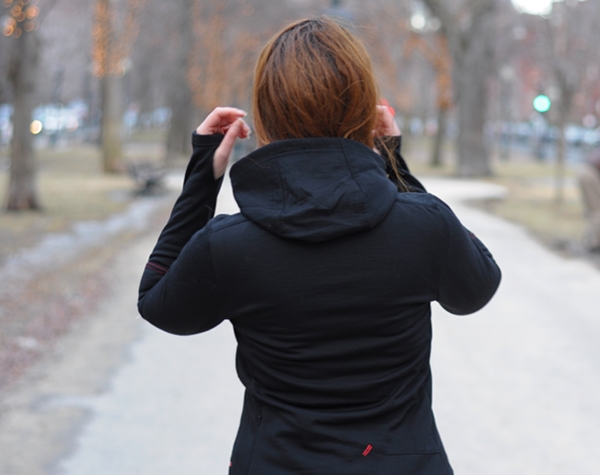
Whatever else might be said about the Pasha, I think it is crucial to recognise that Chrome did it: They made a wool sweatshirt that feels like a "real" sweatshirt and not like a wool sweater pretending to be a sweatshirt. The inside is fluffy and impeccably soft, the outside feels convincingly sweatshirt-like to the touch. The weight, the texture - everything is just like the hoodies I am used to. The asymmetrically placed zipper and structured tailoring add a contemporary touch.

The design of the Pasha is cycling-specific, in that it is semi-form fitting and is cut longer in the back than in the front. I have read some reviews complaining that the cut is too narrow around the chest and too generous around the middle, and I somewhat agree. But I have a modestly sized chest, so the narrowness in that region works well for me. The middle is indeed roomy, but I do not find the cut unflattering. I am a US women's size 4, and the "Small" hoodie is just about spot on.

The hood is tight around the head and neck without requiring pull-strings. I've worn it on a roadbike in windy thunderstorms, and it did not get blown off over the course of the ride as other hoods tend to.

54cm Frame Toptube Clearance
I admit that once I took these photos I blacked out the Chrome logo, which is just too prominent for my taste. I suggest they consider making a subdued version of it, as many don't like displaying branding on their clothing. (And yes, I realise the irony of this photo as I write this - but bicycle logos are different!)

Chrome Pasha Hoodie
My one major real complaint about the design of the Pasha is that the thumb loops are not practical when riding a roadbike; they dig into the space between my thumb and forefinger when I stretch my arms to reach the drop bars. So unless I am riding an upright bike with a short reach, I end up not using them. I will probably sew up the holes in the sides of the sleeves.

Chrome Pasha Hoodie
A lesser complaint is that I do not like the exposed metal zipper. It's cold and "unfriendly," in contrast to the overall feel of the hoodie. The zippers they use on the pockets feel much better, so I would love the central one to be replaced with something in that vein.

Yet another minor complaint is an aesthetic one. There is maroon stitching in some parts of the hoodie, apparently for decorative reasons. This is nice in itself, but it clashes with the primary-red stitching next to the pockets, as well as with the Chrome logo and with the fabric of the same colour inside the pockets. Maybe this is a personal thing, but the combination of the maroon and the primary red looks off to me.

Finally, I should note that the Pasha is made in China, unlike some of Chrome's other items.

Chrome Pasha Hoodie, Pocket
The Pasha has two zippered side pockets - one much larger than the other, due to the asymmetrical placement of the central zipper. The larger pocket easily fits a wallet, point and shoot camera, or sandwich. The smaller pocket will fit a mobile phone or keys. There is also a large zippered rear pocket that will fit the contents of both side pockets together. The pockets have meshy interiors and can also be used for added breathability.

First Spring Ride, Bianchi
As far as weather conditions, I find the Pasha best for cold weather and mild rain - which we've been having a lot of here, even in the summer. In May and June we had stretches of days with temperatures in the 40s-50s, continuous rain, and this horrible bone-piercing dampness. The Pasha kept me warm, not sweaty, and mostly dry from the rain. Being wool, it is wearable in warmer temperatures as well, certainly into the lower 70s.

I've had this hoodie since March and have washed it three times on account of getting it covered in mud while riding a fenderless bike. It is durable and takes well to being washed and dried.

The most enjoyable thing for me about the Chrome Pasha, is that it has all the properties of 100% wool while feeling like a real sweatshirt. The design could be tweaked, but I'll take it even as is. It's great to be able to wear a hoodie on a bike without the "wet rag" effect.
Tuesday, July 5, 2011

Sagging Saddles?

It seems that I complain a lot about saddles, finding fault with most of the ones I try if not immediately then certainly within a year's time. This one won't break in, that one hurts my crotch. This one is too narrow, that one is too wide. This one is too soft, that one is too hard... So what now?

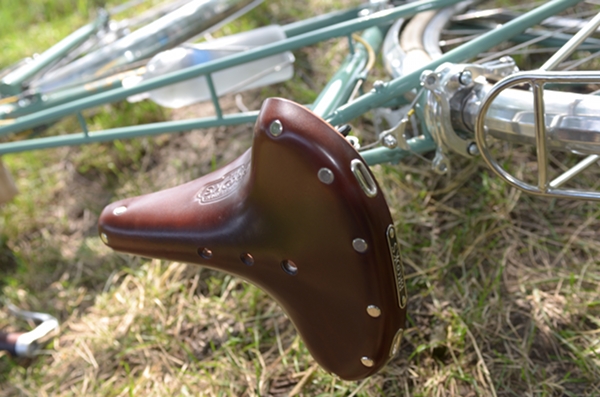
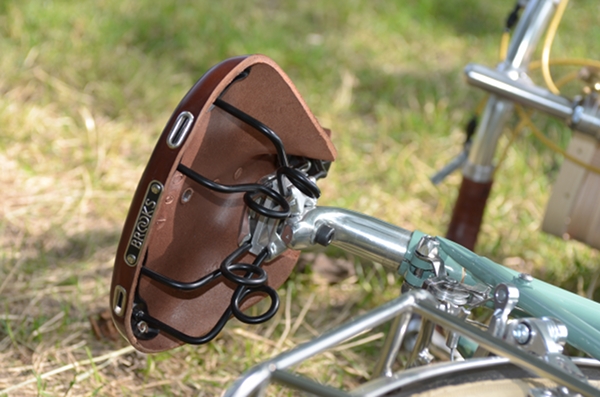
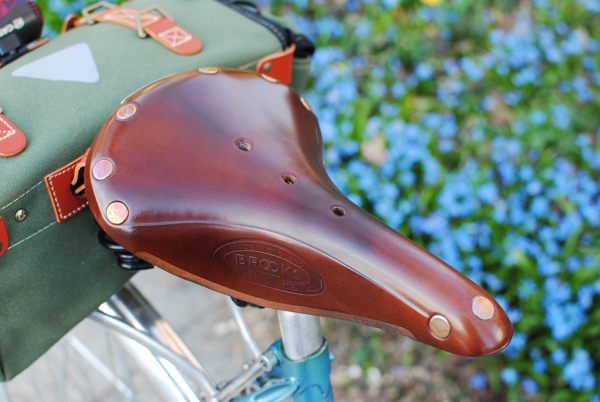
Okay, I've had this Brooks B72 for about a year. No complaints about the shape, size or breaking in period - it felt wonderful from the start on a semi-upright bike. I have owned several other B72 models as well - both modern and vintage - and they've all been good. This was the one saddle of all my saddles I thought was pretty darn perfect. Then a couple of months ago I started to notice that the outer edge was pressing into my derriere. At first it was subtle, but the feeling kept getting worse - until one day I looked at the saddle, and the leather was visibly sagging in the center, with the outer edge (where the rivets are) forming a sharp ridge. Regrettably I neglected to take a picture of this before we messed with the tension, but I really ought to have emailed it to Brooks. It is unexpected that a saddle should sag that much under a 125lb rider in less than a year's time. It had never gotten caught in the rain, I am not a proofide zealot, and I had ridden maybe 600 miles on it in the course of 8 months (it is installed on a city bike) when the problem began to present itself.

Though some recommend not to mess with the tension on a Brooks we went ahead and did, and the saddle felt great again... for a couple of weeks. But now, slowly but surely, I am starting to feel the rivets pressing into my behind once more as the leather continues to sag ever so gradually. Darn.

Having spoken to a few long-time Brooks owners and retailers, I do not think that this is an issue with the B72 model specifically, but rather a general issue with quality control and the natural variation in leather thickness. A couple of retailers have told me that some Brooks saddles will sag in this manner and there does not appear to be a pattern to which models are susceptible to it. Well, that's not very reassuring. I am especially disappointed since this particular saddle was my overall favourite before the sagging problem started. I guess perfection is a myth and it is best to keep that in mind to avoid disappointment. I am curious whether others have experienced the "sudden sag" syndrome on any of their leather saddles, and if so which makes and models. Is there a cure?

Tuesday, June 28, 2011

Shorter Cranks, Dainty Pedals, and the Ambiguity of Toe Overlap

Last week I was offered the opportunity to trade the Sugino Alpina crankset on my mixte for the exact same model with shorter cranks, and I went for it. The original cranks were 170mm. The ones on it now are 165mm. A 5mm difference is very small, but can be significant. For instance, some say that shorter cranks make for a smoother pedal stroke. But my reason for the change was to reduce toe overlap. I mentioned previously that my mixte has it to a small degree, and that I'd like to get rid of it since I now use this bike mainly for transportation. In theory, that could be done either by converting to 650B or re-raking the fork. But before resorting to such drastic measures, I wanted to try something easier.

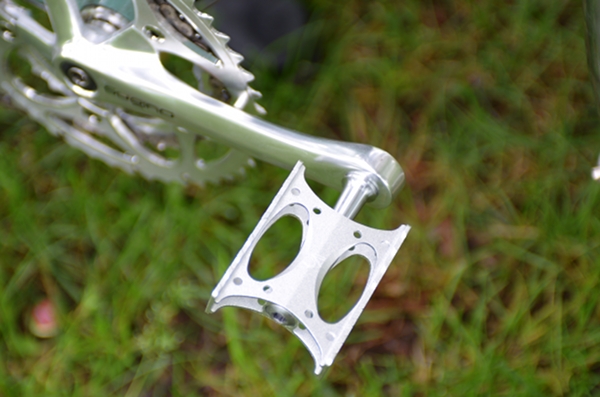
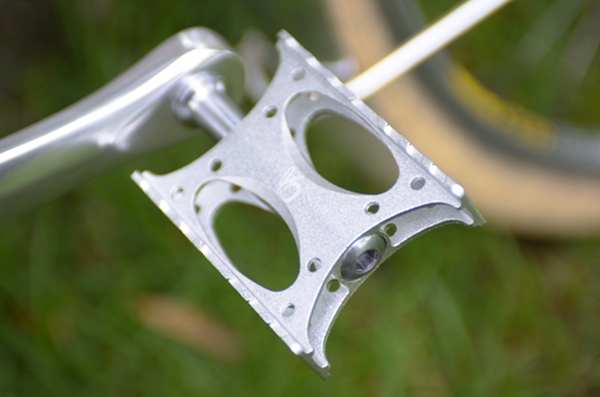
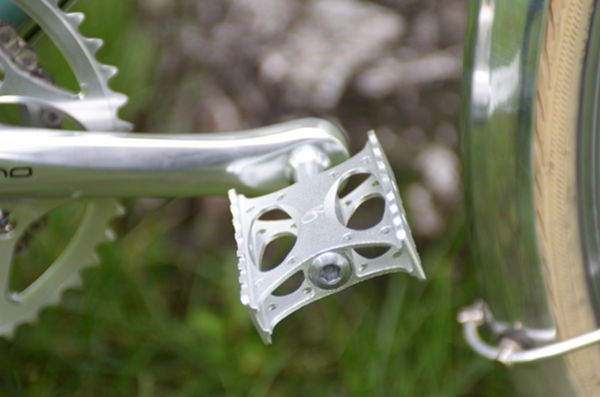
In addition to the shorter cranks, I also replaced the MKS Touring pedals with Velo Orange City Pedals. Being smaller, my assumption was that the new pedals would reduce overlap further still - though I am now told this isn't so.

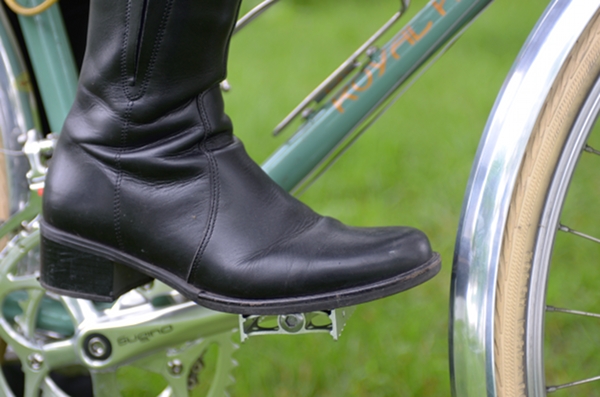
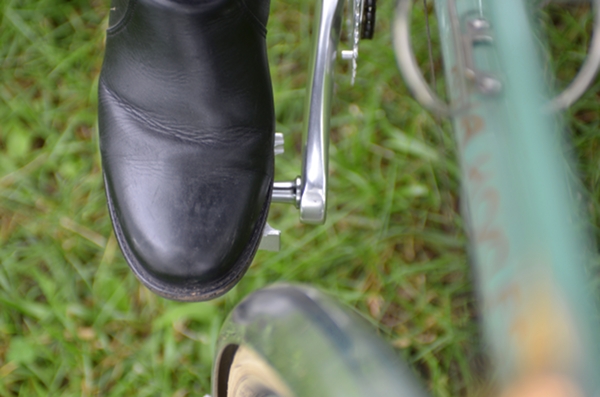
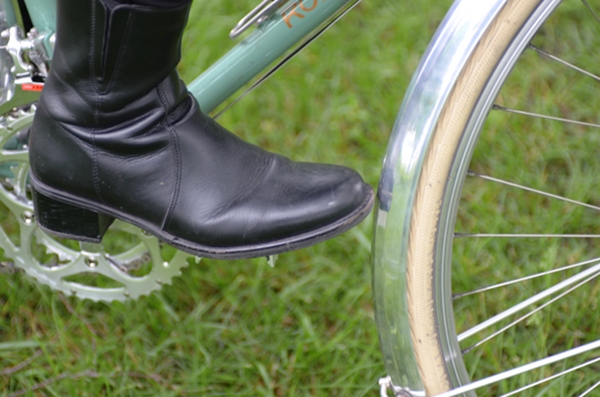
Either way, with the new set-up my toes are about 1/4" further back from the front fender than where they were previously. These are the longest-toed boots I own, and with my foot in its most typical position on the pedal there is no overlap even on the widest turn.

Aerial view.

But the thing about an upright bike that is ridden casually and with no foot retention, is that you can plant your foot on the pedal any which way. Sometimes I am sloppy, and plop it down further forward than typical when starting. In that sense, the toe overlap issue remains ambiguous. I need to ride around with this setup for a few weeks to see whether it still happens on occasion. I am not sure whether I notice any difference between the old cranks and the new ones, but it's possible that my pedaling feels a little "rounder." Or I could be imagining it, because that's what I've been told is supposed to happen. (Crank length placebo effect?)

As for the VO City Pedals, I absolutely love them so far. Ever since having tried them on the Rainbow Bike, I wanted them for myself. They don't stab my bare legs and toes the way MKS Touring pedals do, they are grippy, and they are extremely light (228gr per pair). It also does not hurt that they are pretty - though this, of course, is in the eyes of the beholder.

One caveat though, is that these pedals are very narrow (82mm across) and I have heard from a couple of people who find them uncomfortable for that reason. If you have large feet or tend to wear bulky workboots on your city bike, these are probably not the best choice.

So far I am happy with the changes I've made here, and together with the new basket the mixte has definitely turned into a transportation bike. The toe overlap was minor to begin with, so hopefully this will render it insignificant - but we'll see.

If you've ever played around with crank length on your bikes, did you notice a tangible difference? I have bicycles with cranks ranging from 165mm to 175mm, and they all feel fine, so I tend to use things like bottom bracket height and wheel size to determine what cranks a bike should have. But what do I know! Maybe with time I'll be able to tell the crank length of the bike I am riding just by the way it feels to pedal... though I remain skeptical.

Tuesday, June 21, 2011

Back and Forth: Lessons in Positioning

Last week I rode my Rivendell Sam Hillborne for the first time in three weeks after riding exclusively the loaner Seven on a close to daily basis. It's hard to believe that the body can adapt to one position so quickly as to find other positions unnatural. I confidently got on my bike, expecting that old familiar feeling of riding it to welcome me back. But I was in for a surprise. The ride was as comfortable as I remembered, but everything felt off. It took me a while to understand what was wrong. Initially it was just a vague sense of not feeling as connected to the road and as much in control of the bike, which was disconcerting. As I kept cycling, I became aware that it was really two specific things: I felt that I was seated too far back, and that I wasn't out far enough over the front wheel. I kept wanting to shove my weight forward, and it was frustrating to feel almost as if I were sitting "behind" the bike. 

Looking at the way the two bicycles are set up, the difference makes sense. On the Seven, the saddle sits further forward and the handlebars are further out. I was aware of this difference before, but assumed that I would find the Seven's set-up aggressive and uncomfortable, while the Rivendell's set-up a welcome relief. Instead the Seven's set-up now feels "right" and anything deviating from it feels "wrong" - as if I don't have sufficient control of the bike. That feeling is hard to shake. I think my Rivendell needs a little make-over. 

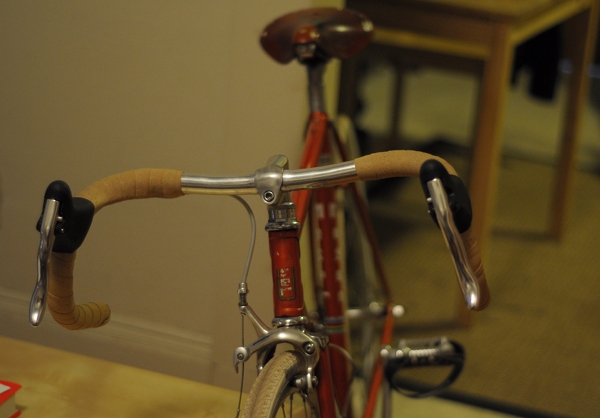
While moving the saddle forward is easy enough, changing the handlebar set-up will be messy, because I will have to replace the fairly short (6cm) stem with a longer one. When I fist began trying to ride with drop bars, I found it extremely difficult and a short stem was recommended to make the transition easier. I cannot say that it was a poor recommendation, because it worked. I rode with this set-up for a year, gradually becoming more comfortable with the whole idea of a roadbike, and feeling increasingly natural in a forward-leaning position. Some would look at my bikes and point out that my stems are too short, and I was perfectly aware that by most standards they are. But these things are highly personal, and last year I was concerned not so much with speed and agility, as with just being able to ride the bike. The way a bike balanced with a shorter stem felt better to me at the time. For what it's worth, I see many roadbikes from the 1970s-80s that were ridden by women set up with short stems. My previously owned vintage Trek had an even shorter stem than this bike, and that was the original owner's doing.

Going back and forth between the Seven and the Rivendell has been educational; each has what the other lacks. It is fairly clear to me that I "need" a lightweight, purely-roadish roadbike like the Seven and that I also "need" a wide-tired, befendered, dynamo-hub, luggage-bearing long distance bike like the Rivendell. I would not want to turn one into the other, or to combine them into something in-between. If I could make changes to the Seven, it would be to magically decrease its size. If I could make changes to the Rivendell, it would be to alter its positioning and to make it lighter. The former we will be doing shortly. The latter is not really possible without getting rid of the very things that make this bike practical. But I am very curious now whether it is the positioning, more than anything else that accounts for the difference in speed between the two bicycles. I am also wondering what the "ideal" stem length for this bike would be. The top tube is unusually long, so it would have to be 8-9cm tops. It's frustrating that experimenting with stems is not easy, but I will report the results of my trial-and-error fumblings. 

Monday, April 25, 2011

Roadie Lads and Lasses: Suggestions for Sunglasses?

Almost as soon as I began cycling long distance, I realised that sunglasses were a must for me - not only to protect against the sun, but also to shield against insects that seemed to be irresistibly drawn to my lashes. When I rode exclusively upright bicycles, I simply wore my regular shades - preferably large ones that covered half of my face. But as I began cycling faster and on roadbikes, those no longer worked so well. Don't know about you, but I find regular sunglasses to be too heavy and also not sufficiently stable when I attempt to wear them on a roadbike. They bounce, slip, and generally feel uncomfortable - even starting to hurt the bridge of my nose and my temples over time.

As someone who is talented at losing sunglasses, I could not imagine buying those expensive ones that bicycle stores sell in glass displays. Instead, I got the cheap ones from the bin at the register (you know the ones, every bike shop has them). These worked somewhat better than regular sunglasses, but they still slipped and felt painful over time. So this summer I think I am ready for the real deal and would appreciate your advice - as I am sure would others seeking this information. I mainly want them to be as lightweight as possible, so that I don't feel them pressing the bridge of my nose and digging into my temples. And, of course, I also want them to be stable while I am cycling fast on a roadbike. There are so many makes and models to choose from - what do the roadcyclists among you wear?

Wednesday, April 20, 2011

Threadless Stems: the Good, the Bad and the Ugly

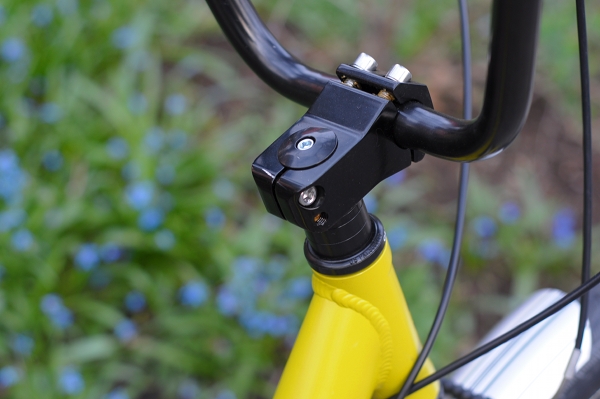
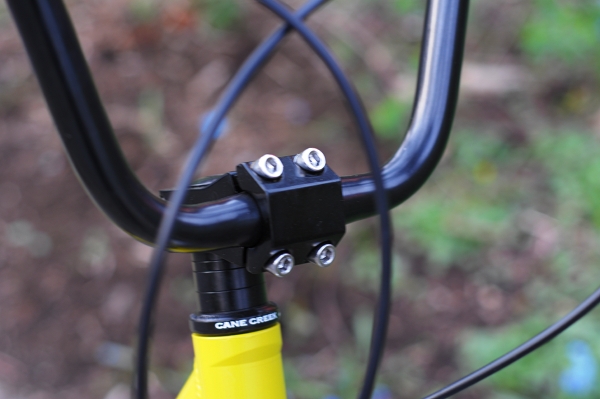
With the Urbana bike temporarily in my possession and the Surly bikes we rode last week-end, I have suddenly undergone a crash course in threadless stems. Though of course I have seen them on bikes before, now I got to actually play around with one and understand it firsthand.

In the world of classic and vintage bicycles, you will find a strong preference for threaded (quill) stems, and for good reason: Threadless stems are a fairly recent invention and their thick, boxy shape tends to clash with the more elegant lines of a lugged steel frame. In other words, they are considered "ugly." But I do not necessarily share this sentiment. While it is true that many - probably most - of the threadless stems we see on production bikes are clunky and offensive-looking, it does not have to be that way: Ugliness is not an inherent property of a threadless stem, but a byproduct of modern manufacturers generally catering to an "athletic gear" aesthetic. Elegant, polished alloy threadless stems do exist - made by the likes of Nitto and Velo Orange. Here is a nice fillet-brazed threadless stem and even a lugged one. Threadless stems can also be painted to match the frame of the bicycle, which to my eye actually works better than when the same is attempted with a quill stem. Even the simple, utilitarian stem on the Urbana bike doesn't look at all bad: I think it suits this bicycle's chunky tubing and contemporary style.

Of course the other major criticism of threadless stems is a practical one, and it is one with which I do agree: While quill stems can easily be raised and lowered to adjust handlebar height, threadless stems cannot. When buying a new frame meant for a threadless stem, there is a process (which I only half-understand), whereby you decide on the handlebar height you want, and they cut the steerer tube accordingly, then attach the threadless headset, spacers, and stem. After that, the handlebar height you chose is fixed, and it is not entirely clear to me what the options are, should you change your mind down the road and want the handlebars raised or lowered.

With a pre-assembled bike there is even less choice, because the threadless stem is already installed and the handlebar height is predetermined without your involvement. For me, this system would pose a major problem - especially on a roadbike - as it usually takes me a while to fine tune my preferred handlebar height on any given bike, and even after that I just occasionally feel like a change. With a threadless stem, I would be out of luck. If you are a novice road cyclist, this also makes it impossible to get yourself gradually accustomed to drop bars via the "lowering the stem" method I described earlier.

But while the lack of height adjustability is a drawback, I also discovered an unexpected benefit to the threadless stem: It is easier for me to work on. As mentioned before, I have problems with my hands that, frustratingly, make it mostly impossible for me to work on bikes. I know how to do most of the stuff and can give clear instructions to someone else, but typically lack the hand strength necessary to perform the operations myself. Not so with the Urbana bike. I first noticed that I was able to work on this bicycle, when we were putting it together and I tightened a bolt that I normally wouldn't have been able to. Later, I wanted to change the angle of the handlebars, so I watched this instructional video and did it - loosening and retightening the bolts with no problems. By contrast, I cannot even budge the bolt on a quill stem on my own. If threadless stems are generally easier to work on, then it's nice to have this bit of independence.

What's your view on the benefits or drawbacks of threadless stems? Do you see them as out of the question on classic bicycles?

Tuesday, April 12, 2011

Bike Fit: A Case of Evolving Preferences?

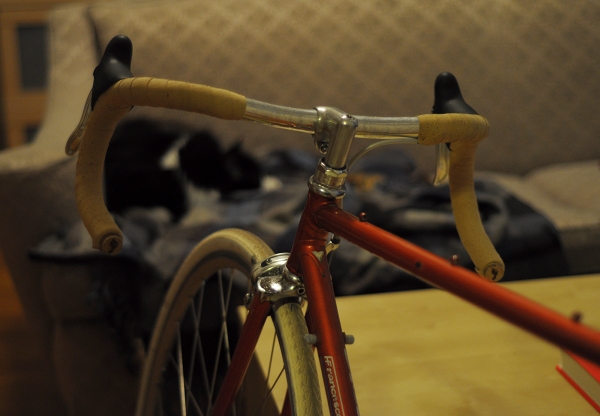
Last weekend we finally picked up my Francesco Moser fixed gear roadbike from Harris Cyclery, where it sat most of the winter after getting its bottom bracket replaced. I haven't been on this bicycle since December, riding the slightly-too-big-for-me Bianchi instead. And now that the Moser is back, guess what? It feels small! I was warned that this would happen once I got used to a larger frame, but it's still hard to believe. How can I feel cramped on a bike that felt "perfect" last year?

In addition to having a shorter top tube than the Bianchi, the Moser is also set up with a shorter stem. The difference between the total distance from the seat post to the handlebars on the two bikes is 3cm - which seems like a small number, but feels quite otherwise, at least to me. The handlebars on the Moser are also set quite a bit lower, which I think contributes to the cramped sensation. Combined with the lower bottom bracket, I almost feel like an adult on a miniature pony when I mount the smaller bike after the larger one. Would a longer stem alone solve this, or have I "outgrown" the frame itself? At the moment, both my Bianchi (with a 55cm top tube and 8mm stem) and my Rivendell (with a 57.5cm top tube and 6mm stem) feel just right, but how can I trust that "just right" feeling when it keeps changing?

It is said that preferences in bike fit "evolve" over time. But does there eventually come a point when they stabilise?  How many times in your cycling history has your idea of comfortable bike fit changed?

Monday, April 4, 2011

Female Anatomy and Saddle Discomfort

Male readers: you may want to skip this one. Of course if you feel up to it, you are welcome to keep reading. But don't say I didn't warn you.

Female readers: I've had email exchanges with so many of you about "women's issues" with bicycle saddles, and it's amazing how much embarrassment there is among us (and I include myself) when it comes to discussing our bodies - especially given how common these problems are. While with men, we can read and hear all about perineal this and genital that, with women it's all hush-hush and seldom addressed in a manner explicit enough to be helpful. So I'll try to get over my own embarrassment, and write about it in detail here.

There are many different kinds of female-specific saddle problems and I will organise them into several categories: posterior discomfort, genital discomfort, infections, and menstruation.

Posterior Discomfort
For the sake of keeping things women-specific, let's assume that the problem is not an overpadded saddle (which can cause bunching up in a way that is painful to both genders), and begin with the premise that you have a leather or plastic saddle with minimal padding. With most new saddles there is a break-in period, and it is normal if your butt feels sore on the first ride, or even several rides. But if it still hurts just the same after a reasonable break-in period, and the pain feels to be the result of pressure on the sit bones, then the saddle may be wrong for your derriere. For women, the problem tends to be choosing a too-narrow saddle. Women typically have wider sit bones than men and also tend to be less aggressive cyclists, which puts more pressure on their behinds. If your butt hurts where the sitbones are, a wider saddle will usually solve the problem. Padding, on the other hand, is not usually effective. Light chamois padding as part of your cycling shorts can make an already comfortable ride more comfortable over long distances. But the more typical heavier padding usually makes things worse, not better.

Genital Discomfort
When riding an upright bicycle, a female cyclist should feel no genital discomfort, because that part of her body is not in contact with the saddle in a way that causes pressure. On the other hand, a roadbike - with its forward-leaning posture, will tilt the genital region directly onto the saddle. Female cyclists typically experience genital discomfort in one of two places: the labia (vaginal "lips") and the clitoral area.

LabiaWhen cycling on a roadbike, some women report that their vaginal lips bunch up and press painfully into the saddle - so much so, that after a long ride there can be abrasions and bleeding. While some recommend getting saddles with a cut-out in the center, this is not always effective: Every woman's anatomy is different and the cut-out may not be in the right place. Though it's pretty much impossible to keep loose folds of skin from shifting about while you're pedaling, you can avoid abrasions with generous applications of chamois cream or vaseline before you set off on your ride. Creams such as DZNuts that use tea tree oil as a main ingredient seem to be particularly effective. Vaseline works as well, but be aware that it can discolour leather saddles if it seeps through shorts. Others prefer to use baby powder or corn starch, but the few times I've tried this it was a mess. Another method to prevent severe chafing may be to wax or epilate (but not shave) the entire area. For some, coarse pubic hair contributes to abrasions and getting rid of it improves things.

Clitoral Region: An even more difficult issue to deal with is clitoral pain. This is a problem that you either have or you don't, depending on your anatomy. For some women the location is safely out of harm's way, while for others it presses directly into the hard nose of the saddle. In the event of the latter, chamois cream is not sufficient to alleviate the discomfort that ensues. Some recommend tilting the nose down, but this is not always possible, as doing so can cause the cyclist to slide forward, putting more pressure on her hands and making the whole riding position uncomfortable. The only solution here is to find a saddle that works through personal trial and error, which can be frustrating and expensive. I've suffered through this particular problem on and off with my Brooks B17S saddle since last Spring. Then I tried the Gilles Berthoud "Marie Blanque" and the problem disappeared entirely. Some also say that the Brooks "S" road saddles actually make this problem worse, not better, since the hard nose of these saddles does not just end sooner, but starts sooner. There are other suggestions out there for specific saddles that could solve this problem, including Terry saddles and "noseless" saddles. But the suggestions are all based on personal experiences of individual women and it is simply impossible to find a single solution for everyone, given the inconsistent location of this particular body part.

Recurring Infections
Female cyclists can be prone to yeast infections and urinary tract infections (UTIs). The causal factors underlying both types of infections are numerous, and contrary to what some believe, they are not necessarily due to poor hygiene. Of course, showering both immediately before and after a strenuous ride will lower the risk of infections, but most women who get them are already doing this. Often, synthetic shorts or underwear could be to blame: bacteria thrives underneath synthetic fabrics, even when the garments are advertised otherwise. If you get recurring yeast infections or UTIs when you cycle, consider wearing exclusively silk or wool underwear and wool cycling shorts. And definitely consider a suspended leather saddle - which unlike other saddles, is breathable. Natural fabrics, good ventilation and moisture wicking are key here. It also helps to use simple soaps (made of actual soap, not perfumed body washes or moisturising soaps) and to avoid artificially perfumed sprays or lotions in or around your vaginal area. Be especially cautious on hot and humid days, as well as on days during which there are drastic weather changes - infections are more likely to occur at these times.

Menstruation
As any exercise, cycling can relieve menstrual cramps and counter PMS symptoms - so if you're up to cycling for sport during your period there is no reason not to do it. But straddling a bicycle saddle for hours while menstruating can present its own set of challenges. Blood flow increases during exercise, so if you are planning on a long ride, it's a good idea to change your tampon or sanitary napkin more frequently than usual. If you don't use tampons, then there is also the issue of blood being an irritant, with the potential to cause abrasions and infection. One way to avoid this is to shower right before your ride, then take wet naps with you and stop every hour in a restroom facility to clean up and change your sanitary napkin. If that sounds like too much trouble, consider using tampons or avoiding cycling for sport during menstruation - especially if you are prone to the abrasions and infections discussed earlier.

I hope this post was helpful. If you would like to discuss these issues, and, especially to share your own experiences and remedies, remember that I allow anonymous comments and you don't need to log in under your regular screen name.

Tuesday, March 29, 2011

Vegan Options for Classic Saddles

[image via somafab.com]

Though I am personally not against using animal products, some of my friends and readers are - which makes bicycle saddle purchases especially difficult for them. The problem is the basic construction of the saddles: There simply aren't any vegan options on the market today that are made in the same manner as suspended leather saddles, whereby a tough yet breathable material is stretched over metal railings like a hammock. So, what is the next best thing in terms of construction? Since saddle preferences are highly personal, I can only tell you what works for me, and hopefully it will be useful to some of you as well. If not suspended leather, then the next best thing for me is an ergonomically-shaped saddle that is a hard plastic shell, covered with a thin layer of synthetic material and very minimal padding in between. I prefer this construction by far over heavy padding or gel, which I find completely unridable. A number of experienced cyclists, such as Jon Forester, recommend these hard saddles over padded ones - the reasoning being, that the padding/gel bunches up under your sitbones and becomes uncomfortable over the course of a ride, whereas a hard plastic support with minimal padding holds up your weight equally.

[image via somafab.com]

For roadbikes, there are several vegan options available as far as these types of saddles go. Notably, SOMA has recently released the Okami series (above, and the previous image), which comes in black, white, and embossed floral "synthetic leather," with copper-plated rivets. I've heard good things about this saddle, though I personally have not tried it. And it certainly looks classic.

[image via tokyofixedgear.com]

The Japanese manufacturer Kashimax has recently re-issued several colourful models in this tradition, many of which are vegan (just look for the models labeled "plastic" rather than "suede"). Though the Kashimax saddles look scary-long and uncushioned, I've tried one on a friend's bike and really liked it.  

[image via cinelli.it]

Another all-plastic option is the Cinelli Unicanitor re-issue - "the first saddle with a plastic shell in the history of cycling".

[image via cinelli.it]

And a limited edition Barry McGee version, covered with a lightly padded synthetic leather.

[image via chari &co]

Two Italian manufacturers have re-issued their original versions of these classic saddles as well. Selle Italia has released several versions of the classic "Turbo" model. I have ridden on several vintage Turbo saddles and loved them, so this would probably my vegan saddle of choice for a roadbike. There is something about the squarish back, the sloping sides and the down-turned nose that I find very comfortable. 

[image via sellesanmarco.it]

The Concor release by Selle San Marco is a similar design to the Turbo, though I have not tried these personally. And SOMA's Ta-Bo is yet another version.

[image via selleroyal.com]

Now, as far as saddles for upright bicycles go, I am not really sure what to tell you. I have not found a good vegan alternative to a sprung leather saddle, so these are more like "the lesser evil" suggestions. The Ondina model by Selle Royal (above image) is a mattress-style saddle. It is more evenly padded than other models I've tried, and resists bunching up. I have ridden on this saddle and thought it was fine for a short urban ride.

[image via lepper.nl]

I have also tried the mattress-style Lepper saddles (which come standard on many Dutch bikes), and those are similar to the Selle Royal, though with a more boxy profile. They are also usually quite heavy and the springs are enormous.

[image via electrabike.com]

Electra offers a number of vintage-inspired saddles that look the part, and aren't as horrendously over-padded as others I've seen - including these narrower styles that would work well on a mixte. 

[image via electrabike.com]

Electra also sells a lot of colourful models that could work well on a traditional bike. After all, a classic look does not necessarily need to imitate leather. 

[image via nirve.com]

The cruiser manufacturer Nirve offers a number of traditional styles as well, including the riveted saddle pictured above and a number of floral-embossed models.

[image via nirve.com]

And another classic design by Nirve, with the "diamond" pattern popular on cruisers. If you are going for looks alone, there is a great deal to choose from between Nirve and Electra, but ride quality reports for these vary considerably.

If you have experience with any of the saddles listed here, please share your thoughts. And if you have other vegan alternatives to recommend for those who do not wish to buy leather saddles,  your suggestions would be much appreciated. 

Tuesday, March 22, 2011

Myths About the Mixte

With the Renaissance of the Mixte still going strong this year, I find myself in frequent discussions over its benefits and drawbacks. And inevitably, I catch myself over-stressing the drawbacks - but it's only because I want to make sure that those who dream of mixtes look at them realistically and not through rose-coloured glasses. There's this idea that the mixte is the perfect do-everything bike, because it can be used both as a roadbike and as a city bike - but I do not entirely agree. So here are some "myths" about the mixte, which I would like to supplement with a more realistic set of expectations:

1. The mixte is a roadbike and a transportation bike in one

In theory yes, in practice not really. The typical mixte frame has roadbike geometry, combined with a lower step-over height than a diamond frame bike. The road geometry is what makes it light, fast, and suitable for being set up as a roadbike. The lower stepover is what makes mounting and dismounting easier, thus making it suitable for transportation.

But while the mixte frame design may work as a roadbike or a transportation bike, you can't actually set it up as both simultaneously. If you set up your mixte with upright handlebars, it will be faster than a heavy, upright city bike, but it will not perform like a roadbike with drop bars. On the other hand, if you set it up with drop bars it may perform like a roadbike, but the positioning will be too aggressive for a city bike. The mixte frame construction has the potential to be either, but you still have to choose.

2. The mixte is easy to mount and dismount

That depends on where you are coming from. If you are used to diamond frame bicycles, then yes it is easier: On a mixte, you don't need to swing your leg around the back, but can lean the bike toward you and step over. However, if you are used to step-through and loop frame bicycles, the mixte may disappoint you. On step-through and loop frames, the top tube is low enough to just freely walk through. The mixte's stepover is considerably higher and requires leaning the bike toward you, then bending your leg at the knee in order to get your foot over. The construction also does not allow you to hop off the bike sideways as you're coming to a stop, as some get accustomed to doing on a step-through.

For comparison: The standover height on my Gazelle loop frame is 18.5", whereas the standover height on my Royal H. mixte is 24" - a substantial difference. Some find the mixte standover to be too high for the easy on-off they seek in a transportation bike.

3. The Mixte is Comfortable

Don't count on it. I've discussed this in an earlier post about buying a vintage mixte, but I still get lots of "I got this nice townie bike, but it's so uncomfortable!" emails, so I wanted to bring it up again. Mixte bicycles look cute and so we tend to assume they are easy to ride. But most of them are essentially roadbikes with upright handlebars, and road geometry does not make for the most relaxed and comfortable ride. Roadbike geometry also presents logistical problems, such as short chainstays making it more difficult to carry panniers, and toe overlap making tight turns trickier.

It is not impossible to find a comfortable mixte. If you're buying vintage, look for one that is a touring and not a road model, and is made of cro-moly steel. If you're buying new, I know that the Rivendell Betty Foy is a comfortable bike, and I've heard good things about the Soma Buena Vista's ride quality as well. And then of course there is the custom route, where the framebuilder can ensure that comfort is a priority. But there is nothing about the mixte design that is inherently comfortable; you will need to put some time into research and test rides.

I hope that all of this does not come across as overly negative. Having gotten one custom made, I am obviously a fan of mixtes. But I do think that it helps to have a realistic understanding of what sort of bicycle a mixte is - which includes not only knowing its benefits, but also its limitations. If you are a mixte owner, what make and model do you ride? how have you set it up? do you use it for transportation or recreationally? and what benefits and drawbacks would you say it has?