Showing posts with label product reviews. Show all posts

Thursday, July 7, 2011

Chrome Pasha Hoodie: Wool That Feels Like a Real Sweatshirt?

Hooded sweatshirts are the comfort food of clothing: There is something so snuggly and relaxing about them, that just putting one on at the end of a long day can improve my mood. Before I started cycling I was a fan of this garment and wore it frequently when not in my dressy attire. But I soon discovered that I can't really wear hoodies on a bicycle: I sweat too much and the thick cotton eventually turns into a heavy wet rag. Comfort food no more. Wool manufacturers have attempted to address this issue by making their own versions of the hoodie. I've tried these from Ibex, Icebreaker and one other company I can't recall, hoping to find a replacement for my beloved cotton sweatshirts.  But the wool versions only vaguely resemble the real thing; something is off about the texture and feel. Thus jaded, when Chrome offered me to review their "Pasha" hoodie I expected more of the same. But I am glad to report that I was wrong.

Chrome Pasha Hoodie
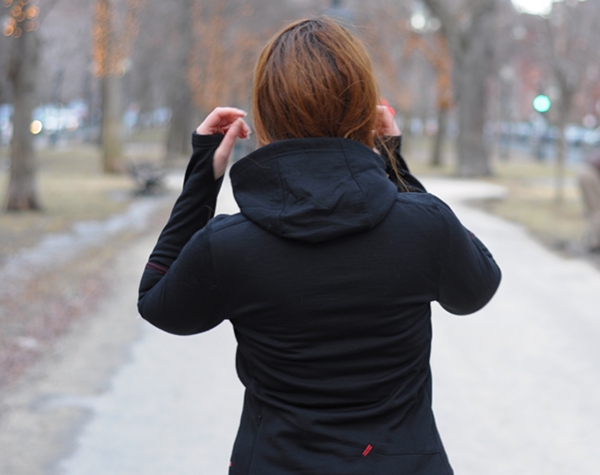
Whatever else might be said about the Pasha, I think it is crucial to recognise that Chrome did it: They made a wool sweatshirt that feels like a "real" sweatshirt and not like a wool sweater pretending to be a sweatshirt. The inside is fluffy and impeccably soft, the outside feels convincingly sweatshirt-like to the touch. The weight, the texture - everything is just like the hoodies I am used to. The asymmetrically placed zipper and structured tailoring add a contemporary touch.

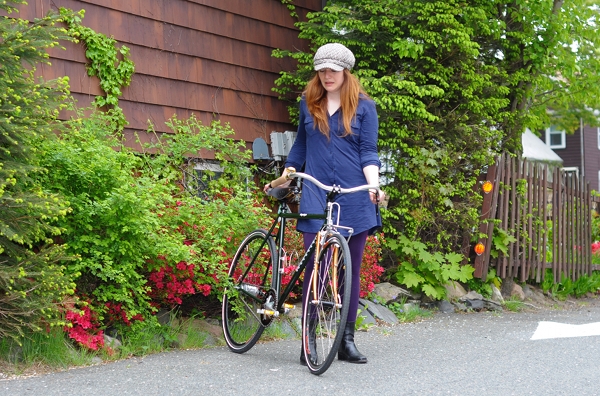
The design of the Pasha is cycling-specific, in that it is semi-form fitting and is cut longer in the back than in the front. I have read some reviews complaining that the cut is too narrow around the chest and too generous around the middle, and I somewhat agree. But I have a modestly sized chest, so the narrowness in that region works well for me. The middle is indeed roomy, but I do not find the cut unflattering. I am a US women's size 4, and the "Small" hoodie is just about spot on.

The hood is tight around the head and neck without requiring pull-strings. I've worn it on a roadbike in windy thunderstorms, and it did not get blown off over the course of the ride as other hoods tend to.

54cm Frame Toptube Clearance
I admit that once I took these photos I blacked out the Chrome logo, which is just too prominent for my taste. I suggest they consider making a subdued version of it, as many don't like displaying branding on their clothing. (And yes, I realise the irony of this photo as I write this - but bicycle logos are different!)

Chrome Pasha Hoodie
My one major real complaint about the design of the Pasha is that the thumb loops are not practical when riding a roadbike; they dig into the space between my thumb and forefinger when I stretch my arms to reach the drop bars. So unless I am riding an upright bike with a short reach, I end up not using them. I will probably sew up the holes in the sides of the sleeves.

Chrome Pasha Hoodie
A lesser complaint is that I do not like the exposed metal zipper. It's cold and "unfriendly," in contrast to the overall feel of the hoodie. The zippers they use on the pockets feel much better, so I would love the central one to be replaced with something in that vein.

Yet another minor complaint is an aesthetic one. There is maroon stitching in some parts of the hoodie, apparently for decorative reasons. This is nice in itself, but it clashes with the primary-red stitching next to the pockets, as well as with the Chrome logo and with the fabric of the same colour inside the pockets. Maybe this is a personal thing, but the combination of the maroon and the primary red looks off to me.

Finally, I should note that the Pasha is made in China, unlike some of Chrome's other items.

Chrome Pasha Hoodie, Pocket
The Pasha has two zippered side pockets - one much larger than the other, due to the asymmetrical placement of the central zipper. The larger pocket easily fits a wallet, point and shoot camera, or sandwich. The smaller pocket will fit a mobile phone or keys. There is also a large zippered rear pocket that will fit the contents of both side pockets together. The pockets have meshy interiors and can also be used for added breathability.

First Spring Ride, Bianchi
As far as weather conditions, I find the Pasha best for cold weather and mild rain - which we've been having a lot of here, even in the summer. In May and June we had stretches of days with temperatures in the 40s-50s, continuous rain, and this horrible bone-piercing dampness. The Pasha kept me warm, not sweaty, and mostly dry from the rain. Being wool, it is wearable in warmer temperatures as well, certainly into the lower 70s.

I've had this hoodie since March and have washed it three times on account of getting it covered in mud while riding a fenderless bike. It is durable and takes well to being washed and dried.

The most enjoyable thing for me about the Chrome Pasha, is that it has all the properties of 100% wool while feeling like a real sweatshirt. The design could be tweaked, but I'll take it even as is. It's great to be able to wear a hoodie on a bike without the "wet rag" effect.

Tuesday, July 5, 2011

Sagging Saddles?

It seems that I complain a lot about saddles, finding fault with most of the ones I try if not immediately then certainly within a year's time. This one won't break in, that one hurts my crotch. This one is too narrow, that one is too wide. This one is too soft, that one is too hard... So what now?

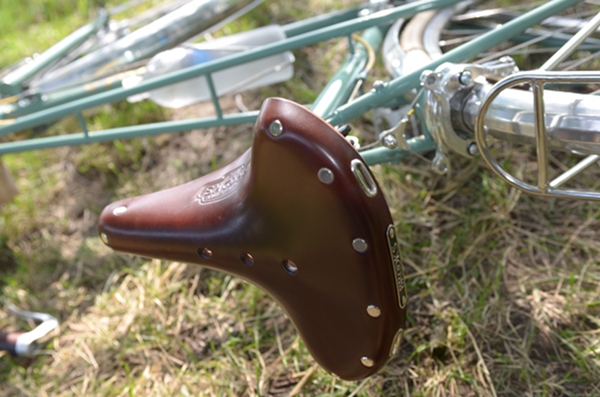
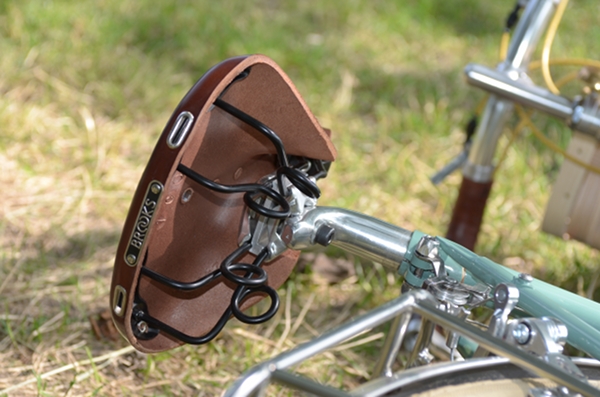
Okay, I've had this Brooks B72 for about a year. No complaints about the shape, size or breaking in period - it felt wonderful from the start on a semi-upright bike. I have owned several other B72 models as well - both modern and vintage - and they've all been good. This was the one saddle of all my saddles I thought was pretty darn perfect. Then a couple of months ago I started to notice that the outer edge was pressing into my derriere. At first it was subtle, but the feeling kept getting worse - until one day I looked at the saddle, and the leather was visibly sagging in the center, with the outer edge (where the rivets are) forming a sharp ridge. Regrettably I neglected to take a picture of this before we messed with the tension, but I really ought to have emailed it to Brooks. It is unexpected that a saddle should sag that much under a 125lb rider in less than a year's time. It had never gotten caught in the rain, I am not a proofide zealot, and I had ridden maybe 600 miles on it in the course of 8 months (it is installed on a city bike) when the problem began to present itself.

Though some recommend not to mess with the tension on a Brooks we went ahead and did, and the saddle felt great again... for a couple of weeks. But now, slowly but surely, I am starting to feel the rivets pressing into my behind once more as the leather continues to sag ever so gradually. Darn.

Having spoken to a few long-time Brooks owners and retailers, I do not think that this is an issue with the B72 model specifically, but rather a general issue with quality control and the natural variation in leather thickness. A couple of retailers have told me that some Brooks saddles will sag in this manner and there does not appear to be a pattern to which models are susceptible to it. Well, that's not very reassuring. I am especially disappointed since this particular saddle was my overall favourite before the sagging problem started. I guess perfection is a myth and it is best to keep that in mind to avoid disappointment. I am curious whether others have experienced the "sudden sag" syndrome on any of their leather saddles, and if so which makes and models. Is there a cure?

Tuesday, June 28, 2011

Shorter Cranks, Dainty Pedals, and the Ambiguity of Toe Overlap

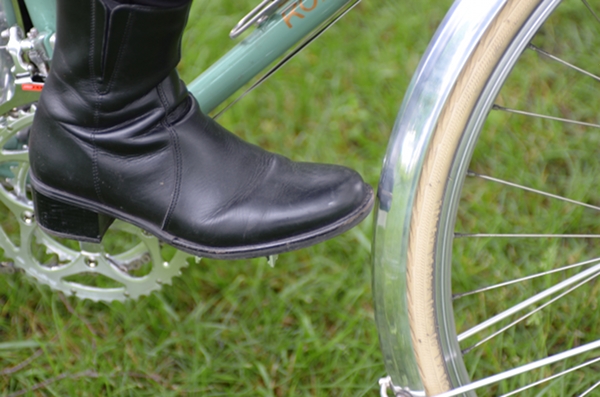
Last week I was offered the opportunity to trade the Sugino Alpina crankset on my mixte for the exact same model with shorter cranks, and I went for it. The original cranks were 170mm. The ones on it now are 165mm. A 5mm difference is very small, but can be significant. For instance, some say that shorter cranks make for a smoother pedal stroke. But my reason for the change was to reduce toe overlap. I mentioned previously that my mixte has it to a small degree, and that I'd like to get rid of it since I now use this bike mainly for transportation. In theory, that could be done either by converting to 650B or re-raking the fork. But before resorting to such drastic measures, I wanted to try something easier.

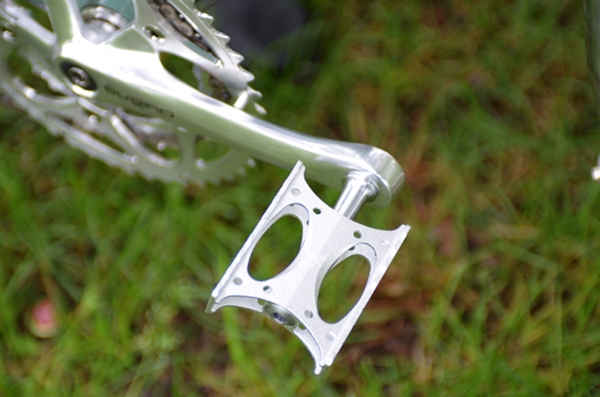
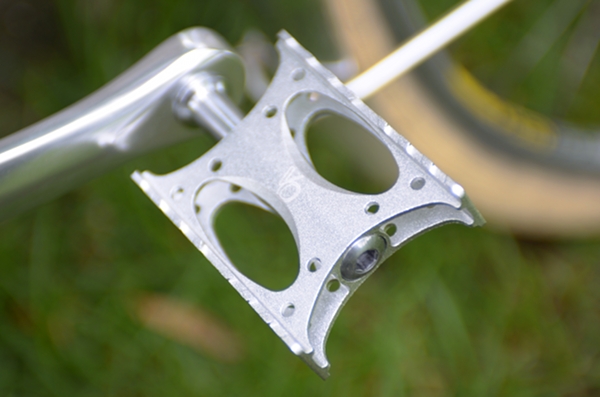
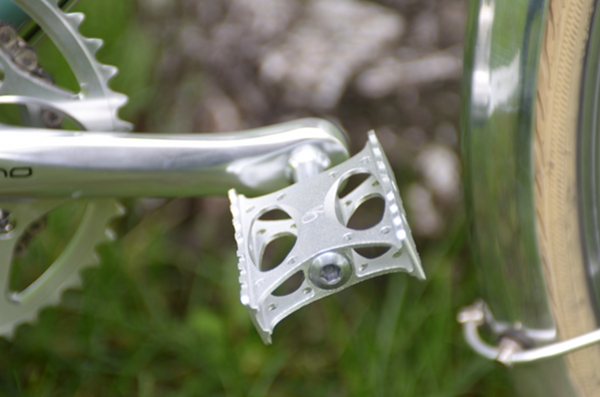
In addition to the shorter cranks, I also replaced the MKS Touring pedals with Velo Orange City Pedals. Being smaller, my assumption was that the new pedals would reduce overlap further still - though I am now told this isn't so.

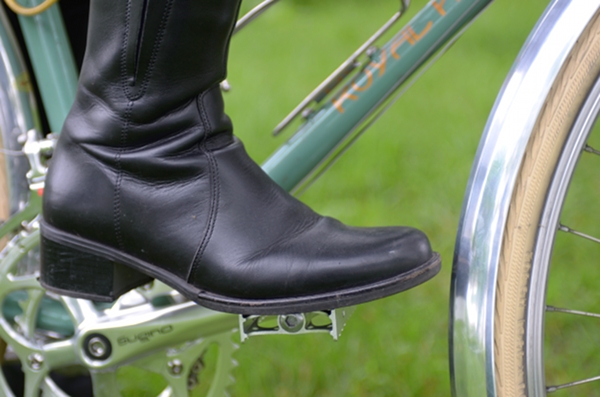
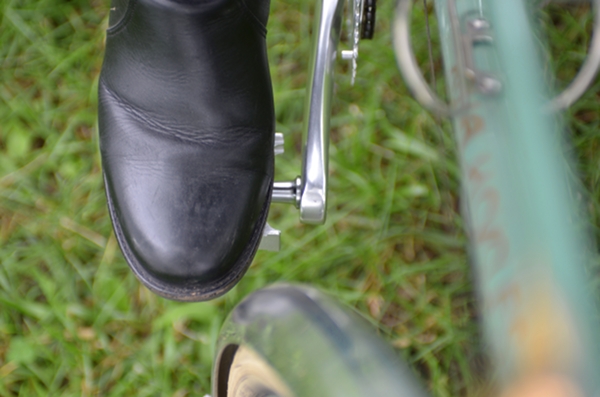
Either way, with the new set-up my toes are about 1/4" further back from the front fender than where they were previously. These are the longest-toed boots I own, and with my foot in its most typical position on the pedal there is no overlap even on the widest turn.

Aerial view.

But the thing about an upright bike that is ridden casually and with no foot retention, is that you can plant your foot on the pedal any which way. Sometimes I am sloppy, and plop it down further forward than typical when starting. In that sense, the toe overlap issue remains ambiguous. I need to ride around with this setup for a few weeks to see whether it still happens on occasion. I am not sure whether I notice any difference between the old cranks and the new ones, but it's possible that my pedaling feels a little "rounder." Or I could be imagining it, because that's what I've been told is supposed to happen. (Crank length placebo effect?)

As for the VO City Pedals, I absolutely love them so far. Ever since having tried them on the Rainbow Bike, I wanted them for myself. They don't stab my bare legs and toes the way MKS Touring pedals do, they are grippy, and they are extremely light (228gr per pair). It also does not hurt that they are pretty - though this, of course, is in the eyes of the beholder.

One caveat though, is that these pedals are very narrow (82mm across) and I have heard from a couple of people who find them uncomfortable for that reason. If you have large feet or tend to wear bulky workboots on your city bike, these are probably not the best choice.

So far I am happy with the changes I've made here, and together with the new basket the mixte has definitely turned into a transportation bike. The toe overlap was minor to begin with, so hopefully this will render it insignificant - but we'll see.

If you've ever played around with crank length on your bikes, did you notice a tangible difference? I have bicycles with cranks ranging from 165mm to 175mm, and they all feel fine, so I tend to use things like bottom bracket height and wheel size to determine what cranks a bike should have. But what do I know! Maybe with time I'll be able to tell the crank length of the bike I am riding just by the way it feels to pedal... though I remain skeptical.

Sunday, June 26, 2011

Basket 2.0

What luck I have. Beset by medical and dental problems simultaneously, the past few days have left me drained. We went for a super slow ride on Saturday, but even that was difficult to manage in my drugged up, diminished lung capacity state. But when we passed Cambridge Bicycle I knew there was one thing that could make me feel better. A basket. Of course. What better cure for life's woes?

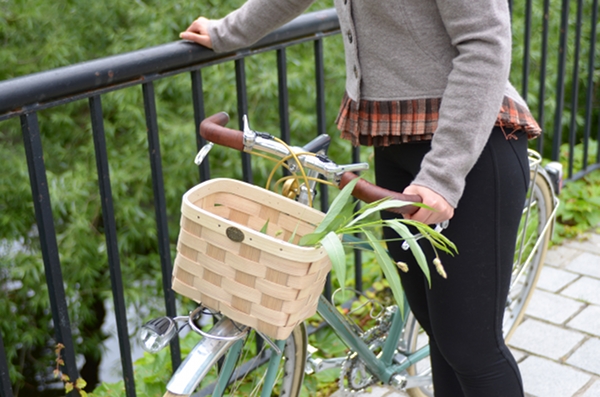
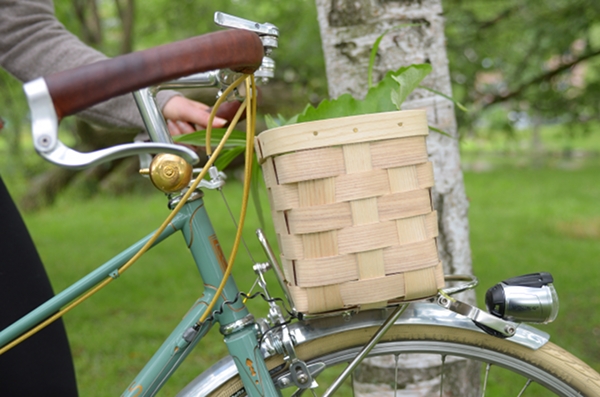
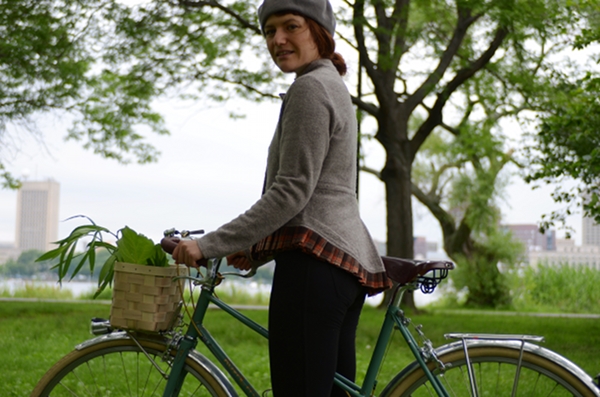
I have been eying this particular basket for months, and finally she is mine! It is made by the Peterboro Basket Company in New Hampshire, out of locally harvested White Ash. I think the model is this one. This basket is small, boxy, with a rectangular footprint, and it does not taper from top to bottom - which was exactly the style I wanted for this bicycle.

I refer to this as Basket 2.0, because I did not get along that well with the large wicker basket on my formerly-owned Pashley, and eventually removed it. This time around I looked for attributes that I hope will work for me.

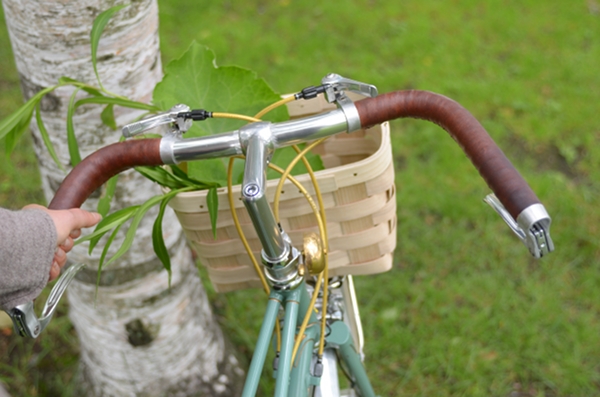
For one thing, the Peterboro basket is fairly small, with a low profile and sides that don't stick out too far. It is also feather-light, made of such thin slivers of Ash that it almost feels like Balsa wood. Finally, we attached it directly to a front rack and not to handlebars, which minimises its impact on steering. Though the basket came with leather straps and metal buckles, we removed these and fastened it to the rack with zip ties. The straps and buckles were heavier than the basket itself, so doing this really made it weightless, as well as eliminated any potential jiggling. Cambridge Bicycle were nice enough to give us a handful of zip ties and some wire cutters, and we installed the basket right outside the shop in a matter of minutes.

When the basket is empty, I cannot feel it on the bike at all. It does not cause the wheel to flop to the side when the bike is parked.

It also leaves the frontmost tip of the tire unobscured, so that I can still see it while cycling. When a huge basket obscures the entire front wheel, I have a harder time feeling connected to the steering, but this is not an issue here.

When the basket is full, the weight feels well distributed and does not interfere with either steering or balance. With dimensions of 10.25" x 7" x 7" it is not meant to carry large objects; I have a rear rack and panniers for that. But the squat, boxy shape allows it to accommodate more stuff than you might think. As pictured above, the basket contains a huge portion of smoked salmon, a bucket of cream cheese, an economy pack of cheese sticks, a blueberry encrusted "goat cheese log," and a flower bouquet. There is room for more.

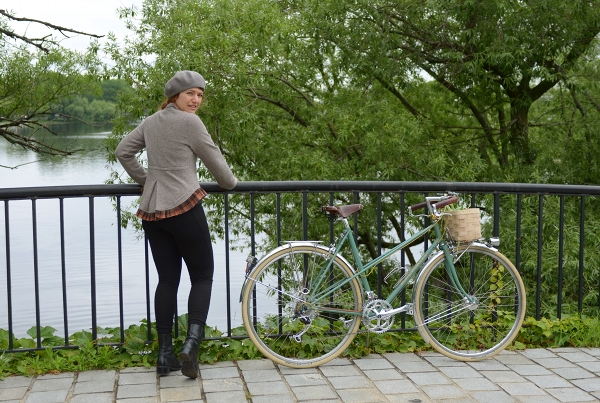
Since I am now using the mixte predominantly as a transportation bike, I wanted to maximise its utility as such. This basket provides a useful space for a jacket, camera, small handbag, or even a quick grocery store purchase, without impacting handling or (to my eye at least) marring the looks of the bike. The Co-Habitant wasn't too crazy about the look at first, but it grew on him. What do you think? What front-mounted basket systems have you used on your bikes, and have they ultimately worked for you? The difference between this set-up and the large, handlebar-mounted basket I used to have on the Pashley Princess is like night and day.

Thursday, June 23, 2011

Po Campo Loop Pannier: a Ladylike Briefcase to Fit Any Bike

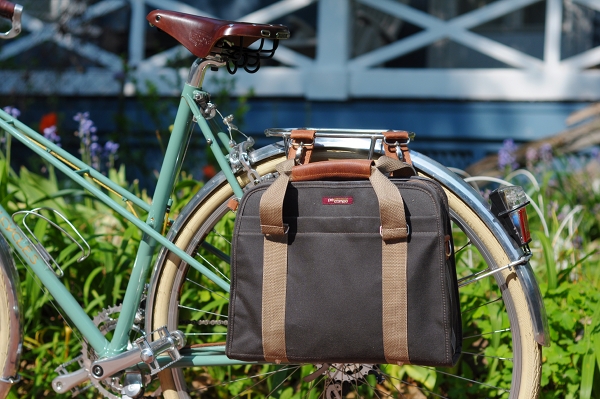
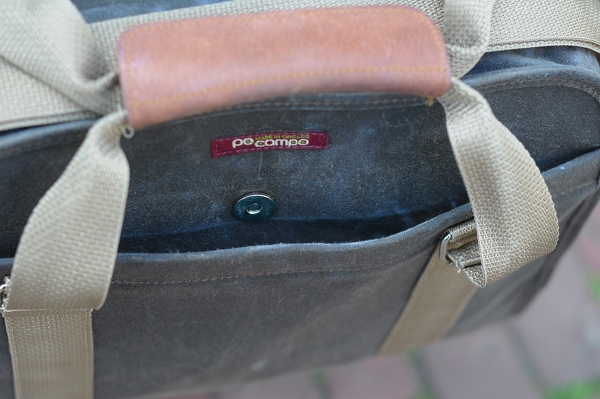
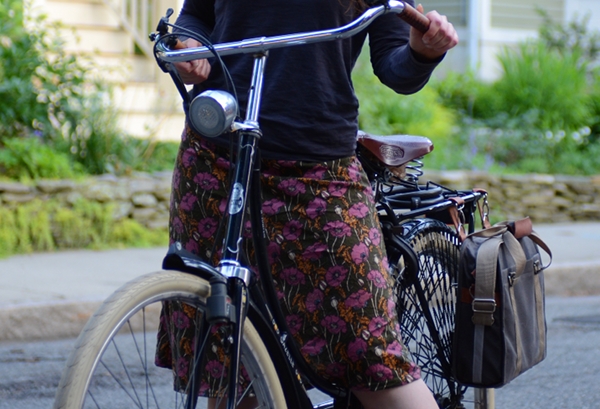
Po Campo is a small Chicago-based company that has been making a variety of bicycle-compatible women's handbags since 2009. This year they introduced a larger, briefcase-like pannier to their lineup and I acquired one in trade a couple of months ago. The Loop Pannier is available in several floral patterns, but I opted for the more subdued waxed canvas version. It is umber with tan straps, metal buckles, and honey leather trim. At 14"x10"x3.5" the size is small enough so that there is no heel strike on bikes with short chainstays, but large enough so as to fit some laptops. These bags are designed to be used on the bike as panniers, off the bike as shoulder bags, and as luggage attachments while traveling.

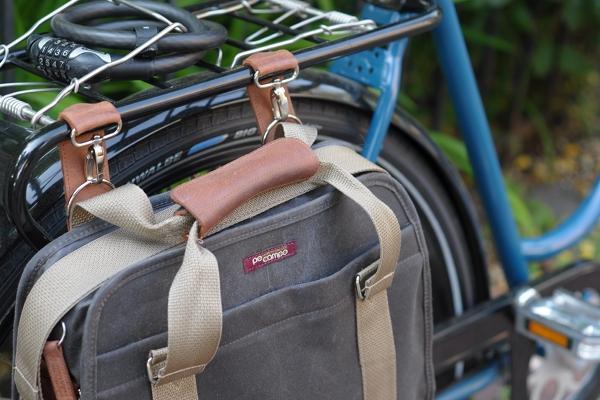
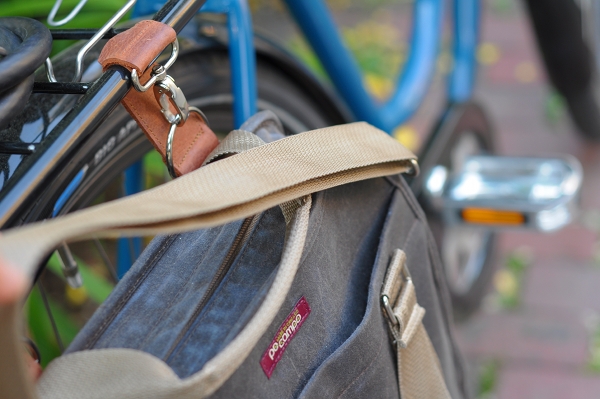
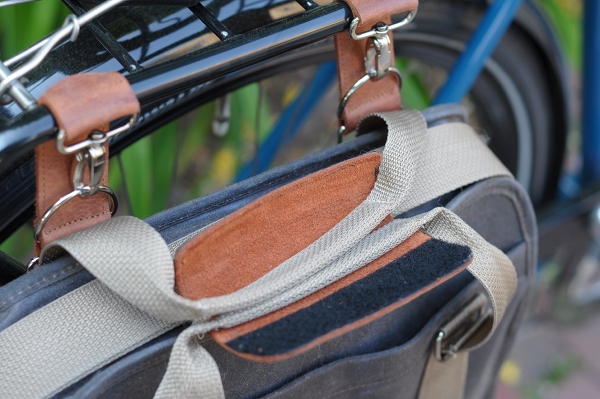
The Po Campo attachment system consists of leather straps with sturdy metal clasps. When I saw this, it was one of those "why did no one else think of this earlier?" moments. The benefit of this design is that it can fit bicycle racks with any tubing diameter. Other quick-release systems max out at 16mm tops, which means that they will not fit some heavy-duty Dutch and Roadster racks. None of our other panniers are compatible with the monstrous tubing on this Pilen rack - but the Po Campo straps have plenty of room to spare.

While using the clasps is not quite as instantaneous as the sort of quick release where you lift up the handle and the hooks open up, it is still easy and quick.

Since the straps are soft and flexible, they also offer the benefit of being adaptable to the rack's layout. Some racks have complicated rat-trap setups that can interfere with typical pannier hooks. The Po Campo straps can simply be looped around them. The more I used this system, the more I began to appreciate the design. Those who dislike plastic hooks will also rejoice at the complete lack of plastic here; it's all metal.

There are two short straps integrated into the pannier, and a longer detachable shoulder strap. While initially managing the system of straps seems complicated, it ends up being very intuitive.

The long shoulder strap folds over the top of the bag. Then, the second of the short straps gets tucked into the leather handle attached to the first, which closes with velcro. This keeps all three straps neatly tucked in and away from the spokes.

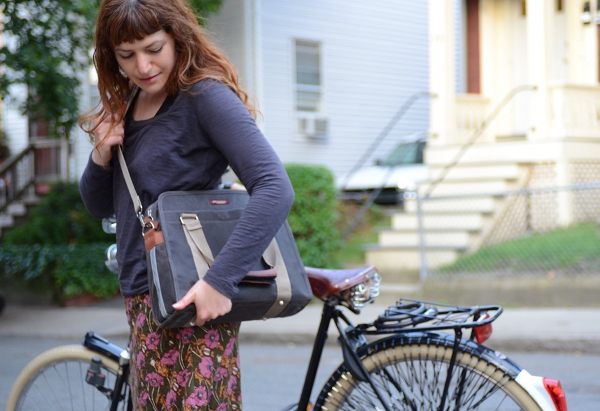
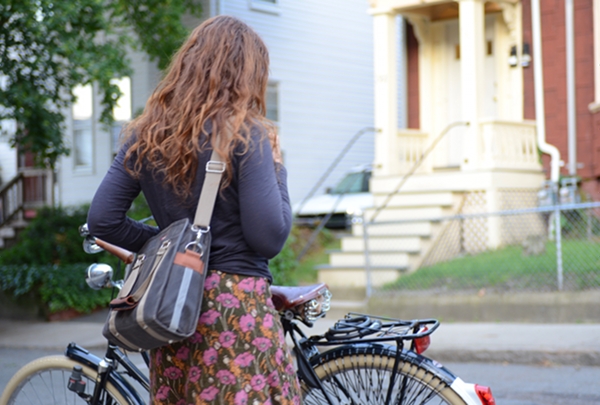
When the bag is off the bike, it can either be handheld, or used as a shoulder or messenger bag. I prefer the latter, especially since adjusting the shoulder strap on the go is very easy - the adjustment buckle slides freely.

I have walked around with the bag as pictured for a couple of miles and it felt fine. I've also shortened the strap and have worn it over one shoulder, like a handbag. Either way is pretty comfortable and the clasps absolutely do not catch on my clothing. It basically feels like a normal bag to carry, not like a bicycle-specific pannier.

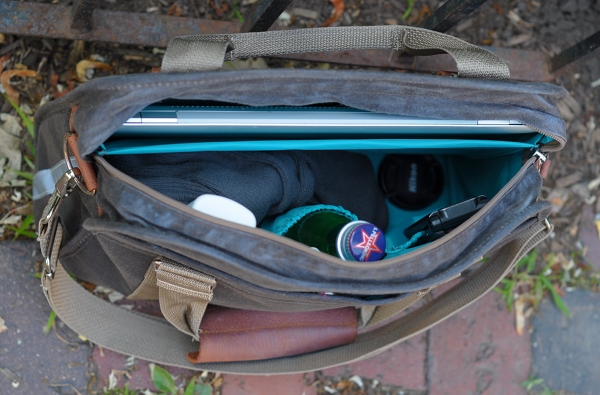
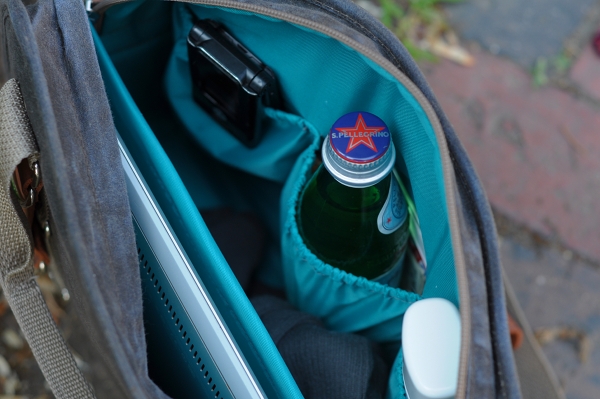
Another feature of the Po Campo I appreciate is the way it is organised inside. There is a large main compartment, and a side compartment that they refer to as a "file/lock pocket." However, I use it for my laptop, which is a MacBook Air and is the perfect size for it. I use the main compartment for clothing, books, notebooks and my DSLR camera.

There are also three elasticised interior pockets that will each fit a wallet, phone, writing instruments, or even a small bottle of water.

The exterior pocket is quite roomy. It is especially useful for those times you need to remove a sweater or grab some water in traffic.

I tend to overpack whenever I leave the house, so this pannier is always bulging with stuff when I use it. Still, the structured design keeps it all looking neat and presentable.

The reflective strip along the back is nice for extra visibility.

I have tried the Po Campo pannier on five different bikes with different types of racks, and it works well on all of them. I cannot imagine a rack design with which this bag will be incompatible, and in my view that is one of its most valuable features. Other strong points include the durable construction, the professional look, and the ease with which the bag can be used off the bike. This is a small pannier and you will not be able to fit groceries in it; it is really meant as a briefcase/ professional bag and will accommodate only the smaller laptop models. But the compact size has the added benefit of preventing heel strike on bicycles with shorter chainstays.

All things considered, I only have one critical suggestion for Po Campo: Think about making a version for men. When I ordered the waxed canvas finish, I was hoping that the Co-Habitant could use it too. He was delighted that the bag fit the unusually fat tubing of his Pashley Roadster rack (no other quick-release pannier we've tried will fit it), but he thinks its shape is too feminine. While Po Campo designs their products with women in mind, I think the versatile attachment system and the elegant briefcase construction of this pannier is too good not to share with the menfolk.
Sunday, June 12, 2011

Fizik Microtex Handlebar Tape

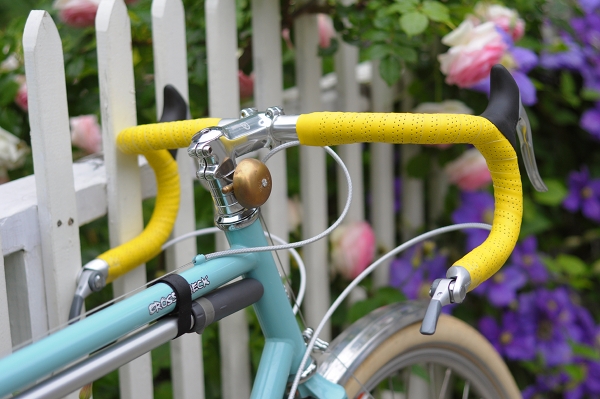
Last week we replaced the cloth tape on the Co-Habitant's Surly with Fizik Microtec tape. He wanted something that would not get dirty, did not require shellacking, and was not as heavily padded as cork tape. I've been using this tape in red for the past several weeks, so I suggested he try it. We both purchased it at Harris Cyclery, but it's available in many bike shops.

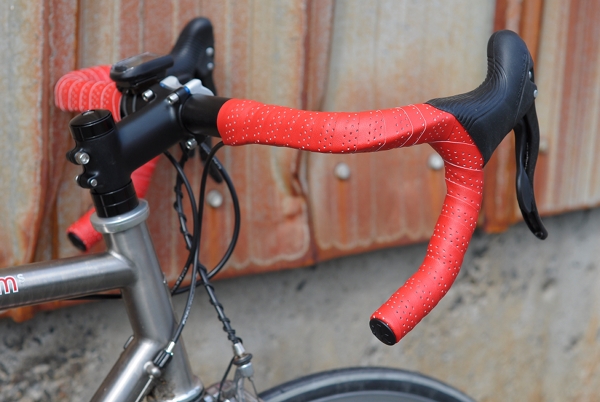
Fizik Microtec bar tape is a synthetic tape with about half the padding of typical cork tape. The perforated surface is smooth, but not slippery. It lies down flat, the edges resist fraying, and the surface stays clean. I know some complain that cloth and cork tape tend to get dirty and frayed, so if you want a bright handlebar tape that is durable and retains its colour, this could be it. Mine looks and feels the same after 300+ miles of sweaty gripping as it did when first installed. But more importantly, this tape could work for those who find cork tape too soft and cloth tape too hard - it is sort of the happy medium.

Although visually the perforations resemble leather tape, there are no tactile similarities. The Fizik tape is stiffer than leather, and it feels distinctly synthetic to the touch. While I would not describe the surface as slick, I can see how some might find it too smooth - especially if riding without gloves. My preferred handlebar wrap is cloth tape, but on some handlebars - particularly on modern ones that have channels for cables - I feel that I need more padding. The Fizik Microtex tape is durable, easy to wrap, provides just enough padding, and is available in a variety of colours.

Sunday, May 22, 2011

An Igleheart and a 'Sex Hub'

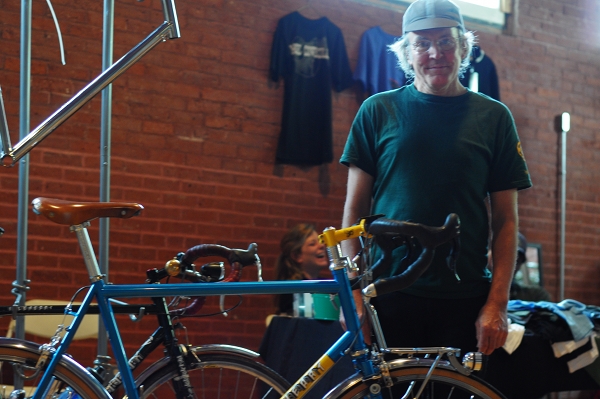
At the New England Bicycle Expo a couple of weekends ago, I had the pleasure of meeting legendary New England framebuilder Christopher Igleheart and briefly test riding one of his bicycles - an upright commuter model called the Yoyodyne. One cool thing about this bike - aside from it being an Igleheart - was the 3-speed Sturmey Archer S3X hub - aka "the sex hub." Several people I know have set up their bikes with this hub and their feedback has been intriguing, so I wanted to try for myself. And what better way than on an Igleheart bike?

Located just North of Boston, Mr. Igleheart - like many local builders - traces his professional beginnings to the legacy of Fat City Cycles, where he started as an apprentice welder in the 1980s. By 1994 he had established Igleheart Custom Frames as an independent operation, spcialising in TIG-welded steel. In the chaotic environment of the Bicycle Expo, a sense of calm presided over the crowded Igleheart booth. The man is very comfortable with his work and discusses it in a way that communicates his experience and versatility. Road bikes, mountain bikes, transportation bikes and even randonneuring bikes - he knows them all, executing them in his distinct aesthetic.

Unfortunately, I somewhat dropped the ball on photographing this beautiful bicycle. The high noon light was unflattering from every angle, the background I chose was too busy, and people kept coming up to ask about the bike and distracting me. The results are washed out and entirely unworthy of the Yoyodyne, so I did what I usually do with ruined pictures: upped the contrast and at least tried to make them atmospherically interesting.

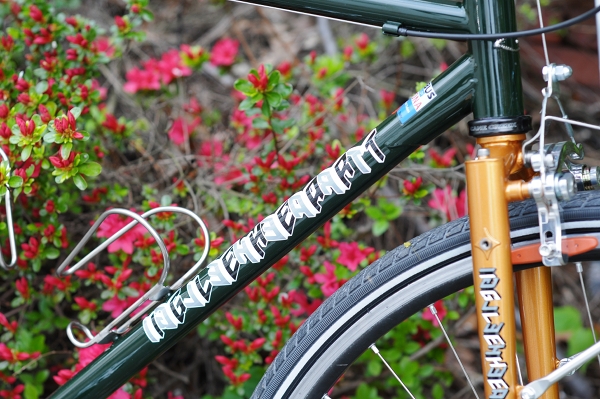
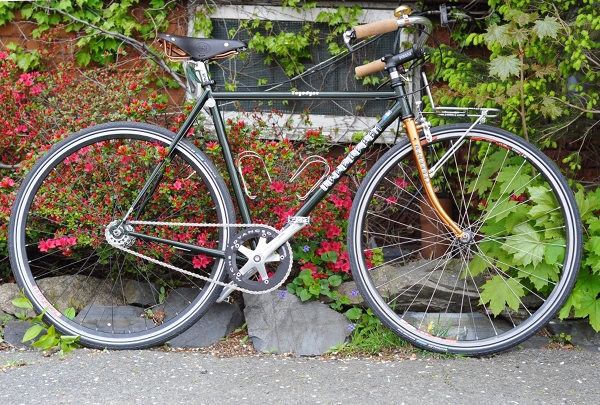
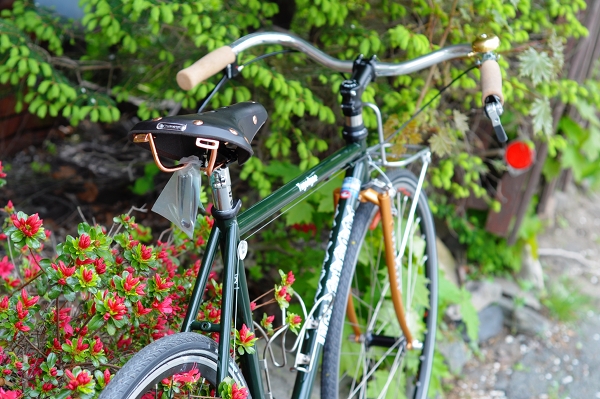
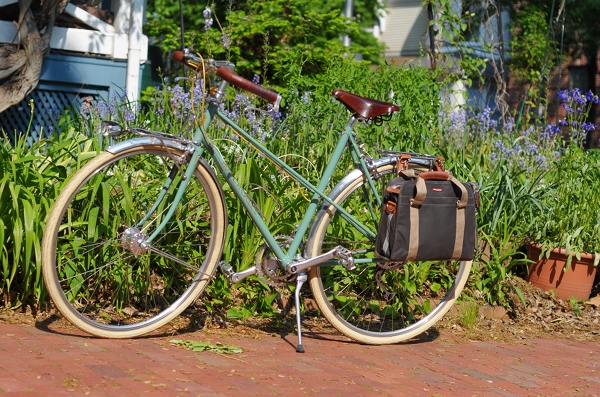
The Yoyodyne is designed as a fun and comfortable city bike. This particular one has a green frame and an orange fork, which is an unexpectedly pleasing colour combination. 

Columbus Zona is a comfortable all-around tubing that contributes to a plush ride quality. The welds are very cleanly done. The segmented fork is one of my favourite fork designs and I never tire of its various iterations from different New England framebuilders.

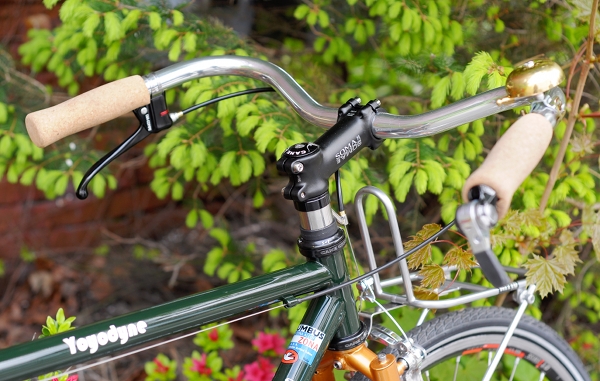
Components cater to urban commuting, combining good quality and budget considerations: single crankset, Soma stem and Oxford swept-back handlebars, cork grips, simple city brake lever, brass bell, and a front rack. [edited to add: I just learned that the price for this complete bicycle is $1900 - good deal!]
Cardiff leather saddle with copper rivets. You can't see this very well here, but the seat post has a special feature that allows the top of it to be easily detached and reattached, without having to re-adjust saddle position.

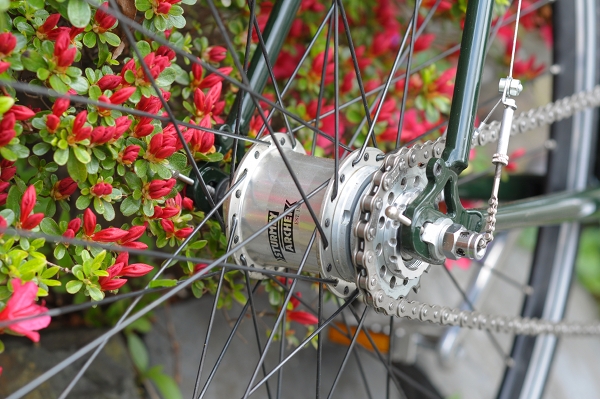
And of course, the exciting 3-speed fixed gear hub. A testament to just how distracted I was, I even failed to capture the "S3X" label. It's on the other side. 

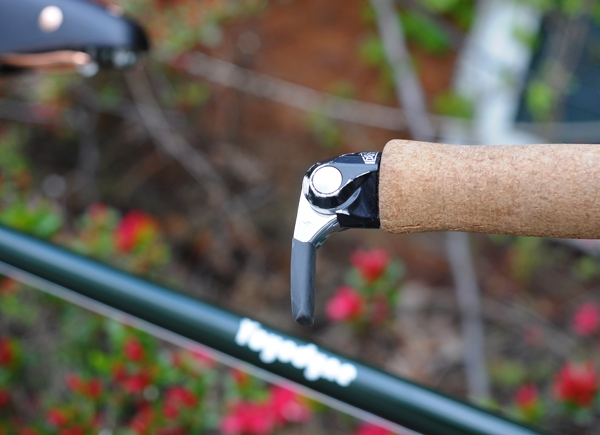
Sturmey Archer has a new gear shifter for 3 and 5-speed hubs that is versatile in that it can be used both on upright and drop handlebars. I found it a little difficult to budge in comparison to the traditional trigger shifter, but perhaps that can be adjusted. 

It's difficult to properly test ride a bicycle at a crowded Bike Expo, but I made a half dozen laps on it around the large parking lot in the back of the building, as well as cycled up and down the long driveway a few times. With a constant stream of cars coming and going it was like a slower version of actual urban cycling.

The ride quality of the bicycle felt familiar as soon as I began pedaling. Cushy and easy to handle, it was not unlike a vintage Raleigh Sports - only more responsive, 1/3 of the weight, and made of far nicer tubing. I would feel comfortable riding it in city traffic. However, I would need a longer test ride to determine how it handles potholes at speed. 

All of this struck me before I remembered about the bike being fixed gear. What I mean is that usually the fixed-gearness of a bicycle tends to dominate my impression of it, but here this was not the case. It felt more like a comfortable 3-speed, on which it just so happened that I didn't coast. This could be due to the bicycle's handling, or it could be due to the hub.

The ride with the S3X hub felt interesting, but I would say not entirely like a fixed gear bike. When I ride a single speed fixed gear, there is more to the sensation than merely not coasting. I feel like I have a direct connection to the drivetrain, and for me that is part of what makes riding fixed gear bikes enjoyable. This aspect is gone with the S3X: It basically feels like a nice 3-speed hub that does not allow you to coast. Shifting is easy and the gear spacing is just about perfect, but no matter what gear it is in, the feeling is not quite the same as single speed fixed gear.

One thing you have to watch out for with the S3X is that if not adjusted properly, the hub can "space out" and go into coasting mode for a millisecond's time at the end of each pedal revolution. Several people I know who've installed the S3X hub report this, and I experienced it as well - which makes me think that the adjustment has to be extremely precise in order for it not to happen. 

While I like 3-speed hubs and I like fixed gear, I am not sure that the combination is for me, as it introduces a degree of complexity into both categories. But I still think it's a neat idea, and I am glad I tried it. In future, I hope to have the opportunity to learn more about Igleheart bicycles and to take one on a longer test ride. Many thanks to Mr. Igleheart for allowing me to ride the Yoyodyne!