Showing posts with label saddles. Show all posts

Tuesday, July 5, 2011

Sagging Saddles?

It seems that I complain a lot about saddles, finding fault with most of the ones I try if not immediately then certainly within a year's time. This one won't break in, that one hurts my crotch. This one is too narrow, that one is too wide. This one is too soft, that one is too hard... So what now?

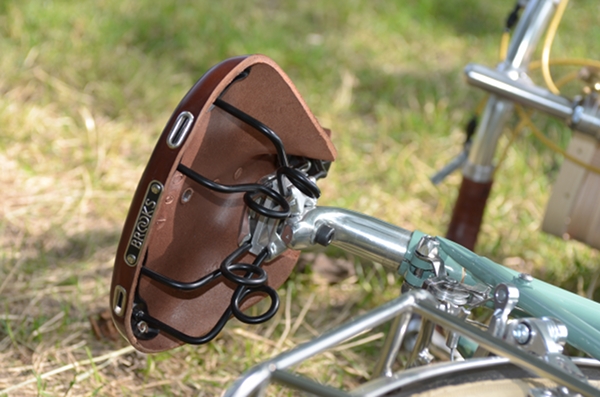
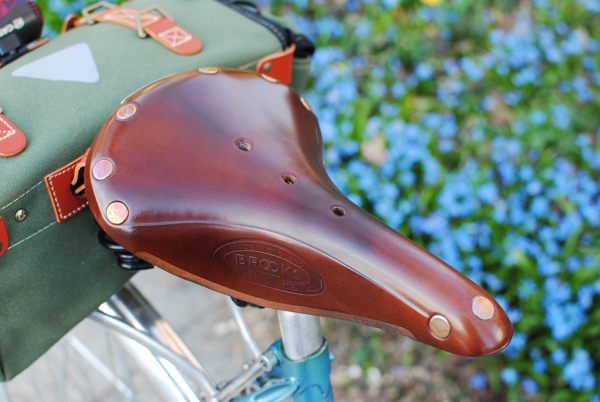
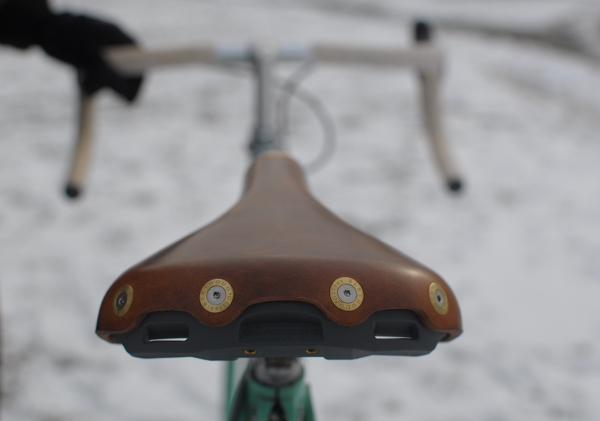
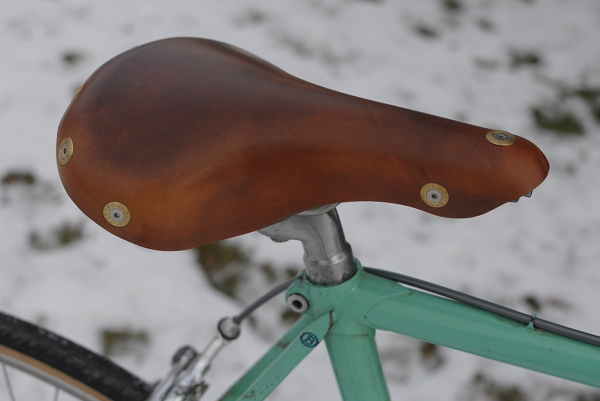
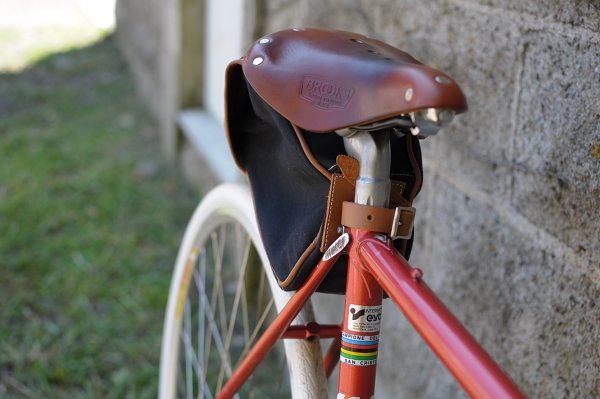
Okay, I've had this Brooks B72 for about a year. No complaints about the shape, size or breaking in period - it felt wonderful from the start on a semi-upright bike. I have owned several other B72 models as well - both modern and vintage - and they've all been good. This was the one saddle of all my saddles I thought was pretty darn perfect. Then a couple of months ago I started to notice that the outer edge was pressing into my derriere. At first it was subtle, but the feeling kept getting worse - until one day I looked at the saddle, and the leather was visibly sagging in the center, with the outer edge (where the rivets are) forming a sharp ridge. Regrettably I neglected to take a picture of this before we messed with the tension, but I really ought to have emailed it to Brooks. It is unexpected that a saddle should sag that much under a 125lb rider in less than a year's time. It had never gotten caught in the rain, I am not a proofide zealot, and I had ridden maybe 600 miles on it in the course of 8 months (it is installed on a city bike) when the problem began to present itself.

Though some recommend not to mess with the tension on a Brooks we went ahead and did, and the saddle felt great again... for a couple of weeks. But now, slowly but surely, I am starting to feel the rivets pressing into my behind once more as the leather continues to sag ever so gradually. Darn.

Having spoken to a few long-time Brooks owners and retailers, I do not think that this is an issue with the B72 model specifically, but rather a general issue with quality control and the natural variation in leather thickness. A couple of retailers have told me that some Brooks saddles will sag in this manner and there does not appear to be a pattern to which models are susceptible to it. Well, that's not very reassuring. I am especially disappointed since this particular saddle was my overall favourite before the sagging problem started. I guess perfection is a myth and it is best to keep that in mind to avoid disappointment. I am curious whether others have experienced the "sudden sag" syndrome on any of their leather saddles, and if so which makes and models. Is there a cure?

Monday, April 4, 2011

Female Anatomy and Saddle Discomfort

Male readers: you may want to skip this one. Of course if you feel up to it, you are welcome to keep reading. But don't say I didn't warn you.

Female readers: I've had email exchanges with so many of you about "women's issues" with bicycle saddles, and it's amazing how much embarrassment there is among us (and I include myself) when it comes to discussing our bodies - especially given how common these problems are. While with men, we can read and hear all about perineal this and genital that, with women it's all hush-hush and seldom addressed in a manner explicit enough to be helpful. So I'll try to get over my own embarrassment, and write about it in detail here.

There are many different kinds of female-specific saddle problems and I will organise them into several categories: posterior discomfort, genital discomfort, infections, and menstruation.

Posterior Discomfort
For the sake of keeping things women-specific, let's assume that the problem is not an overpadded saddle (which can cause bunching up in a way that is painful to both genders), and begin with the premise that you have a leather or plastic saddle with minimal padding. With most new saddles there is a break-in period, and it is normal if your butt feels sore on the first ride, or even several rides. But if it still hurts just the same after a reasonable break-in period, and the pain feels to be the result of pressure on the sit bones, then the saddle may be wrong for your derriere. For women, the problem tends to be choosing a too-narrow saddle. Women typically have wider sit bones than men and also tend to be less aggressive cyclists, which puts more pressure on their behinds. If your butt hurts where the sitbones are, a wider saddle will usually solve the problem. Padding, on the other hand, is not usually effective. Light chamois padding as part of your cycling shorts can make an already comfortable ride more comfortable over long distances. But the more typical heavier padding usually makes things worse, not better.

Genital Discomfort
When riding an upright bicycle, a female cyclist should feel no genital discomfort, because that part of her body is not in contact with the saddle in a way that causes pressure. On the other hand, a roadbike - with its forward-leaning posture, will tilt the genital region directly onto the saddle. Female cyclists typically experience genital discomfort in one of two places: the labia (vaginal "lips") and the clitoral area.

Labia: When cycling on a roadbike, some women report that their vaginal lips bunch up and press painfully into the saddle - so much so, that after a long ride there can be abrasions and bleeding. While some recommend getting saddles with a cut-out in the center, this is not always effective: Every woman's anatomy is different and the cut-out may not be in the right place. Though it's pretty much impossible to keep loose folds of skin from shifting about while you're pedaling, you can avoid abrasions with generous applications of chamois cream or vaseline before you set off on your ride. Creams such as DZNuts that use tea tree oil as a main ingredient seem to be particularly effective. Vaseline works as well, but be aware that it can discolour leather saddles if it seeps through shorts. Others prefer to use baby powder or corn starch, but the few times I've tried this it was a mess. Another method to prevent severe chafing may be to wax or epilate (but not shave) the entire area. For some, coarse pubic hair contributes to abrasions and getting rid of it improves things.

Clitoral Region: An even more difficult issue to deal with is clitoral pain. This is a problem that you either have or you don't, depending on your anatomy. For some women the location is safely out of harm's way, while for others it presses directly into the hard nose of the saddle. In the event of the latter, chamois cream is not sufficient to alleviate the discomfort that ensues. Some recommend tilting the nose down, but this is not always possible, as doing so can cause the cyclist to slide forward, putting more pressure on her hands and making the whole riding position uncomfortable. The only solution here is to find a saddle that works through personal trial and error, which can be frustrating and expensive. I've suffered through this particular problem on and off with my Brooks B17S saddle since last Spring. Then I tried the Gilles Berthoud "Marie Blanque" and the problem disappeared entirely. Some also say that the Brooks "S" road saddles actually make this problem worse, not better, since the hard nose of these saddles does not just end sooner, but starts sooner. There are other suggestions out there for specific saddles that could solve this problem, including Terry saddles and "noseless" saddles. But the suggestions are all based on personal experiences of individual women and it is simply impossible to find a single solution for everyone, given the inconsistent location of this particular body part.

Recurring Infections
Female cyclists can be prone to yeast infections and urinary tract infections (UTIs). The causal factors underlying both types of infections are numerous, and contrary to what some believe, they are not necessarily due to poor hygiene. Of course, showering both immediately before and after a strenuous ride will lower the risk of infections, but most women who get them are already doing this. Often, synthetic shorts or underwear could be to blame: bacteria thrives underneath synthetic fabrics, even when the garments are advertised otherwise. If you get recurring yeast infections or UTIs when you cycle, consider wearing exclusively silk or wool underwear and wool cycling shorts. And definitely consider a suspended leather saddle - which unlike other saddles, is breathable. Natural fabrics, good ventilation and moisture wicking are key here. It also helps to use simple soaps (made of actual soap, not perfumed body washes or moisturising soaps) and to avoid artificially perfumed sprays or lotions in or around your vaginal area. Be especially cautious on hot and humid days, as well as on days during which there are drastic weather changes - infections are more likely to occur at these times.

Menstruation
As any exercise, cycling can relieve menstrual cramps and counter PMS symptoms - so if you're up to cycling for sport during your period there is no reason not to do it. But straddling a bicycle saddle for hours while menstruating can present its own set of challenges. Blood flow increases during exercise, so if you are planning on a long ride, it's a good idea to change your tampon or sanitary napkin more frequently than usual. If you don't use tampons, then there is also the issue of blood being an irritant, with the potential to cause abrasions and infection. One way to avoid this is to shower right before your ride, then take wet naps with you and stop every hour in a restroom facility to clean up and change your sanitary napkin. If that sounds like too much trouble, consider using tampons or avoiding cycling for sport during menstruation - especially if you are prone to the abrasions and infections discussed earlier.

I hope this post was helpful. If you would like to discuss these issues, and, especially to share your own experiences and remedies, remember that I allow anonymous comments and you don't need to log in under your regular screen name.

Tuesday, March 29, 2011

Vegan Options for Classic Saddles

[image via somafab.com]

Though I am personally not against using animal products, some of my friends and readers are - which makes bicycle saddle purchases especially difficult for them. The problem is the basic construction of the saddles: There simply aren't any vegan options on the market today that are made in the same manner as suspended leather saddles, whereby a tough yet breathable material is stretched over metal railings like a hammock. So, what is the next best thing in terms of construction? Since saddle preferences are highly personal, I can only tell you what works for me, and hopefully it will be useful to some of you as well. If not suspended leather, then the next best thing for me is an ergonomically-shaped saddle that is a hard plastic shell, covered with a thin layer of synthetic material and very minimal padding in between. I prefer this construction by far over heavy padding or gel, which I find completely unridable. A number of experienced cyclists, such as Jon Forester, recommend these hard saddles over padded ones - the reasoning being, that the padding/gel bunches up under your sitbones and becomes uncomfortable over the course of a ride, whereas a hard plastic support with minimal padding holds up your weight equally.

[image via somafab.com]

For roadbikes, there are several vegan options available as far as these types of saddles go. Notably, SOMA has recently released the Okami series (above, and the previous image), which comes in black, white, and embossed floral "synthetic leather," with copper-plated rivets. I've heard good things about this saddle, though I personally have not tried it. And it certainly looks classic.

[image via tokyofixedgear.com]

The Japanese manufacturer Kashimax has recently re-issued several colourful models in this tradition, many of which are vegan (just look for the models labeled "plastic" rather than "suede"). Though the Kashimax saddles look scary-long and uncushioned, I've tried one on a friend's bike and really liked it.  

[image via cinelli.it]

Another all-plastic option is the Cinelli Unicanitor re-issue - "the first saddle with a plastic shell in the history of cycling".

[image via cinelli.it]

And a limited edition Barry McGee version, covered with a lightly padded synthetic leather.

[image via chari &co]

Two Italian manufacturers have re-issued their original versions of these classic saddles as well. Selle Italia has released several versions of the classic "Turbo" model. I have ridden on several vintage Turbo saddles and loved them, so this would probably my vegan saddle of choice for a roadbike. There is something about the squarish back, the sloping sides and the down-turned nose that I find very comfortable. 

[image via sellesanmarco.it]

The Concor release by Selle San Marco is a similar design to the Turbo, though I have not tried these personally. And SOMA's Ta-Bo is yet another version.

[image via selleroyal.com]

Now, as far as saddles for upright bicycles go, I am not really sure what to tell you. I have not found a good vegan alternative to a sprung leather saddle, so these are more like "the lesser evil" suggestions. The Ondina model by Selle Royal (above image) is a mattress-style saddle. It is more evenly padded than other models I've tried, and resists bunching up. I have ridden on this saddle and thought it was fine for a short urban ride.

[image via lepper.nl]

I have also tried the mattress-style Lepper saddles (which come standard on many Dutch bikes), and those are similar to the Selle Royal, though with a more boxy profile. They are also usually quite heavy and the springs are enormous.

[image via electrabike.com]

Electra offers a number of vintage-inspired saddles that look the part, and aren't as horrendously over-padded as others I've seen - including these narrower styles that would work well on a mixte. 

[image via electrabike.com]

Electra also sells a lot of colourful models that could work well on a traditional bike. After all, a classic look does not necessarily need to imitate leather. 

[image via nirve.com]

The cruiser manufacturer Nirve offers a number of traditional styles as well, including the riveted saddle pictured above and a number of floral-embossed models.

[image via nirve.com]

And another classic design by Nirve, with the "diamond" pattern popular on cruisers. If you are going for looks alone, there is a great deal to choose from between Nirve and Electra, but ride quality reports for these vary considerably.

If you have experience with any of the saddles listed here, please share your thoughts. And if you have other vegan alternatives to recommend for those who do not wish to buy leather saddles,  your suggestions would be much appreciated. 

Saturday, January 29, 2011

Barter Economy

Some of my most interesting bicycle-related acquisitions have been through trades with others, and I find these barter exchanges to be great. Whether bicycle related or not, trades can work out nicely - with each party feeling as if they are getting something new and useful.

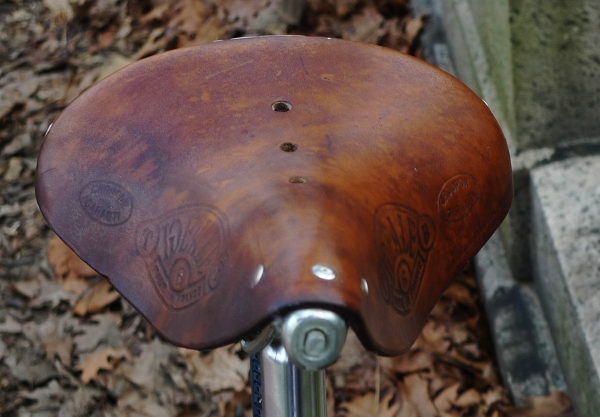
For instance, I received this vintage Ideale saddle in exchange for some vintage Brooks.

I received these beautiful dressguards in exchange for a spare saddlebag.

I even had some custom metalwork done in exchange for a basket. Other trades have included embroidery in exchange for a rear rack, collectible fountain pens in exchange for artwork, and products in exchange for photography.

A good place to start looking for bartering opportunities as far as bicycles go, is bikeforums. They've set up "For Trade" threads for different geographical regions, where you can list the items you have available and the items you are looking for. Here is the one for the Northeastern USA. I have been considering setting up something similar - but cannot think of a way to do it without it eating up too much of my time.

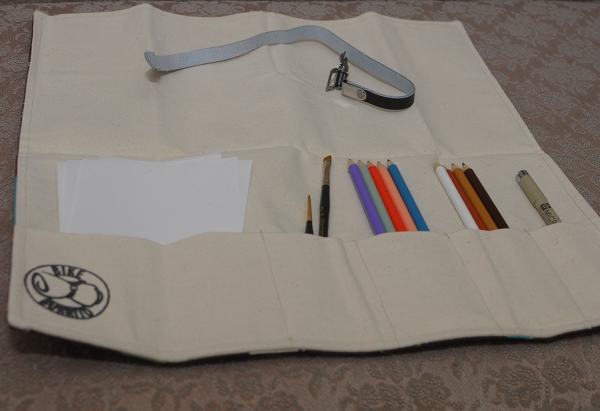
And while trades can be pre-determined and formal ("I'll give you my Item X in exchange for your Item Y"), they can also be a sort of reciprocal, whimsical gift-giving - like pen pals exchanging objects instead of letters: You send the person something you think they might like, and at some later point they do the same. There are no explicit arrangements or expectations, and that is the neat thing about it. I've had these types of exchanges with several bike people, and it's been really nice - my latest gift being the delightfully named "bike burrito."

These things have fascinated me for some time, so I was pretty happy to get one. It's called a "bike burrito" because - well, it folds up like a burrito.

...And unfolds to reveal compartments for your tools. (We all have different concepts of "tools!")

The "burrito" is held together by a toe-clip strap, which can be easily threaded through the rails under your saddle. With the "epic" winter we are having, it's safe to say that I won't be using it any time soon - but it deserves to be seen!

Connecting with other bicycle-loving people from around the world can be fun, and can lead to all sorts of exchanges you would not otherwise have. What are your thoughts on developing a system to facilitate this? Would you find it helpful? What features would be useful? Would simply using the comments section of a post be enough, or do you think it won't work without a message board? Ideas welcome!

Sunday, January 16, 2011

Brooks Colt: New vs Vintage

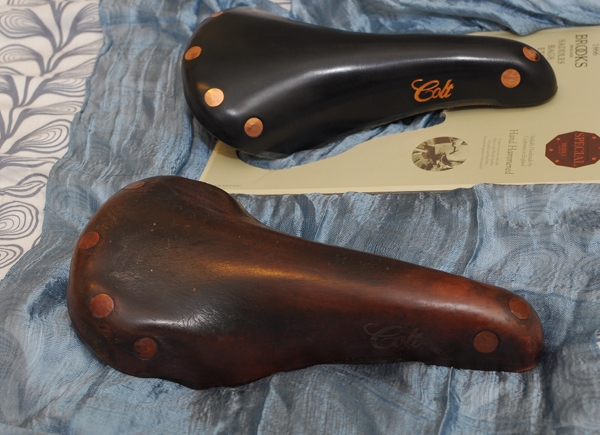
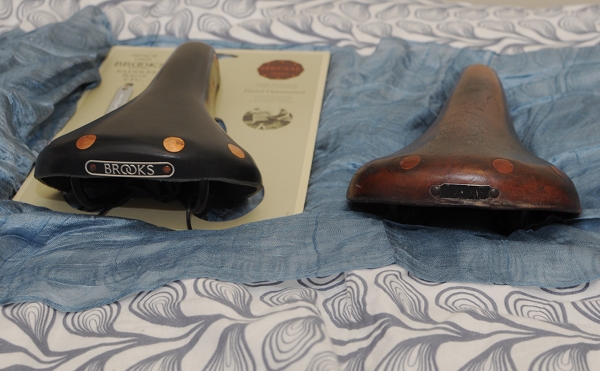
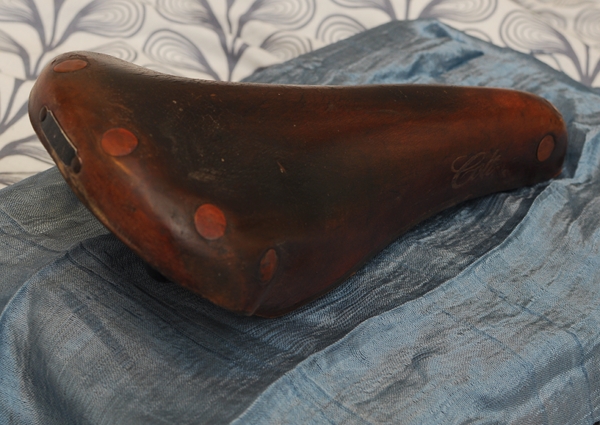
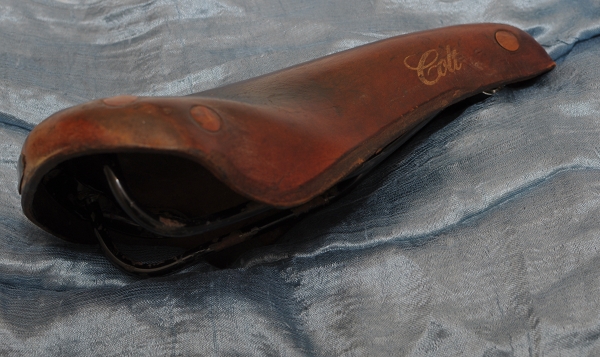
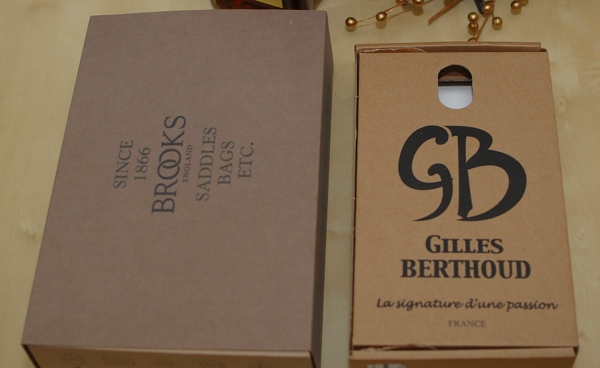
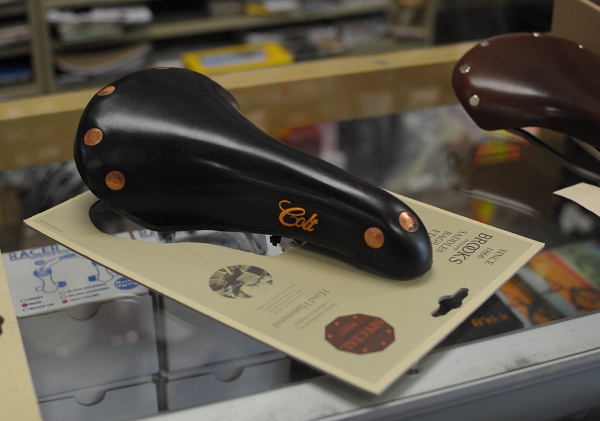
I have a new-release Brooks "Colt" saddle on loan from Harris Cyclery (for comparison with the Gilles Berthoud) and have just received a vintage "Colt" from a reader to try out as well. The weather we've been having has not allowed me to ride either of them just yet, but I thought a side-by-side comparison might be useful for those who are wondering how the re-released version compares to the original (produced 1979-2001).

What attracts me to the "Colt" model, is its shape, which in some ways resembles the Selle Italia "Turbo" and similar models of 1980s Italian racing saddles. Those saddles have fairly narrow (but not too narrow) platforms that gently curve in a way that feels very comfortable to me. But while the foam, plastic and padded leather surfaces of the "Turbo" style saddles start to bother me after a while, the suspended leather of the Brooks "Colt" should solve that problem.

Like the '80s Italian racing saddles, the "Colt" has a fully covered, squarish, down-turned nose. It is the only Brooks model where the nose is styled in this manner, and to me the design holds the promise of anatomical comfort. The new and the vintage versions of the "Colt" appear to be identical in form, dimensions and basic construction - differing only in colour, in the shape of the Brooks placket in the back (see previous picture), and, of course, in the amount of wear.

I have two roadbikes for which I need saddles, and I have more or less decided to keep the Berthoud for one of them. For the other, I would ideally keep the vintage "Colt," and return the new one. One reason I prefer the vintage version is the classic, rich brown colour (the only normal colour the new release comes in, is black - the other options being purple, mustard, turquoise and hot pink). The other reason, is that everyone complains about the "Colt" being difficult to break in, and the vintage version looks like it has most definitely been broken in by the previous owner.

On the other hand, the vintage saddle may in fact be too broken in. The colour variations in the leather make this difficult to capture in pictures, but basically the sit bone indentations from the previous owner are so deep, that a narrow, raised ridge has formed along the center of the saddle. There are several online tutorials that give instructions for re-shaping saddles that exhibit such distortions, and I am considering doing this. The process (as described by Hilary Stone) basically involves getting the saddle wet, then stuffing it with paper and reshaping it as it dries. Curious about the experience of those who have tried it!

Thursday, January 6, 2011

Gilles Berthoud Saddles: Something Different Entirely!

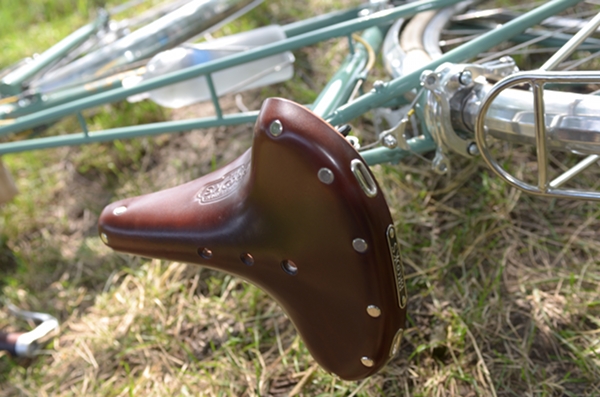
When I started having problems with the width of the Brooks B17 on my roadbike, I received many excellent suggestions from readers. I also received a suggestion from several staff members at Harris Cyclery: a Gilles Berthoud. Bethoud saddles and luggage are made in France and are associated with exquisite randonneuring bicycles. It is generally agreed that their handlebar bags are the finest one can get, and several respected members of the industry describe the saddles as being "even better" than Brooks. However, I was both skeptical of that description and weary of the high price tag. When I returned to Harris Cyclery the following week, I still had not decided what saddle to get, and they suggested that I try the Berthoud and see what I think. So I now have the saddle on loan, and have ridden with it on my Bianchi roadbike.

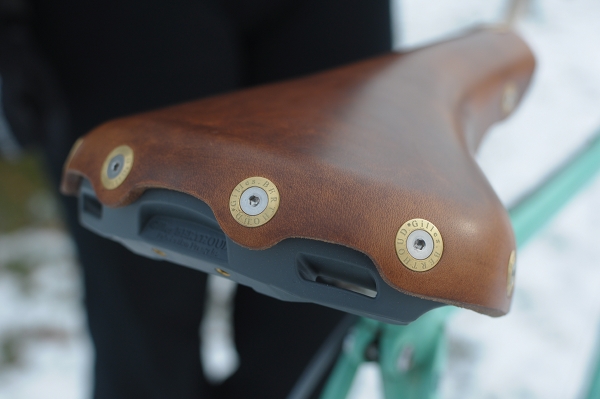
The saddle I have is a Gilles Berthoud touring model, which is available in three different colours (black, natural and cork), with regular or titanium rails, and in either a man's or a woman's length. Mine is the woman's version, which is the same width as the men's (160mm), but with a shorter nose. You can read the detailed specs for these saddles here. The woman's model is called the "Marie Blanque"- after a short, steep climb in the French Pyrenees.

The Berthoud differs from Brooks and the other leather saddles available today in several ways. The leather is stretched using a different method - a modular system involving bolts instead of rivets. This system allows for the saddle to be taken a part and also for more control over tension adjustment. The leather is somewhat thicker than that of other brands.

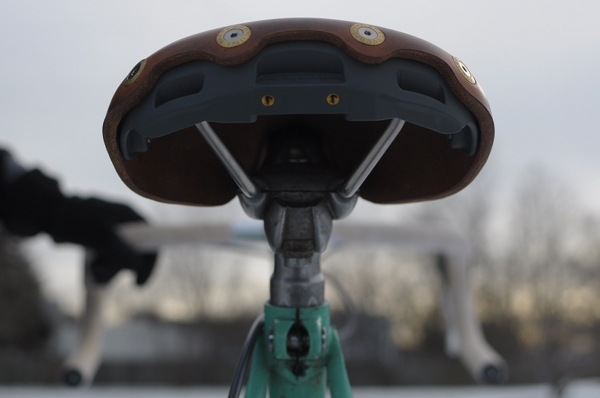
The undercarriage consists of metal rails combined with a polycarbonate (plastic) rear support, which accommodates the proprietary Berthoud "Klikfix" saddlebag attachments. The openings can probably also be used with standard saddlebag straps, though I have not yet tried to attach one. This aspect is where the Berthoud saddles receive most of their criticism: "Not only is the saddle more expensive, but it has plastic parts?" However, both Berthoud and fans of the saddle insist that this construction method is superior in terms of comfort and adjustment possibilities, and is not prone to failure. I am cautiously open-minded on this, and would be curious to know the statistics of Brooks vs Berthoud saddle failure.

Another distinct feature of the Berthoud's design, is that the bolts (not rivets) are located behind and below the surface of the saddle - so that the cyclist's rear end does not come in contact with them no matter how far back they sit. This will make a huge difference to those who are bothered by the texture of the rivets on other leather saddles.

Finally, the very shape of the saddle is different than what I have gotten used to from Brooks. The Berthoud's surface platform is completely flat, whereas the surface of Brooks has "undulations" to it (some call it the "banana shape"). As a result,  the Berthoud works best when mounted completely level - whereas I mount the Brooks with the nose pointing slightly up, in order to not slide forward.

An additional difference, is the Berthoud's relative lack of "side skirts" (compare it to the Brooks here). Despite being classified as a touring saddle, the leather on the Berthoud is closely trimmed along the sides - typical of a much more aggressive saddle in the Brooks range.

My experience riding on the Berthoud is limited to a short (12 miles or so) winter ride, but here are my impressions so far: The saddle felt "just right" out of the box and I simply forgot about it once I got on the bike and began cycling (no padded shorts). Because the Bianchi is a bit big on me, I am leaned forward on it considerably. The saddle did not feel too wide (it is 10mm narrower than a lady's Brooks B17) and my legs did not rub against the "side skirts". Because the Berthoud is level, the nose does not come into contact with any sensitive areas. With Brooks road saddles, I need to make a lot of adjustments to get this aspect just right - but the Berthoud seems to naturally stay away from that region. As I was cycling, I was not so much experiencing any of this, as not experiencing anything. I was taken with the winter scenery and genuinely forgot that I was supposed to be trying the saddle and forming impressions of it. There were no impressions, and only later did I realise that this in itself meant that the saddle was comfortable.

I have to admit that I am "emotionally biased" towards Brooks, which is an obstacle to recognising that the Berthoud suits me better - at least on roadbikes with considerable forward lean. The Berthoud basically gives me the width of a touring saddle with the side cut-outs of a racing saddle - plus the shape does not interfere with my "lady areas". In that sense, it is also more versatile, and I can see myself using it both on a touring bike and on a more aggressive roadbike. All this is exactly what I need.  But... a $200+ saddle? I suppose that if I sell my spare Brooks B17S and the titanium-rail Brooks Finesse that I received in a trade but find unridable, that would give me the funds. But it still feels like an overindulgence and I need to think about it. Regardless of whether I keep the saddle or not, I hope this write-up was helpful to those considering a Berthoud.
Monday, December 13, 2010

The Skinny on Narrow Brooks Saddles?

I did not think this would happen to me in a million years, but the Brooks B17 saddle that is so blissfully comfortable on my touring bike - is now apparently too wide for me on my fixed gear roadbike. I kept lowering the handlebars on that bike (isn't it funny how our ideas of "what feels comfortable" can change?), until they've become considerably lower than the saddle. As a result, parts of my inner/rear thighs have begun to press into the hard edges of the saddle uncomfortably as I pedal. This never used to happen when the handlebars were up higher, so "saddle too wide" seems like a reasonable diagnosis.  Just when I thought that the B17 was my "perfect" default saddle for roadbikes, I guess I am proven wrong. 

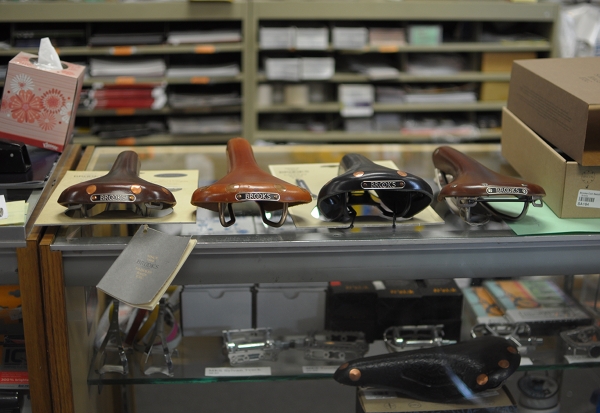
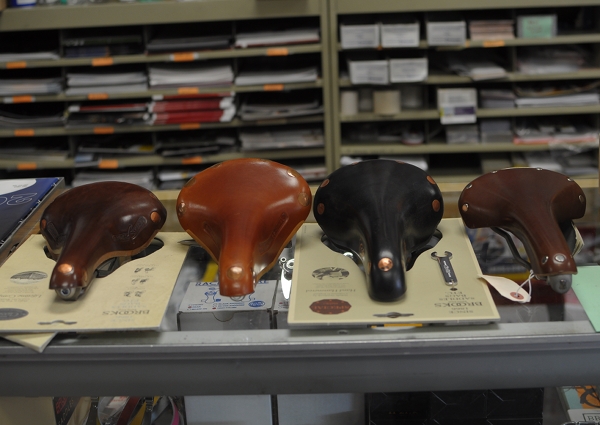
I am completely lost when it comes to choosing a narrow saddle, and the Brooks classification system is not helpful. Even examining them all side by side (at Harris Cyclery) was more confusing than informative. Left to right, these are: the Swift, the Pro, the Colt, and the Swallow. I imagine the box of kleenex on the left is for clean-up, lest customers drool on the saddles. Or cry about not being able to afford them.

More frustrating still, is the fact that, once you get into the narrower-than-B17 territory, nobody seems to agree about what's comfortable. Some say that they ride the Brooks Pro exclusively and love it. Others say that the Brooks Pro is "unrideable". Reviews of the Swift and the Swallow are equally mixed. From what I read, I am beginning to think that as a lighter cyclist (125lb) I may find it especially difficult to deal with these saddles, as they tend to be harder to break in.
One model I am considering is the new (re-released) Colt. The width is similar to the Pro, but the nose is pointed down, like on these 80s racing saddles. I have tried a couple of the old vinyl and foam saddles in that style, and found their shape surprisingly comfortable (though not the material they are made of). I am not sure what the actual purpose of the downpointed nose is, but it sure is female-anatomy-friendly, which is why I am considering it. The Brooks Colt has been out for a few months, but I have not found any substantial reviews of it. The hard-as-a-rock surface does give me pause.

While Brooks saddles are fantastic when you find the right one, they are just too expensive for me to experiment with. I am open to other brands as well, though in my experience I don't do well with anything other than suspended leather. Maybe some of the imitation-Brooks that people consider "flimsy" might actually work for me, since they break in faster. Any suggestions - keeping my weight in mind - would be much appreciated.

Monday, November 22, 2010

Colour Theory for Bikes

As someone who deals with colour all the time - taking pains to get it "just right" for paintings and photography setups - I am fascinated by the role of colour in bicycles. Choosing colour is not just a matter of "what matches what." It is a matter of understanding the psychological mechanisms involved in human colour perception and processing - which to me has always been interesting. But taking it down a notch from the realms of art-speak and neuro-psychology, here are some thoughts on colour choices as they pertain to setting up bicycles:

Handlebars and saddle
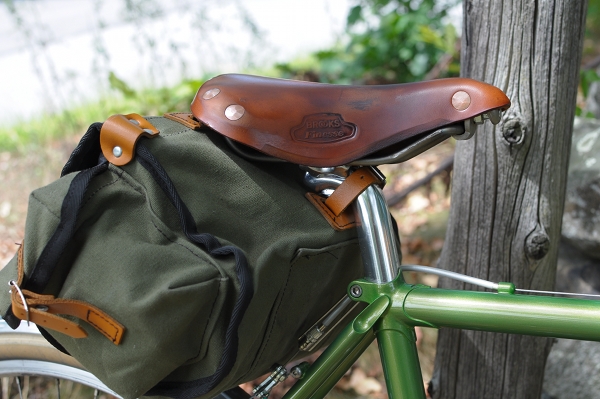
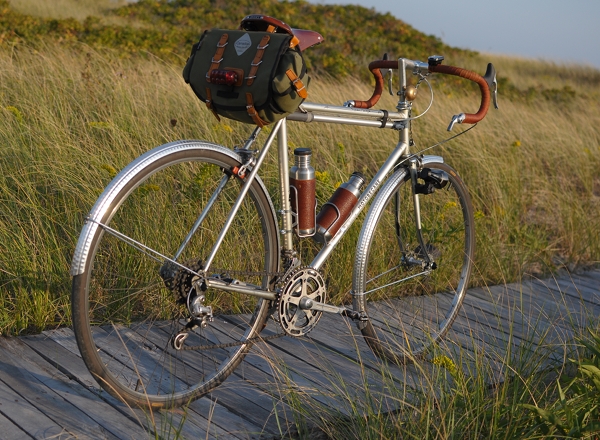
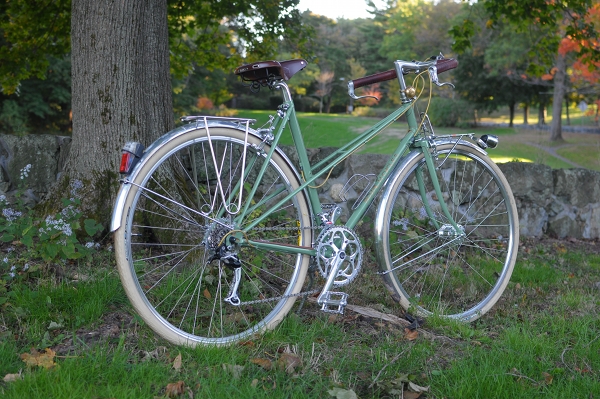
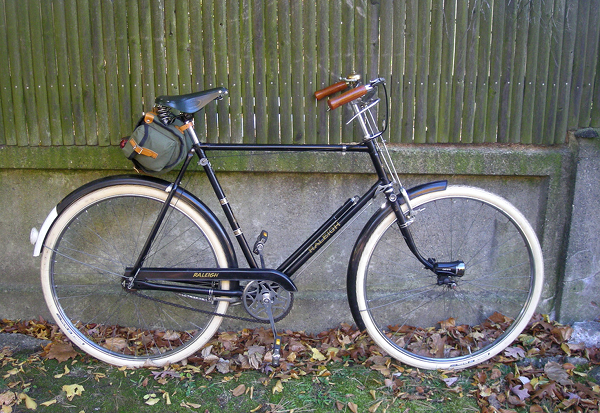
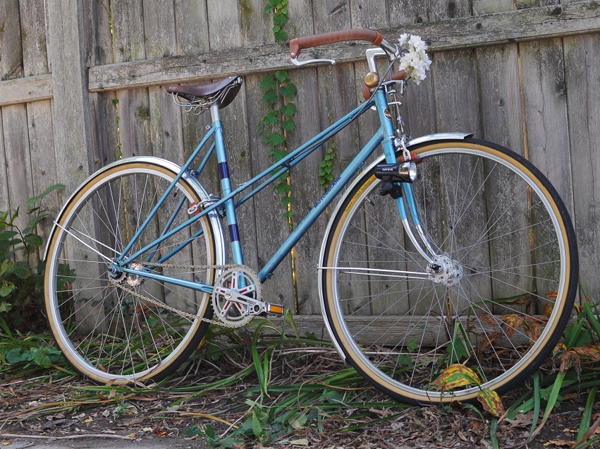
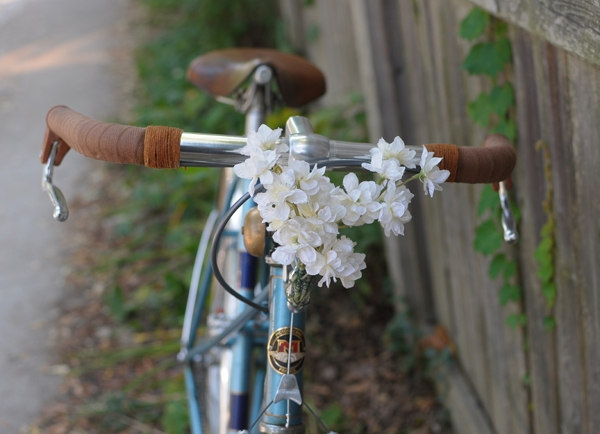
My go-to standard for handlebars and saddles is the brown family. The reason I like to use brown as opposed to black, is that brown enhances the colour of the bicycle frame, whereas black tends to "deaden" it. Being neutral, brown will not compete with the frame colour, just as black will not. But it will make the colour more vibrant, more emphatic - whereas black will leave it flat.

This works especially well on "cool" frame colours - such as blue and silver. And using twine and bits of leather on other parts of the bike (chainstay protector, kickstand, waterbottle, saddlebag straps) will further enhance the "warming" effect.

Brown can also make a black frame look less intimidating and more "personable" - as well as bring out the details in what would otherwise be an expanse of black-on-black.

But of course, black has its place as well. Black accessories make a bike seem more aggressive - which can look good on some bicycles. And depending on the "personality" of a particular bike (lady's military bike?), you might not necessarily want the frame colour to be overly vibrant.

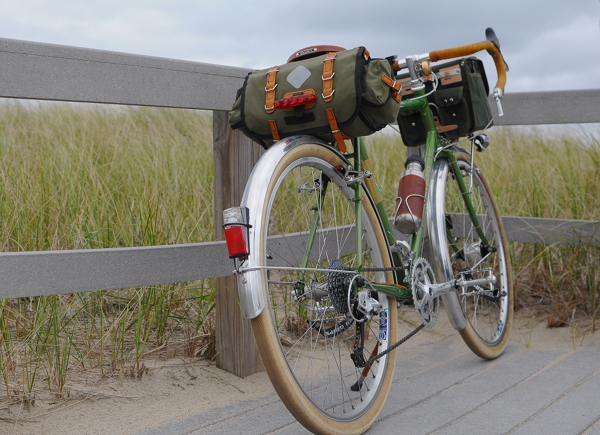
And when it comes to racing bikes, an aggressive or sporty look is usually more fitting than an "earthy" look. This can be achieved either with black, white, or brightly-coloured saddle and tape combinations (ideally in a contrasting colour to the frame). Bright and high-contrast colour schemes are exciting and suggest high energy, fast movement. If that is what you want your bike to communicate - go with it. And if not, you can tone it down with browns and neutrals, as I have done to this bike.

Tires
It goes without saying that performance and not colour should be the first consideration when it comes to tires. But assuming that you can get equally well-performing tires in a variety of colours, it can be nice to play around with that element as well. While I do not hide my crazed preference for cream tires, I do not suggest that they are "the best" option.

Cream tires can look elegant if you are going for a delicate look and have taken pains not to include any black on your bike. Here they make the bicycle look a lot more "serene" than had I used other tire choices.

And they can also look elegant as a contrast to the frame. But there comes a point - and for some it arrives much sooner than for others - where cream tires can be just too much and overwhelm the rest of the bike (I think that here I am dangerously approaching that). I also don't think that cream tires look good on a cream or white bicycle. It is too low-contrast and reminds me of "ghost bikes." Achielle does the cream-on-cream look better than others, and if you go in this direction adding prominent brown accessories to break it up a bit is the key.

A good, traditional option if you are looking for classic tires, are "gumwalls" - which are tires with back tread but tan sides. The tan fits nicely into the "organic" saddle and handlebar colour scheme, without the tires competing with the rest of the bicycle for prominence. I also like it how the alloy rims, the tan sidewalls and the black tread create the visual impression of 3 circles, one inside the other.

Bags and accessories
I am very conservative when it comes to bicycle "luggage," so perhaps I am not the best person to ask about this one. Mainly, I don't like it when bicycle bags are too distinct in relation to the bicycle itself - whereas the trend now (especially for accessories targeted at women) seems to be brightly coloured luggage with prominent graphics. It's not that I am "against" flowers, polka-dots, curly-cues, and the like. It's more that I want my bicycle to be the main focal point and not the bag. So I prefer to get subtle, classic accessories in neutral colours. As with saddles and handlebars, I think that the brown/olive family works well for a nature-exploring sort of look, whereas black works well for a more aggressive or racy look.

Decorations
Unless intentionally using decorations to distract from the rest of the bike, the colour of the decorations should not stand out too much from the other colours on the bicycle. Otherwise, the eye will get drawn to the decoration itself, with the rest of the bike an afterthought.

Frame Colour
If you are getting a bicycle frame re-painted, or are trying to choose a colour for a custom bike, the colour selection is of course a matter of personal preference. But based on my own experience (and conversations with others), keep a few things in mind:

1. Speaking very generally, super-bright colours work better on sporty bikes, whereas subdued colours work better on touring and transportation bikes.

2. True white is very harsh and almost never looks good. Even if a bicycle you like appears white to you, the actual colour is almost definitely a pale cream, a very light gray, or an off-white. Think twice before asking for a true white paintjob.

3. If you are getting the paintjob (especially powdercoat) done at a "budget" type of establishment, beware of asking for metallic colours. They are easier to mess up, and flaws in them are more visible than with regular colours. Flaws in lighter colours are also more visible than flaws in darker colours.

4. Prepare yourself for the fact that the colour never, ever looks the same on the bike as it does on the tiny colour chip, let alone on the online colour sample. I have seen some pretty amazing discrepancies, where after the person spends a month wringing their hands about the "perfect" shade, the colour on the bike does not even look like the same colour family as the chip they chose. One thing you can do, is give the painter a sample of the colour you want and ask them to find the closest match. They have experience with the way the colours actually looks on a bike. Alternatively, you can find out the colour code of a bike you like, and ask for that exact one.

There are those who take bicycle aesthetics very seriously and start to pull their hair out in despair if they cannot find the exact shade of orange handlebar tape they wanted. And there are those who could not care less about the details, and just use whatever components and accessories are available. I see myself as somewhere in the middle, leaning perhaps just a tad towards the former. (What? You think it's more than just a tad?...) While I enjoy setting up my bicycles in a way that is aesthetically pleasing to me, I do it quickly and intuitively, without dwelling on it too much. Then I ride the bike and get it filthy beyond all recognition - which is part of the fun, at least for me.