Showing posts with label Rivendell. Show all posts

Tuesday, June 21, 2011

Back and Forth: Lessons in Positioning

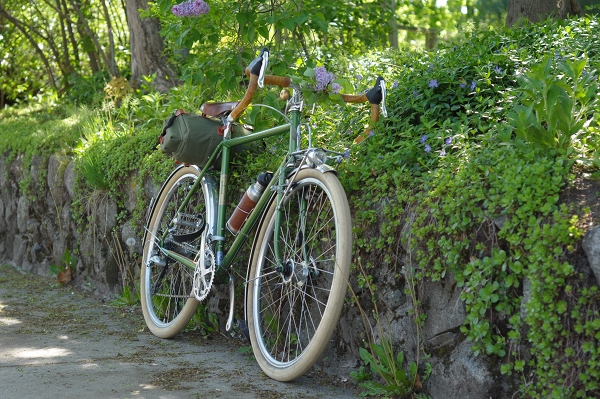
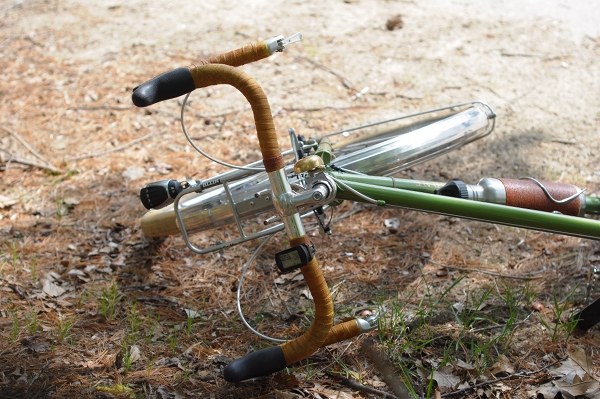
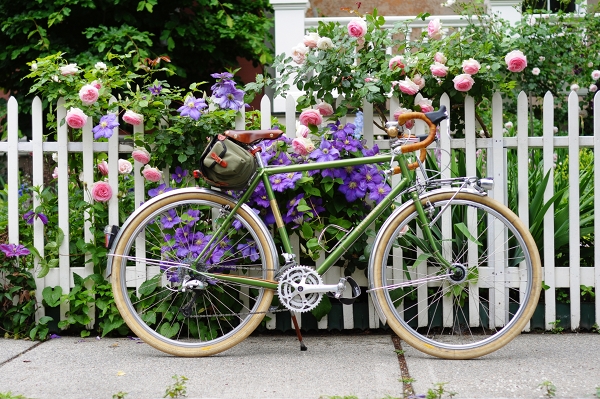
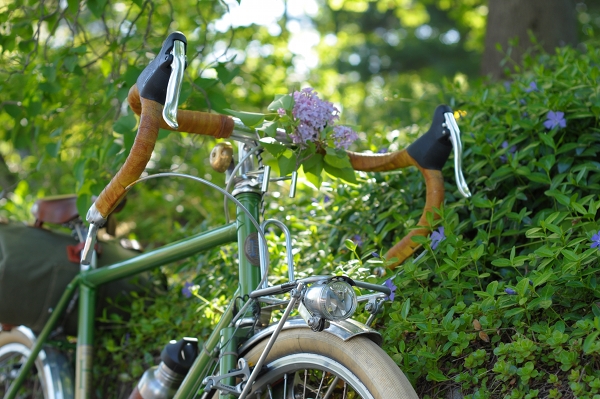
Last week I rode my Rivendell Sam Hillborne for the first time in three weeks after riding exclusively the loaner Seven on a close to daily basis. It's hard to believe that the body can adapt to one position so quickly as to find other positions unnatural. I confidently got on my bike, expecting that old familiar feeling of riding it to welcome me back. But I was in for a surprise. The ride was as comfortable as I remembered, but everything felt off. It took me a while to understand what was wrong. Initially it was just a vague sense of not feeling as connected to the road and as much in control of the bike, which was disconcerting. As I kept cycling, I became aware that it was really two specific things: I felt that I was seated too far back, and that I wasn't out far enough over the front wheel. I kept wanting to shove my weight forward, and it was frustrating to feel almost as if I were sitting "behind" the bike. 
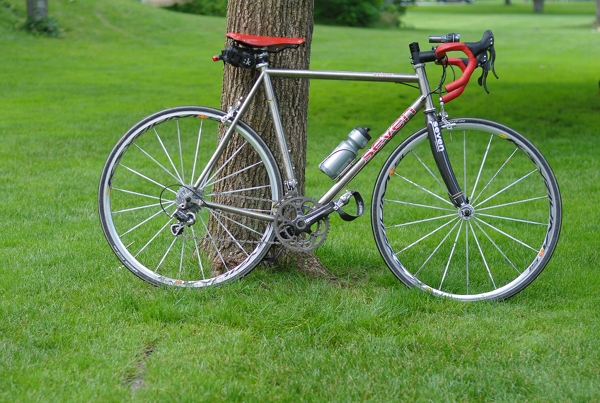
Looking at the way the two bicycles are set up, the difference makes sense. On the Seven, the saddle sits further forward and the handlebars are further out. I was aware of this difference before, but assumed that I would find the Seven's set-up aggressive and uncomfortable, while the Rivendell's set-up a welcome relief. Instead the Seven's set-up now feels "right" and anything deviating from it feels "wrong" - as if I don't have sufficient control of the bike. That feeling is hard to shake. I think my Rivendell needs a little make-over. 
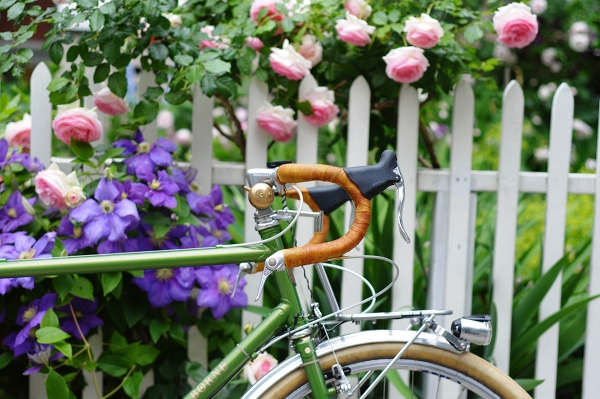
While moving the saddle forward is easy enough, changing the handlebar set-up will be messy, because I will have to replace the fairly short (6cm) stem with a longer one. When I fist began trying to ride with drop bars, I found it extremely difficult and a short stem was recommended to make the transition easier. I cannot say that it was a poor recommendation, because it worked. I rode with this set-up for a year, gradually becoming more comfortable with the whole idea of a roadbike, and feeling increasingly natural in a forward-leaning position. Some would look at my bikes and point out that my stems are too short, and I was perfectly aware that by most standards they are. But these things are highly personal, and last year I was concerned not so much with speed and agility, as with just being able to ride the bike. The way a bike balanced with a shorter stem felt better to me at the time. For what it's worth, I see many roadbikes from the 1970s-80s that were ridden by women set up with short stems. My previously owned vintage Trek had an even shorter stem than this bike, and that was the original owner's doing.
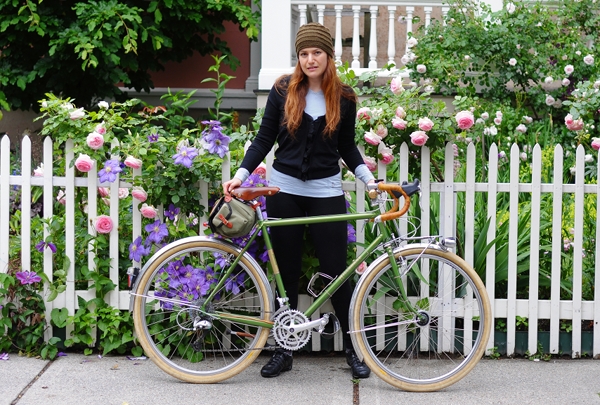
Going back and forth between the Seven and the Rivendell has been educational; each has what the other lacks. It is fairly clear to me that I "need" a lightweight, purely-roadish roadbike like the Seven and that I also "need" a wide-tired, befendered, dynamo-hub, luggage-bearing long distance bike like the Rivendell. I would not want to turn one into the other, or to combine them into something in-between. If I could make changes to the Seven, it would be to magically decrease its size. If I could make changes to the Rivendell, it would be to alter its positioning and to make it lighter. The former we will be doing shortly. The latter is not really possible without getting rid of the very things that make this bike practical. But I am very curious now whether it is the positioning, more than anything else that accounts for the difference in speed between the two bicycles. I am also wondering what the "ideal" stem length for this bike would be. The top tube is unusually long, so it would have to be 8-9cm tops. It's frustrating that experimenting with stems is not easy, but I will report the results of my trial-and-error fumblings. 
Saturday, May 14, 2011

Perfect Just the Way You Are

In describing my experience in a paceline training ride earlier, I had written that my Rivendell was not the right bike for that ride. Subsequently, I've received some suggestions for how to make it faster - including getting narrower tires, installing "brifters," removing the saddlebag, rack and fenders, and stripping off the dynamo lighting. While I appreciate the advice and agree that all of that may indeed improve my paceline performance, I do not plan to make any changes to this bicycle. Right now, I have a bicycle that is perfect for me as a touring bike. Why turn something that's perfect for one activity into something that's okay but not ideal for another?

In stating that my Rivendell was not the right bike for a racing team-sponsored paceline ride, I was by no means criticising it or expressing unhappiness with it. I was merely reiterating a simple fact: Touring bikes are not racing bikes.

A touring bicycle is about exploration and about experiencing one's surroundings. You cannot do that when cycling 6" behind someone's rear wheel at 20mph.
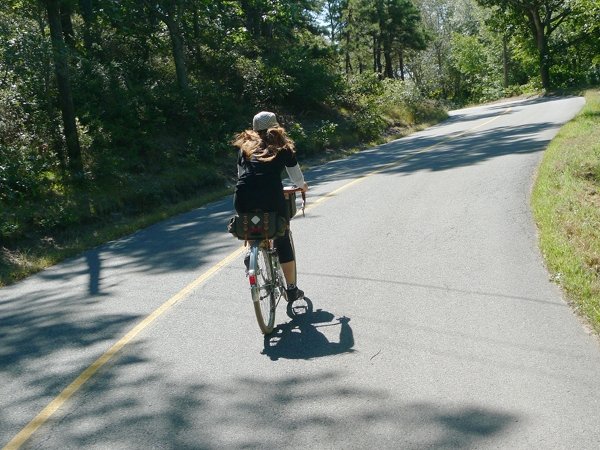
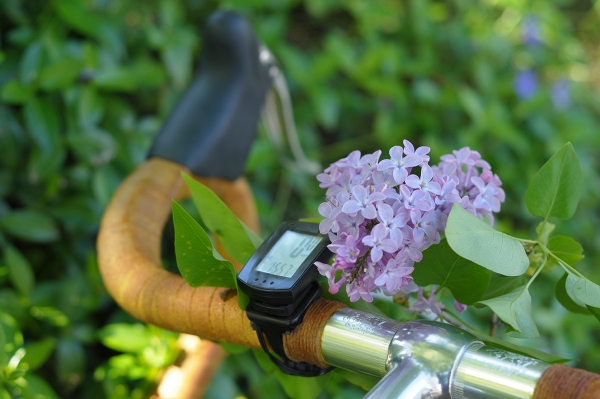
A touring bike is about the long haul and about going at one's own pace.  I use the computer as a handlebar-mounted clock and odometer more than I use it as a speedometer - because "how far" is a more interesting question for this bike than "how fast."

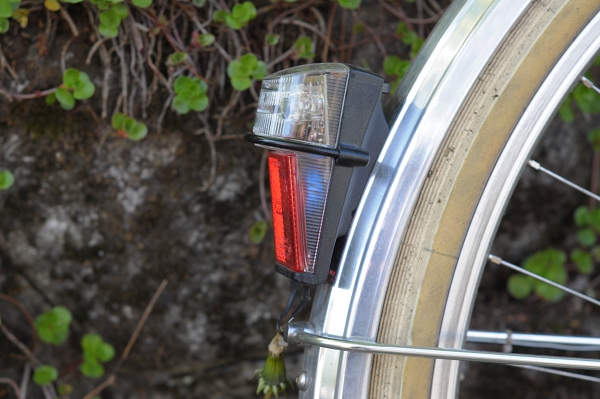
A touring bike is about the freedom of going anywhere, without having to cultivate the handling skills of a pro racer. Comfortable geometry and stable handling enable novice and experienced cyclists alike to ride. My bicycle is easy, and its wide, cushy tires make me immune to most of the fears that plague cyclists on modern roadbikes: potholes, rain, sand, uneven terrain - bring them on. I can even wear nice clothing while I'm at it, because the fenders will protect me from road grime. And with my bright, dynamo-generated lights I can cycle through the night and not worry about batteries.

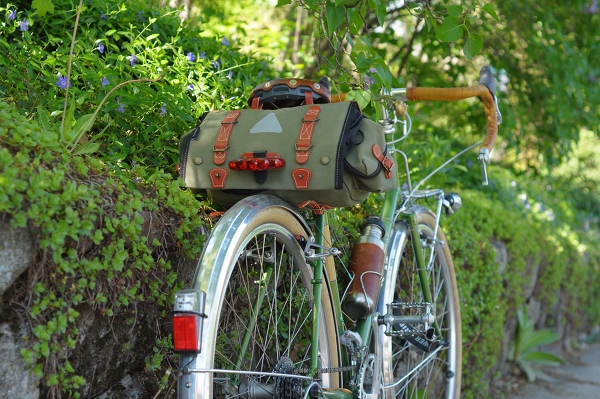
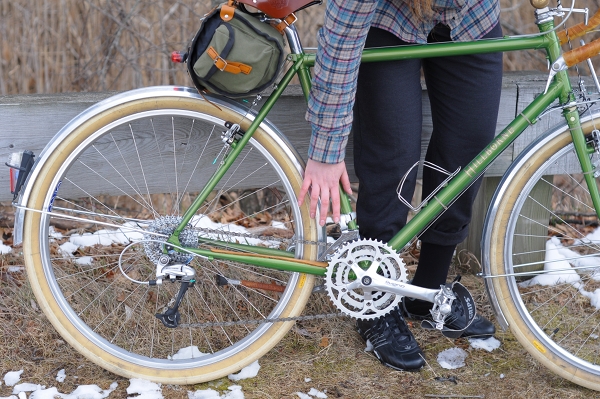
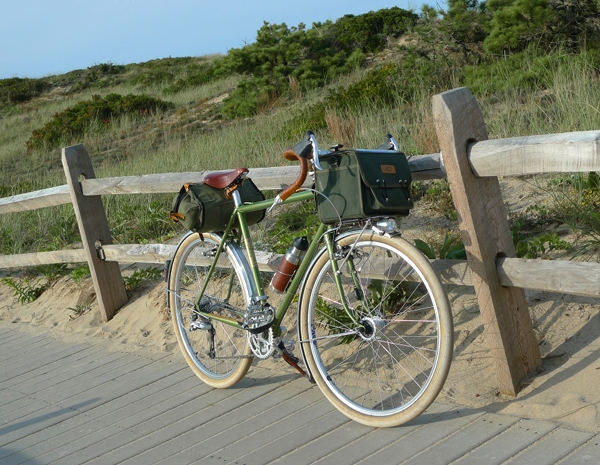
A touring bike is a home away from home. In my saddlebag, on the day this picture was taken I carried: a large DSLR camera, a sweater, a hat, an apple, a notebook, a fountain pen, a bar of chocolate, a saddle cover, gloves, sunscreen, a lock and a mini pump. And that's nothing compared to what I could have brought had I also attached my handlebar bag. Setting off on a racing bike limits you to a training ride and nothing more. On a touring bike a ride can start out as one thing and morph into another. Groceries can be involved, or a spontaneous visit to a friend's house. Who knows!

Riding a touring bike is an organic experience. My Rivendell's steel, brass, canvas, leather, twine, shellac and rubber fit harmoniously with its riding style and with my enjoyment of exploring nature. It is not about competing with nature with ever-more-efficient materials and aerodynamic postures, but about simply existing.

In turning this bicycle into a performance-oriented bike, I would essentially be giving up the very things that make it special. And that would be a shame.

Sure, we may be curious about pacelines and racing.

But not at the expense of smelling the flowers. Some bicycles are perfect just the way they are.

Monday, May 9, 2011

First Group Ride!

Yesterday, I went on my first group ride. Yes, there were only three of us and we're all friends. But those who were reading this blog last summer understand what an accomplishment this is for me.

Ever since I began to ride a roadbike, I've been whining about wanting to learn how to ride in a group... yet refusing to go on group rides. Yes, it was paradoxical. But you see, I wanted to learn the skills of riding in a group, while at the same time being afraid of it - convinced that I would perish in a high speed crash, images of the most gruesome bicycle race pile-ups flashing through my mind. I toyed with the idea of joining the women's training rides offered by a local cycling team, but ultimately the entire summer passed and I did not do it - opting for solitary rides and occasional rides with the Co-Habitant instead. I had to be coaxed into joining yesterday's ride, and I did try to back out as usual... but in the end something just clicked in my head and I went. And I'm very glad. Yes, I know you told me so!

My cycling partners were the Co-Habitant on his nearly-finished Surly Cross-Check (notice the fenders!) and our neighbour Somervillain on his vintage 650B conversion.

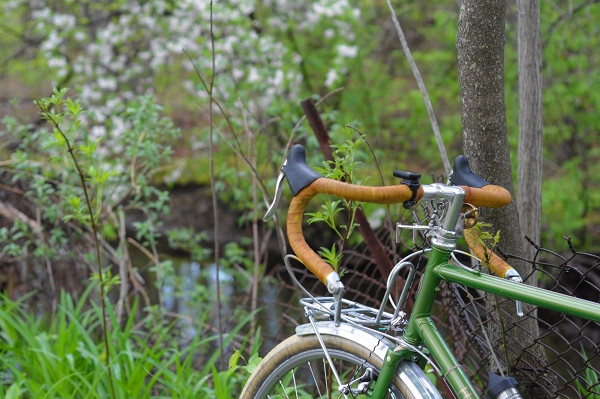
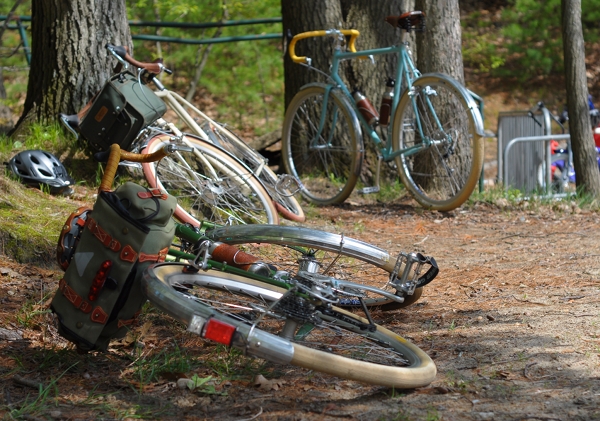
I was on my Rivendell Sam Hillborne. How happy he was to be out amidst the cherry blossoms!

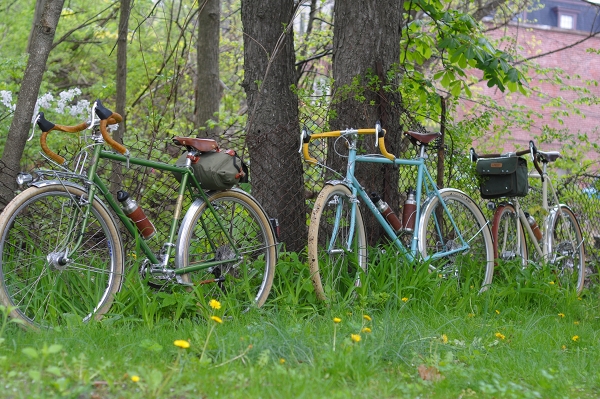
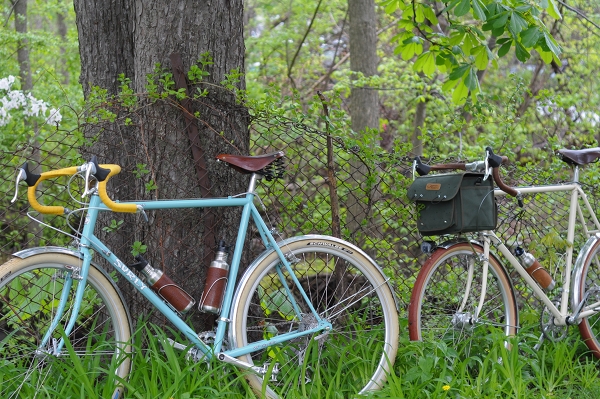
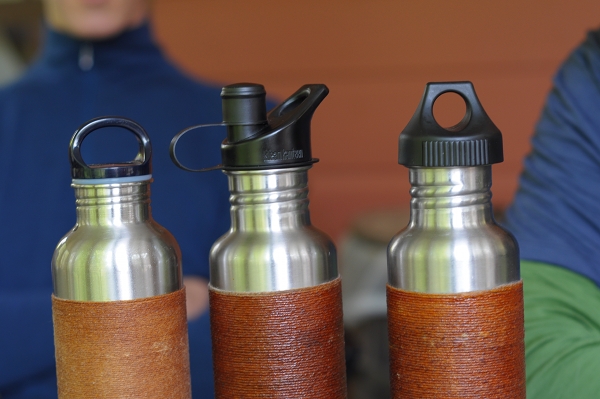
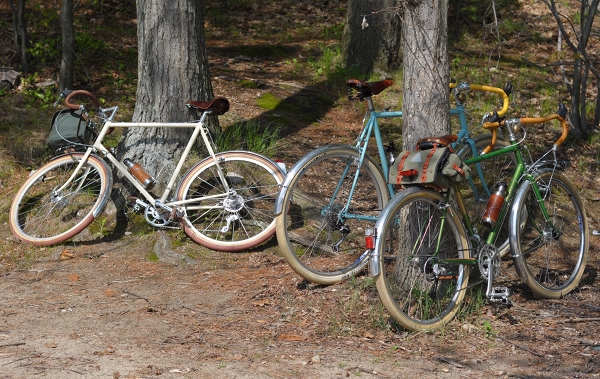
Though we were riding different bikes, the aesthetic was amusingly similar. We all had candy-coloured frames with fat tires, cantilever brakes, aluminum fenders, leather saddles, classic bar wrap, and even twined water bottles. All three of us were also wearing wool. We looked like a team of eccentric bicycle obsessionists. The plan was to go on a roughly 40 mile loop - starting on the Minuteman Trail, then going through the hilly parts of Lexington, and arriving in Concord, MA - where we would stop before returning along a similar route.

Any nervousness I had about the ride dissipated as soon as the three of us set off in city traffic on the way to the Minuteman Trail. I expected this to be stressful - keeping pace with the others while paying attention to cars and negotiating treacherous intersections - but instead it was easy. Easier than cycling in traffic alone and easier than cycling in traffic with just the Co-Habitant. I still need to think this through in order to understand why, but possibly because three cyclists really do constitute a group in the eyes of motorists and are thus given more space. Maybe. Whatever the reason, it was great.

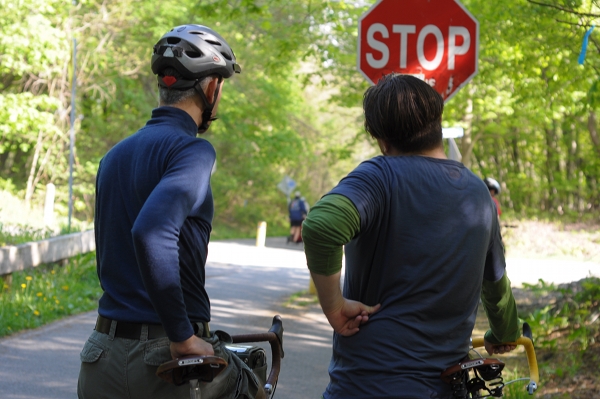
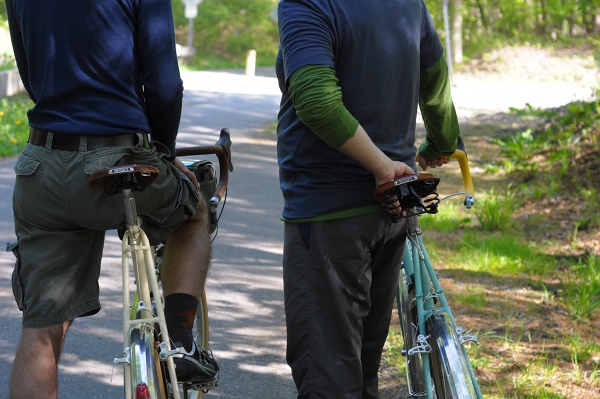
For the first part of our ride, we went in an unchanging single file procession - with the Co-Habitant first, Somervillain second, and me last. We cycled fairly closely behind one another, which I did not find problematic. It took me some time to get used to the rhythm with which Somervillain started from a stop, and to time my own starts the same way so that I wouldn't run into him. But otherwise, it was all very intuitive. I did not have trouble pacing myself to maintain the same speed consistently. And I also liked it that they hand-signaled every move they would make on the road. When we cycle alone, the Co-Habitant and I don't do this - which sometimes results in miscommunication.

We went along the Minuteman Trail at 14-16mph, then headed for the hills in Lexington. We've had an especially long winter and rainy spring this year, and I had not done major hills like this since last Fall. I was physically unprepared for them. I also forgot how steep and long this one particular hill was. We began climbing it, and almost immediately I was spinning in a low gear and my speed dropped to 7mph. I just couldn't do any better. It was at this point that we dispersed, so that the stronger riders would not lose momentum. Somervillain took off uphill and the Co-Habitant followed him at a slower pace, but still faster than me. I eventually made it, but the climb was such a huge shock to my system that even the downhill decent that followed made me unable to catch up with them. As soon as the distance between us decreased, came another uphill and I would lose them again. While I found this frustrating, I also appreciated having a true sense of the differences in our abilities. And I certainly preferred them going ahead to slowing down for me - that would have made me feel excruciatingly self-conscious.  We cycled over a series of hills in a similar style - the distance between us decreasing on the descent, then increasing again on the ascent - until finally the elevation changes lessened and we were able to cycle in a single file again. I did not have trouble keeping up on flats and mild hills, so that was a relief. The day had been beautiful and sunny up until then, but now it started to rain, which was a relief as well. The raindrops cooled me down.

We stopped in the Concord town center to have lunch and coffee. The sun came out again by then, and the small town looked ridiculously picturesque - blue skies, green grass and cherry blossoms everywhere.

We filled up our water bottles.

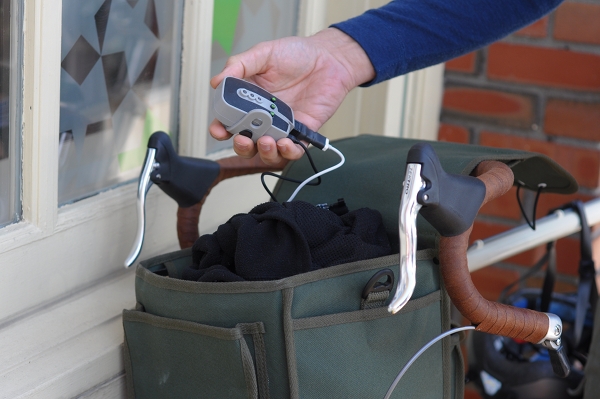
And Somervillain showed us his clever iphone-charging system.

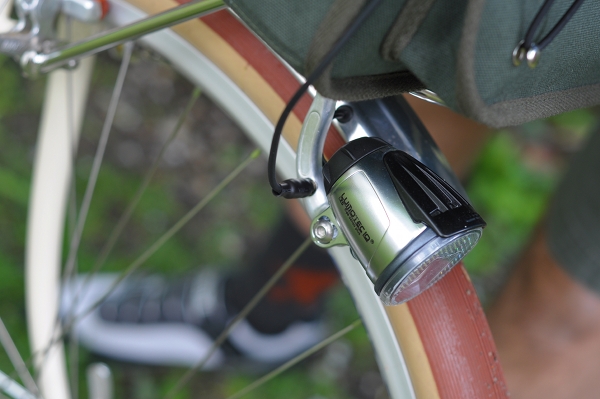
The socket is built into the light mount and derives its power from the dynamo hub. He made it himself. I don't own an iphone, but still want this on my bike!

At some point in the course of the ride, the Co-Habitant's brakes suddenly became stronger, solving his brake dilema. Looks like they just needed to wear in.

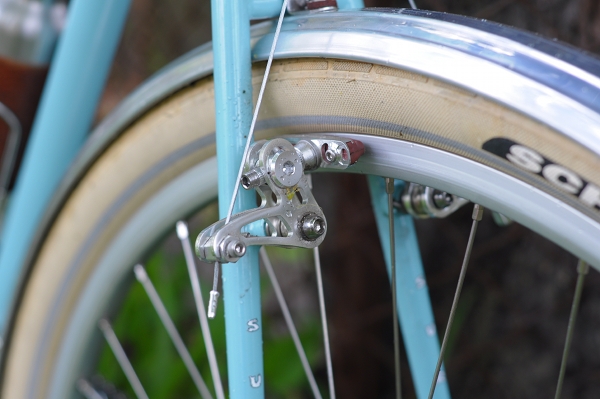
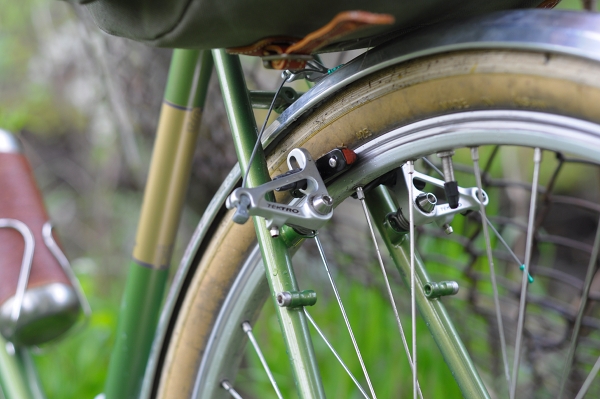
My writing skills are not strong enough to make the canti-comparison conversation that followed sound interesting, but I'll show you Somervillain's Mafac brakes.

And my Tektro brakes.  After a thorough examination of my bike, we may now have a diagnosis for my complaint about the drivetrain fussiness: bent derailleur hanger, possibly. So I will have to take care of that.

After the town center, we cycled a bit further and stopped by Walden Pond.

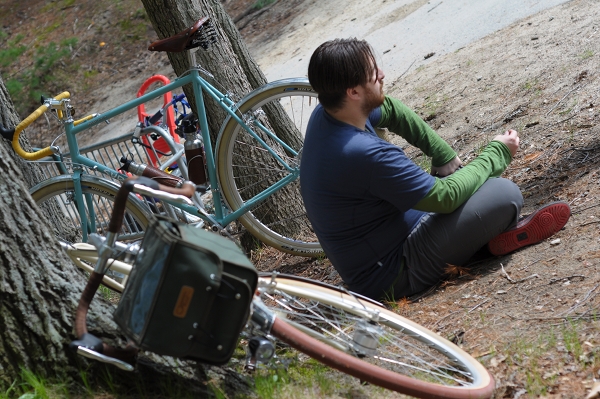
Even with lots of people there on a Sunday, it is still such a quiet, meditative place.

We chose a slightly less hilly route home, and the return part of our loop was more casual. We switched places in line frequently, and at times cycled in a cluster instead of a procession - all of which I was fine with. I got a sudden burst of energy on the way back and did not feel tired.

It is fair to conclude that my first group ride was a success. I enjoyed cycling in a procession at a controlled speed, and I did not have problems riding in close proximity to the others. I guess my sense of incompetence in this respect was exaggerated. The losing them on hills aspect I will have to work on, but I think it is to be expected given the differences in physical strength between us.

I looked up the schedule for the women's training rides this summer, and the first one of the season is this Tuesday - tomorrow! Before I lose my nerve, I think I need to just force myself to show up. Will make my best effort - now off to shop for a certain required accessory!

Saturday, April 9, 2011

Doubling Down?

When I was specifying the build for my Rivendell Sam Hillborne just over a year ago, I had no experience with these types of bikes, and went with recommended specs for the major components. For the most part, this has worked out well - with the possible exception of the drivetrain. This Spring I would like to replace the Shimano Deore rear derailleur with the Shimano XT "Shadow," and I am also wondering, whether I would be better off with a double, instead of my current triple crankset. I've mentioned before that I find shifting on this bicycle to be somewhat high maintenance for my taste, with the front derailleur being especially difficult to get into that perfect position where it doesn't rub. I am given to understand that this is fairly typical for a "triple," and that if I want low maintenance I need to switch to a double crankset. With just two chainrings in the front, there is more room and less rubbing.

Switching my triple crankset to a double is something I am willing to undergo, as long as I can keep my current range of gears. This bicycle is used for hills, and I need to keep it that way. And while that is doable in theory, I am not sure what my options are as far as modern cranksets go. The chainrings on my current triple (Sugino XD2) are 46x36x2426 - so I would need to find a double crankset with just the 46x26 rings. Is that even possible? I know that it can be done with vintage-style TA cranksets, but I think I have a cognitive deficiency when it comes to understanding how exactly to buy those: It seems like every single part needs to be purchased from a different seller and they are all super-expensive and frequently out of stock. What other options are there? Someone has suggested simply removing the middle chainring from the current crankset, but I am pretty sure that's not how it's done. If you have a double with a wide touring range, I would love to know what your set-up is.
Sunday, April 3, 2011

When Simplicity Trumps Comfort

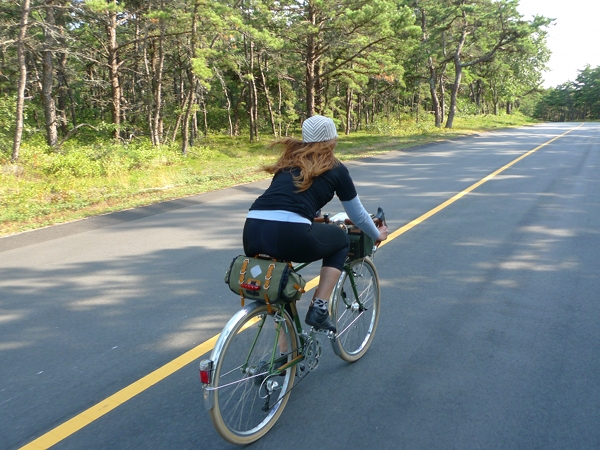
Will Spring ever arrive this year? Looking at all the new snow on the trail as we braved another "spring ride," I began to seriously doubt it. Nonetheless, my Rivendell is back in action after a long winter.

Now, here's an admission: Although the Sam Hillborne is super-comfortable, when it comes to shorter rides without major hills I've come to prefer a more pared-down roadbike. In fitting the Rivendell with a front rack, decalleur, handlebar bag and good sized saddlebag, we made a conscious decision to optimise it for long distance travel and exploration at the expense of simplicity. Though individually each accessory is fairly lightweight, all together they do add heft to the bike and make it more difficult to take in and out of the apartment. And I find it inconvenient to detach and reattach the bags depending on what kind of ride I am taking, so I would rather just leave them on.

I have a routine 30 mile ride that I do whenever weather permits, and on this ride my ideal bike would be a lightweight single speed (fixed/free flip-flop hub), with a tiny saddlebag and no fenders. Currently, my Moser and Bianchi share this role, with the Moser being the fixed gear and the Bianchi essentially acting as the freewheel singlespeed, since the 2x6 gearing is so unfinicky that it allows me to forget it's there. By contrast, the 3x8 gearing on the Rivendell feels cumbersome on a ride where I don't need to shift gears.

I am not the first person to experience the epiphany that "for fast and short rides I prefer Roadbike A, while for long and hilly rides I prefer Roadbike B." Still, I was surprised to feel myself developing this preference - particularly the single speed and no fenders part of it. There is something to be said for just being able to throw a bike down on the grass and not worry, for pedaling fast and not playing around with shifters. At times I value this simplicity and ease more than I value load capacity, gearing, comfort, and yes - even keeping my clothes clean and dry. There, I said it!

Friday, April 1, 2011

Uphill Momentum?

One distinct aspect of ride quality I've been noticing in different bicycles, is the way they retain (or fail to retain) momentum* when going uphill. I am pretty sure that this is a separate issue from the way a bicycle climbs hills in general, though I haven't found any literature addressing it specifically. But in any case, what I mean is this: Say you're cycling super-fast, either downhill or along a flat stretch, then suddenly in front of you is an uphill stretch and you take it at full speed. Initially the speed you've already attained will propel you, and only once you've spent that momentum will you need to switch into a lower gear or pedal harder. The point at which you lose the momentum depends of course on how much of it there was to begin with, as well as on how long and how steep the hill you are climbing is. But in my experience, it also depends on the bicycle - with some bicycles being better at it than others, aerodynamics and weight notwithstanding.

Take for instance, my formerly owned Pashley versus my current Gazelle - both of which are heavy, upright loop frame bicycles made of hi-ten steel. The Pashley seemed almost indifferent to momentum: It was not much easier on climbs after picking up considerable speed on a descent, than it was after starting from a complete stop. I could be flying downhill at 20mph, but as soon as I'd hit an uphill stretch, the bicycle would just stop dead. The Gazelle, on the other hand, retains momentum surprisingly well - soaring uphill if I manage to pick up sufficient speed. I have sensed this difference to various degrees in a variety of other bikes, and I want to make it clear that I am comparing like to like: roadbikes to roadbikes, upright bikes to upright bikes - so it is not a matter of aerodynamic advantage or weight.

Though I am fairly certain that what I am experiencing in this regard is real, I am not sure what accounts for it.  If it's in the geometry, then it must be something fairly subtle - as I am sensing a difference in bicycles that, in principle, ought to handle similarly. Have others noticed what I am describing? What do you make of it?

___

* I am using the term "momentum" here loosely and colloquially. From the point of view of physics, if all of my bicycles start riding up a hill at a particular speed, they will reach approximately the same point before they stop, slightly variable due to rolling resistance, weight distribution and aerodynamics. So, I am not using the term as it is used in physics (i.e. conservation of momentum, energy, etc.), but rather as shorthand to describe how each bicycle behaves while being pedaled uphill under my power after having first picked up speed.

Sunday, February 20, 2011

Choosing Your Gospel: Rivendell vs Bicycle Quarterly

For those who are interested in classic touring bicycles that combine speed, maneuverability and comfort, we live in interesting times. Such bicycles have gained in popularity over the past several years, with many custom framebuilders and manufacturers introducing touring models into their line-ups. And while trends like this are not easy to trace, I think it is fair to say that Grant Petersen of Rivendell and Jan Heine of Bicycle Quarterly deserve a great deal of the credit. Rivendell is a small bicycle manufacturer with a distinct philosophy, which they promote with a tireless output of literature. The Bicycle Quarterly (review here) is a niche cycling magazine, with a focus on classic bicycles in the French randonneur tradition.

To the untrained eye, the type of bicycle promoted by these two camps may seem similar, if not identical: lugged steel frames, wide tires, fenders, racks, classic luggage, leather saddles. But in fact, there are major differences as far as geometry and historical lineage go, and these differences have been inspiring impassioned debates among bicycle connoisseurs for years.

[image via stronglight]

When it comes to frame geometry, Rivendell's emphasis is on relaxed angles and clearance for wide tires. The resulting bicycles are fast, stable, comfortable, and have excellent off-road capacity. The bicycle championed by Bicycle Quarterly is rather more specific. Jan Heine believes that bicycles made in the French randonneur tradition - which had reached its height in the 1940s and 50s before its recent resurrection - offer an unrivaled combination of speed and comfort. These bicycles are aggressive and maneuverable, yet cushy and easy to control. They are super light, yet designed to carry a great deal of weight.  The main difference from Rivendell structurally, is that such bicycles have what is known as "low trail geometry" while Rivendell bicycles have "mid trail geometry." The difference cannot be easily summed up here, but suffice to say that this factor controls the bicycle's responsiveness, and that mid trail is considered classic whereas low trail is more exotic - not often seen outside the early French tradition. In addition, Jan Heine insists on wide 650B tires, lack of toe overlap, and integrated features such as racks and dynamo lighting. Grant Petersen does not place as much emphasis on 650B tires per se, considers toe overlap to be a non-issue, and does not take lighting into consideration when designing frames.

If these differences seem too subtle for those not familiar with frame design, let me rephrase it like this: The bikes may look similar, but they are built differently and ride differently, and there is some debate about which is "better."

[image via protorio]

As a reader of both Rivendell literature and Bicycle Quarterly, I am equally convinced by Petersen and Heine; both arguments make sense while I'm reading them. But they can't both be right, because some of their views are in direct opposition!

Since I own a Rivendell and have now ridden close to 2,000 miles on it, it would be fantastic to try a classic randonneur with low trail and 650B wheels for comparison. The problem is that these bicycles are extremely rare. To try one, I would need to either find a vintage Rene Herse or Alex Singer in my size to test ride - which is next to impossible, as they are not exactly the kind of bike a neighbour would have lying around in their garage, or commission a new one custom built just for me by the handful of framebuilders who specialise in them, or find someone who has commissioned such a bike, is the same size as me, and would be willing to lend it to me for a test ride. As neither option is realistic, my interest in classic randonneurs seems destined to remain hypothetical. Has anybody out there actually tried both a Rivendell and a traditional randonneur?

Saturday, January 8, 2011

Stealth Pantaloons: Clever Wool Trousers for Cycling

For some time now, I have been searching for "cycling pants" to be worn on a roadbike that look sufficiently like trousers. Regular trousers have seams in the crotch that start to hurt me after cycling for more than 15 minutes in a forward-leaning position. And women's trousers specifically tend to be quite form-fitting, which makes it uncomfortable to swing a leg over the diamond frame, as well as to pedal. I explored several possibilities for trousers that would work, but everything was either too sporty or had too much of a "cycling culture" look. I wanted something conservative and subtle. The "Stealth Pantaloons" from Clever Cycles seemed to fit the bill, and being my sponsors they graciously allowed me to try the pants before deciding whether to buy them. The pants ended up being just what I needed, and I have since purchased them.

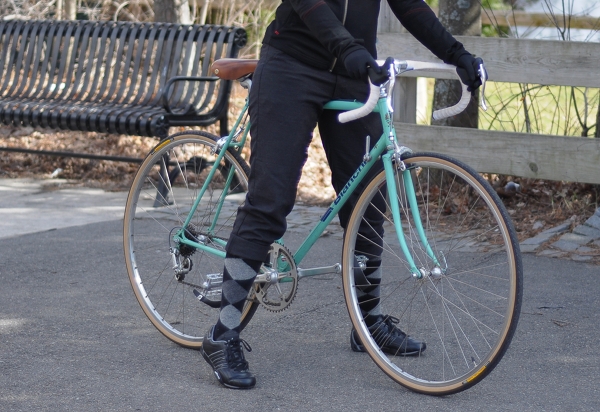
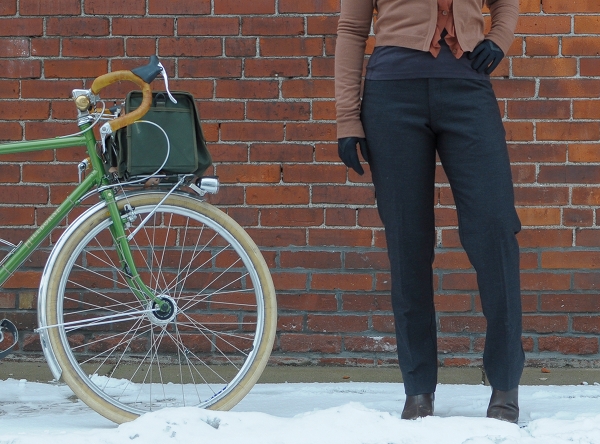
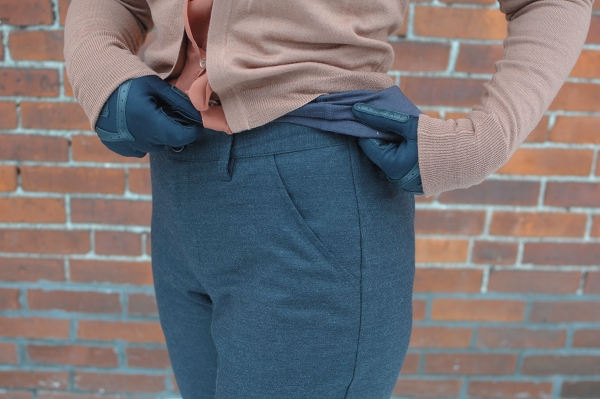
Upon superficial examination, the Clever Cycles "Stealth Pantaloons" look like regular trousers in every way. They are made of a lightweight wool and have a classic, straight cut to them that tapers slightly towards the ankles.

The cut is unisex, and after reading my MUSA knickers review Clever Cycles warned me that I might find some aspects of these not ideal for the female figure either. However, I found the "Stealth Pantaloons" to be reasonably flattering. For instance, compare the above picture to this. Not even in the same category.

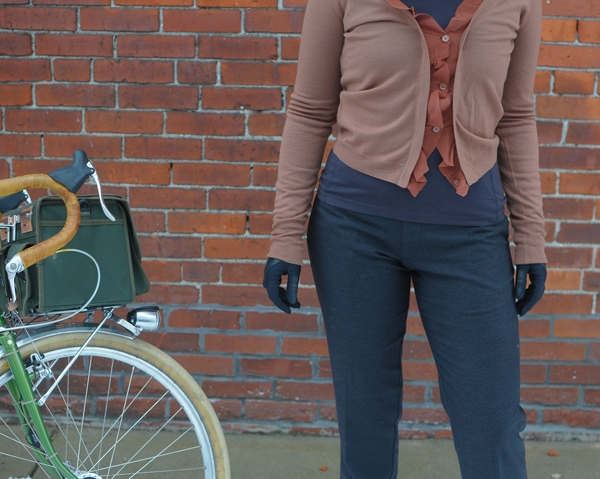
I am 5'7" and wear a US women's size 4.  I got the Stealth Pantaloons in size 30. They look form-fitting in the pictures, but in fact they are fairly loose in the abdomen, inner thighs, and below the waistband in the back - similarly to the Rivendell MUSAs. What's not similar, is that the wool fabric falls and drapes in a way where this is not noticeable. As a result, I can wear these pants with leggings underneath or without, and the fit will be flattering either way. The versatility is good for when the temperatures fall below freezing.

I believe the waistband is supposed to hit about mid-waist. However, due to the elasticised area in the back (picture below), I find this to be adjustable: I can wear the pants both high on my waist and low on my hips by simply pulling them up or pushing them down. Here they are shown relatively high on the wait.

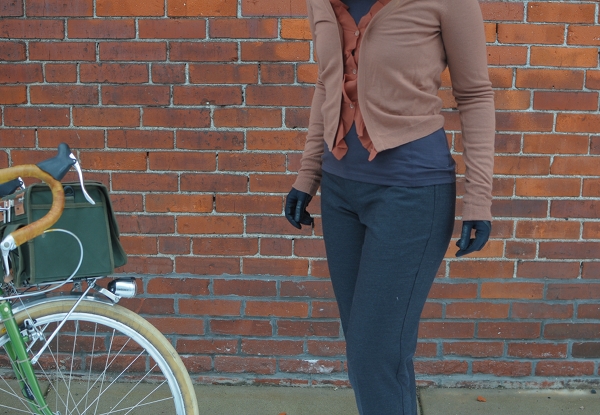
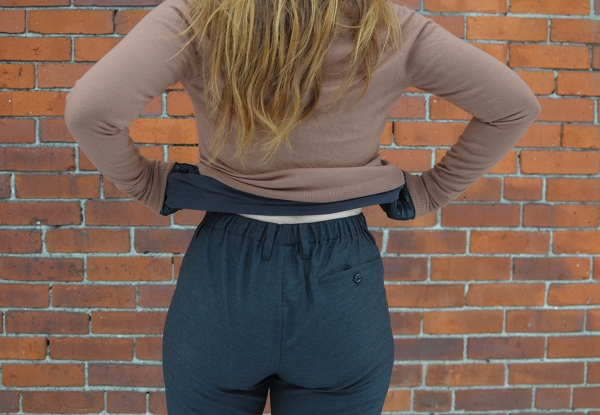
And here is the elasticised waist in the rear. This is the only aspect of the "Stealth Pantaloons" that is potentially unflattering to the female figure and it all depends on how you are built. The feature is useful in that it makes the fit versatile and prevents the waistband from digging into tummy fat when cycling in a leaned-forward position. However, it also detracts from the formal look of the trousers, and makes the fabric bunch up under the waistband. For me both of these problems are solved by the fact that I do not like to wear tucked-in blouses: My top covers up the elasticised area and the bunching underneath. If you like to wear your tops tucked in, beware. However, even with the elastic and the bunching, the look suits me better than this.

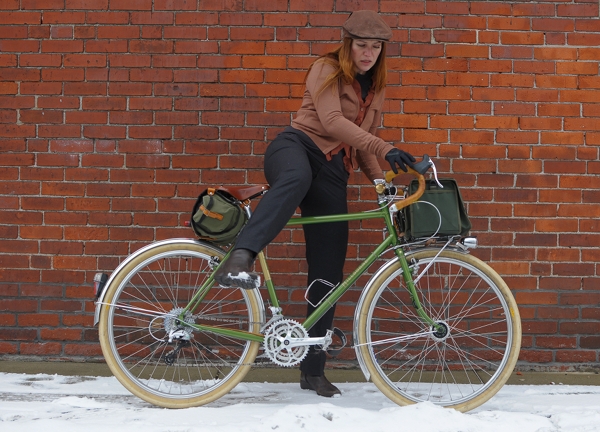
In addition to the elasticised feature, there is something about the fit of the "Stealth Pantaloons" that allows for unconstrained movement. I can mount a diamond frame while wearing without feeling any pulling at the seams. Same with pedaling or pretty much any motion. This is not typical of form-fitting women's trousers.

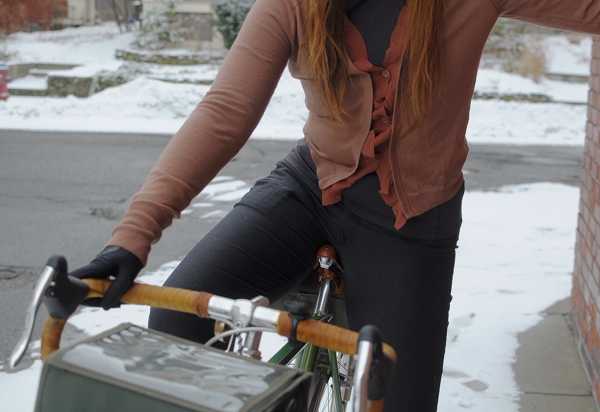
Another cycling-specific feature is the flat seam construction. The "Stealth Pantaloons" do not have a gusseted crotch. However, the seams are flat and do not cut into my "soft tissue" (crotch-related problems on a roadbike are an ongoing theme for me!) when I lean forward on the saddle. I have not gone on long rides with these yet, but I can usually feel seams right away once I am on the saddle, whereas these I cannot feel.

There is no bunching in the rear while on a bike, which is good.  As a woman with a smallish waist and an obscenely voluminous behind, I find it difficult to find even regular trousers that offer a flattering fit, let alone cycling-specific pants. The "Stealth Pantaloons" fit me better than I had imagined they would after the very cautious description I was given by Clever Cycles.  My experience may or may not be applicable to you, but I am happy. They are comfortable on and off the bike, they are all-wool, and they are a neutral colour. They can be worn with shoes, tucked into tall boots, or pushed up the calves like knickers. I am also told that they are fairly stain-resisant, though I have not yet tried this out. Oh, and today I was trying on a jacket in a clothing store and two women complimented the pants as they walked by. I am pleased with the purchase and might get another pair in black a few months from now.

---
Update 18 April, 2011: After 4 months of wearing the pantaloons, I have a few things to add to the review. On the positive side, the manufacturer's claim regarding stain resistance has held true so far: I have spilled coffee, tomato juice, various soups and other items on the pantaloons, and there are no visible stains. There is no visible wear on the pants so far despite my frequently donning them. I cannot feel the flat seams at the crotch on a roadbike even on long rides. On the downside, the pants have stretched out and become somewhat baggy, while I prefer a slender fit. I might try shrinking them intentionally in the wash.