Showing posts with label mixte. Show all posts

Thursday, June 30, 2011

Writing on the Wall

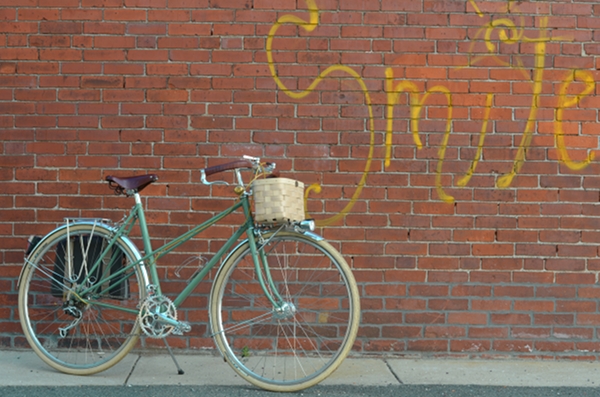
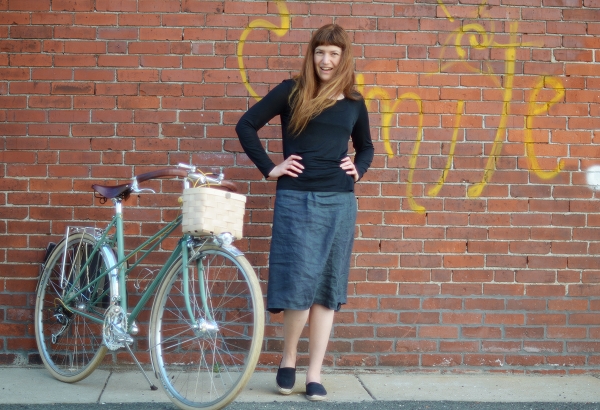
About a week ago, I left the house in the morning to discover the wall of a nearby building covered in graffiti. Screaming for attention with its searing yellow hue and the swirly sunshine dotting the "i" the graffiti tells the residents of our little neighbourhood to "smile." Very funny, we think. Smile because they defaced property? Smile because someone will have to spend time cleaning that up in mid-summer heat and humidity? Smile because this action rubs it in our faces that we are powerless to prevent others violating our living space?

Then a funny thing happens. As we continue to live with the graffiti (the building's manager has not had time to clean it up), the initial feeling of indignation recedes and we begin to take the message literally - to respond automatically to the word's actual meaning, instead of responding intellectually to the symbolic meaning of it having been spraypainted there. Smile! The vandal (artist?) has managed to elevate our mood in spite of everything.

I am not comparing cycling to graffiti, really I am not. But it is impossible not to notice that those who don't ride bikes often feel threatened and, yes, even invaded by the appearance of bicyclists and (gasp) bike lanes in their neighbourhoods. These are strong feelings that those of us who cycle can too easily dismiss. But look at it this way: If after some time a vandalised wall can make us smile because of its sunny message, then surely the fun of cycling can be contagious enough to override any hostility toward it as well.

Along the main street around the corner from our house, from 5 pm to 6 pm on any given weekday there is a continuous parade of cyclists traveling home from work. They are all sorts, and most wear their regular clothing - including women in colourful dresses and crazy footwear. Two years ago, not nearly as many cyclists rode through that street - a quarter of the number I see today, at best. There was also a lot of honking from drivers, hostile insults exchanged as a matter of course. Now it hardly happens at all. I see business owners sitting on the front steps and watching the cyclists as the sun sets. It really is a sight when so many different people pass through on their bikes; there is a festive feel to it.

Maybe our neighbourhood has internalised the bicycle as part of its character, as opposed to thinking of it as a hostile foreign body. Maybe drivers and cyclists both have decided to lighten up and smile.

Tuesday, June 28, 2011

Shorter Cranks, Dainty Pedals, and the Ambiguity of Toe Overlap

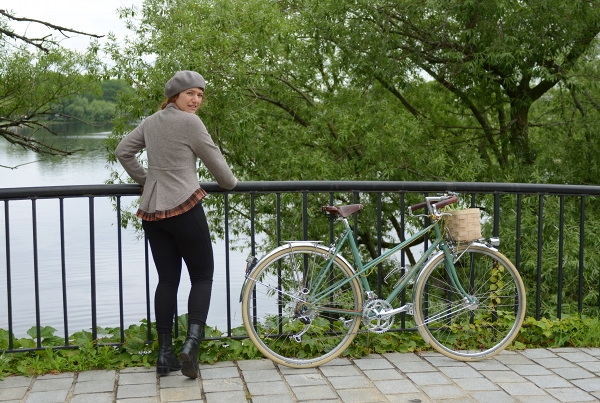
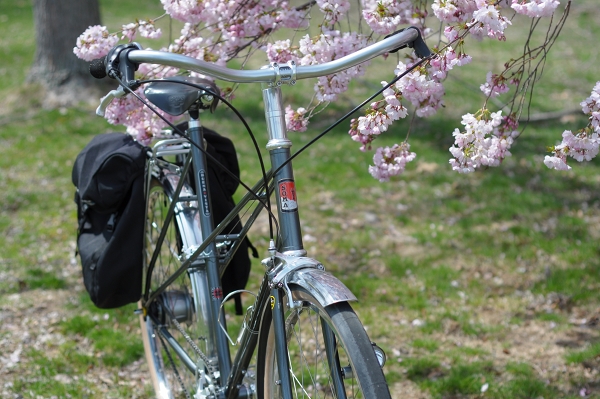
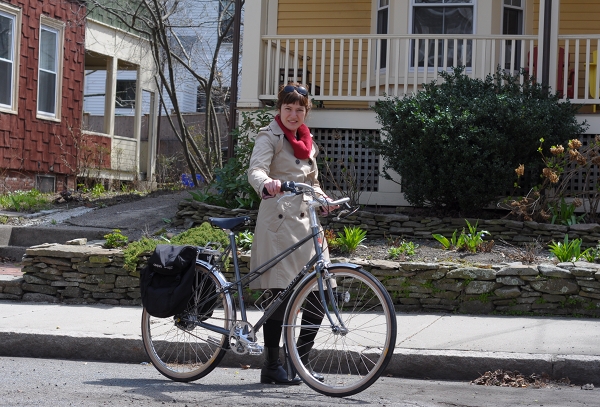
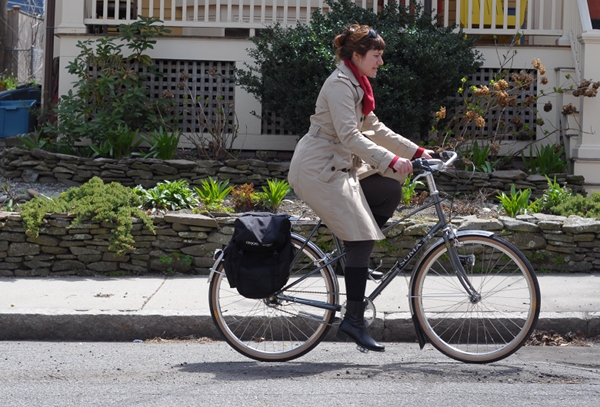
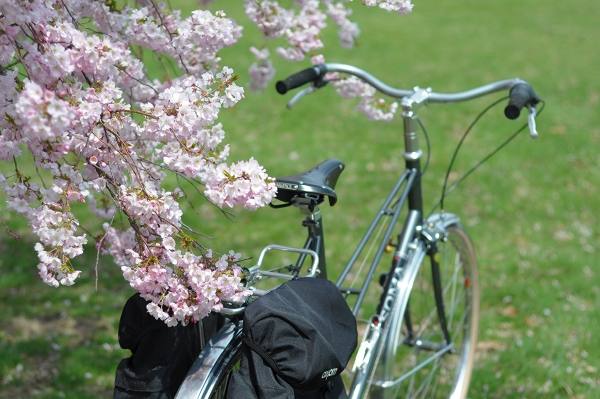
Last week I was offered the opportunity to trade the Sugino Alpina crankset on my mixte for the exact same model with shorter cranks, and I went for it. The original cranks were 170mm. The ones on it now are 165mm. A 5mm difference is very small, but can be significant. For instance, some say that shorter cranks make for a smoother pedal stroke. But my reason for the change was to reduce toe overlap. I mentioned previously that my mixte has it to a small degree, and that I'd like to get rid of it since I now use this bike mainly for transportation. In theory, that could be done either by converting to 650B or re-raking the fork. But before resorting to such drastic measures, I wanted to try something easier.

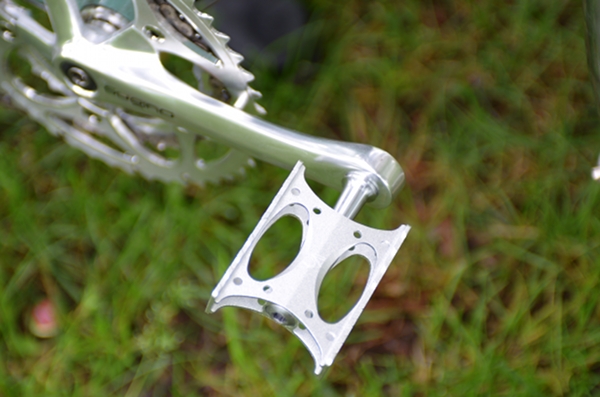
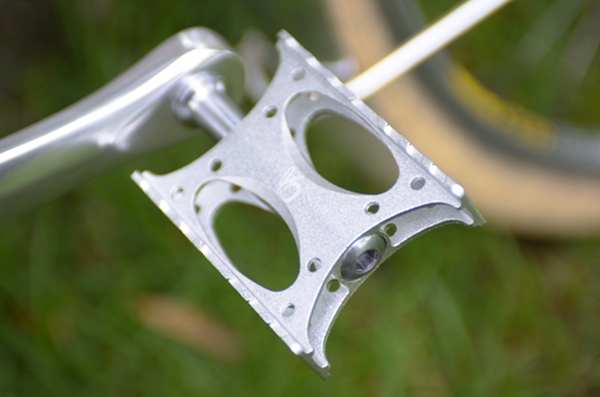
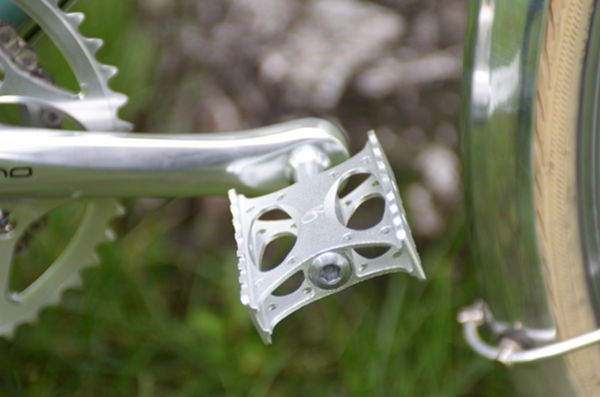
In addition to the shorter cranks, I also replaced the MKS Touring pedals with Velo Orange City Pedals. Being smaller, my assumption was that the new pedals would reduce overlap further still - though I am now told this isn't so.

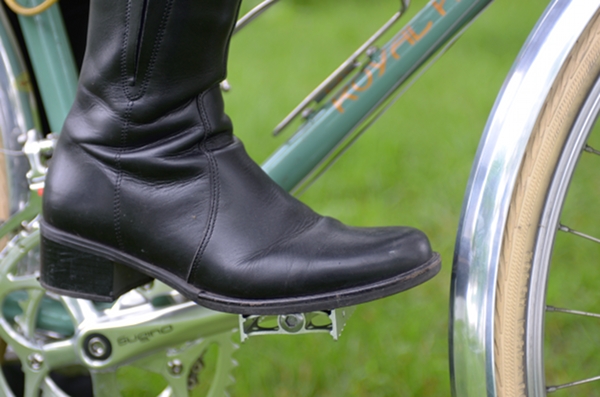
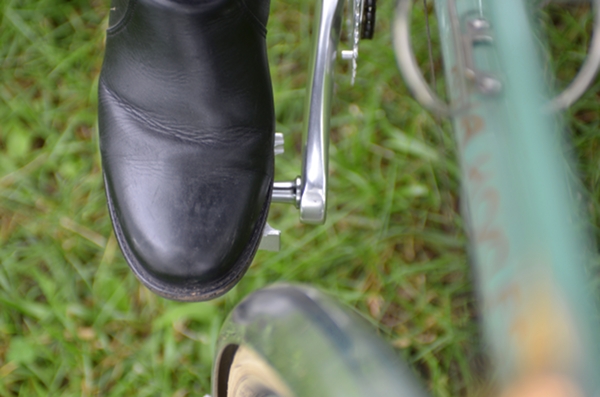
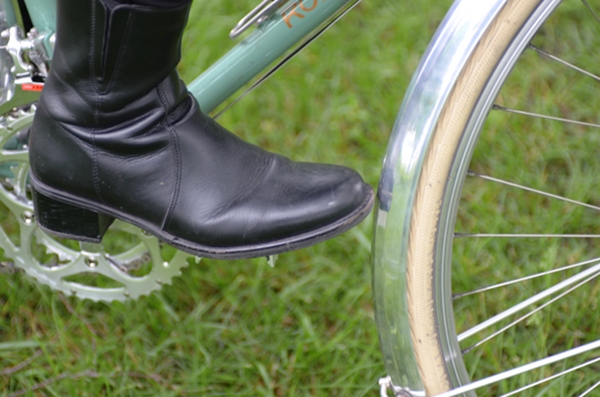
Either way, with the new set-up my toes are about 1/4" further back from the front fender than where they were previously. These are the longest-toed boots I own, and with my foot in its most typical position on the pedal there is no overlap even on the widest turn.

Aerial view.

But the thing about an upright bike that is ridden casually and with no foot retention, is that you can plant your foot on the pedal any which way. Sometimes I am sloppy, and plop it down further forward than typical when starting. In that sense, the toe overlap issue remains ambiguous. I need to ride around with this setup for a few weeks to see whether it still happens on occasion. I am not sure whether I notice any difference between the old cranks and the new ones, but it's possible that my pedaling feels a little "rounder." Or I could be imagining it, because that's what I've been told is supposed to happen. (Crank length placebo effect?)

As for the VO City Pedals, I absolutely love them so far. Ever since having tried them on the Rainbow Bike, I wanted them for myself. They don't stab my bare legs and toes the way MKS Touring pedals do, they are grippy, and they are extremely light (228gr per pair). It also does not hurt that they are pretty - though this, of course, is in the eyes of the beholder.

One caveat though, is that these pedals are very narrow (82mm across) and I have heard from a couple of people who find them uncomfortable for that reason. If you have large feet or tend to wear bulky workboots on your city bike, these are probably not the best choice.

So far I am happy with the changes I've made here, and together with the new basket the mixte has definitely turned into a transportation bike. The toe overlap was minor to begin with, so hopefully this will render it insignificant - but we'll see.

If you've ever played around with crank length on your bikes, did you notice a tangible difference? I have bicycles with cranks ranging from 165mm to 175mm, and they all feel fine, so I tend to use things like bottom bracket height and wheel size to determine what cranks a bike should have. But what do I know! Maybe with time I'll be able to tell the crank length of the bike I am riding just by the way it feels to pedal... though I remain skeptical.

Sunday, June 26, 2011

Basket 2.0

What luck I have. Beset by medical and dental problems simultaneously, the past few days have left me drained. We went for a super slow ride on Saturday, but even that was difficult to manage in my drugged up, diminished lung capacity state. But when we passed Cambridge Bicycle I knew there was one thing that could make me feel better. A basket. Of course. What better cure for life's woes?

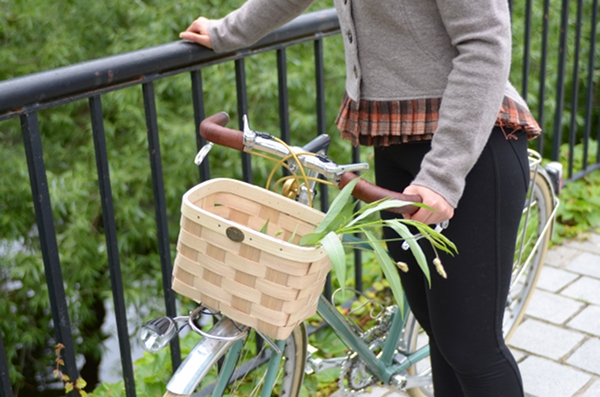
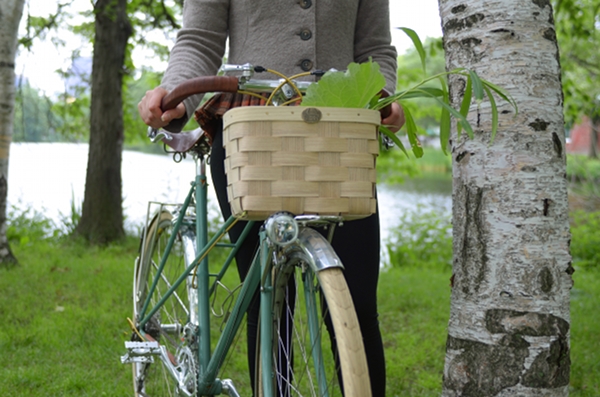
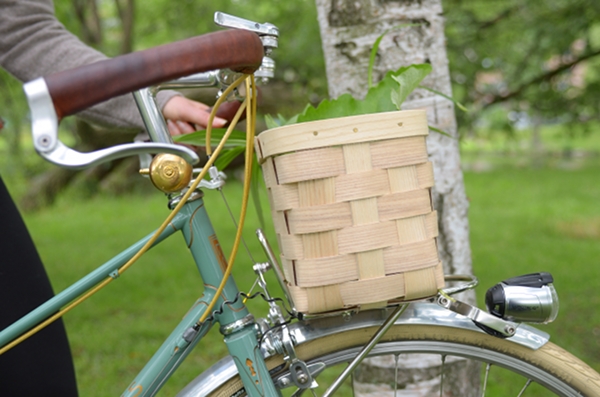
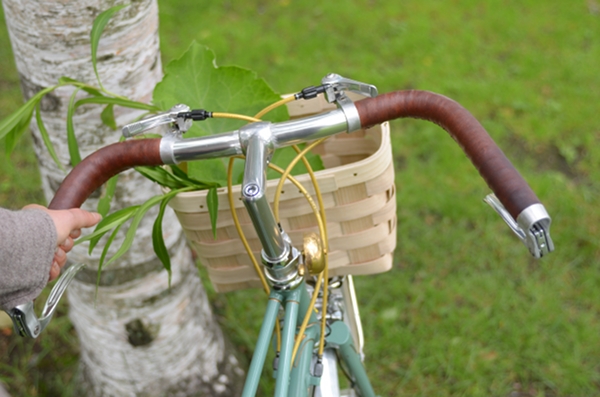
I have been eying this particular basket for months, and finally she is mine! It is made by the Peterboro Basket Company in New Hampshire, out of locally harvested White Ash. I think the model is this one. This basket is small, boxy, with a rectangular footprint, and it does not taper from top to bottom - which was exactly the style I wanted for this bicycle.

I refer to this as Basket 2.0, because I did not get along that well with the large wicker basket on my formerly-owned Pashley, and eventually removed it. This time around I looked for attributes that I hope will work for me.

For one thing, the Peterboro basket is fairly small, with a low profile and sides that don't stick out too far. It is also feather-light, made of such thin slivers of Ash that it almost feels like Balsa wood. Finally, we attached it directly to a front rack and not to handlebars, which minimises its impact on steering. Though the basket came with leather straps and metal buckles, we removed these and fastened it to the rack with zip ties. The straps and buckles were heavier than the basket itself, so doing this really made it weightless, as well as eliminated any potential jiggling. Cambridge Bicycle were nice enough to give us a handful of zip ties and some wire cutters, and we installed the basket right outside the shop in a matter of minutes.

When the basket is empty, I cannot feel it on the bike at all. It does not cause the wheel to flop to the side when the bike is parked.

It also leaves the frontmost tip of the tire unobscured, so that I can still see it while cycling. When a huge basket obscures the entire front wheel, I have a harder time feeling connected to the steering, but this is not an issue here.

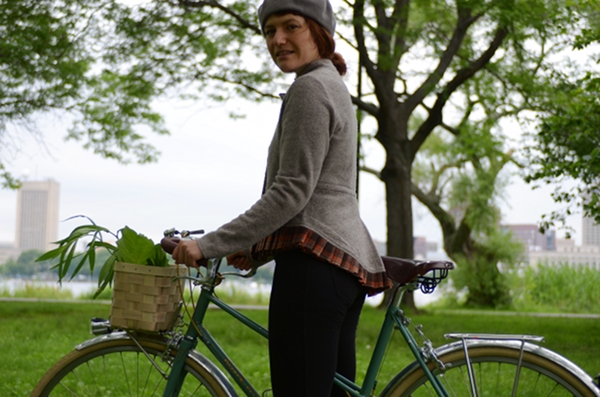
When the basket is full, the weight feels well distributed and does not interfere with either steering or balance. With dimensions of 10.25" x 7" x 7" it is not meant to carry large objects; I have a rear rack and panniers for that. But the squat, boxy shape allows it to accommodate more stuff than you might think. As pictured above, the basket contains a huge portion of smoked salmon, a bucket of cream cheese, an economy pack of cheese sticks, a blueberry encrusted "goat cheese log," and a flower bouquet. There is room for more.

Since I am now using the mixte predominantly as a transportation bike, I wanted to maximise its utility as such. This basket provides a useful space for a jacket, camera, small handbag, or even a quick grocery store purchase, without impacting handling or (to my eye at least) marring the looks of the bike. The Co-Habitant wasn't too crazy about the look at first, but it grew on him. What do you think? What front-mounted basket systems have you used on your bikes, and have they ultimately worked for you? The difference between this set-up and the large, handlebar-mounted basket I used to have on the Pashley Princess is like night and day.

Sunday, May 15, 2011

Custom Leather Pannier by Cristobal &Co

[edited to add: Cristobal &Co was not a sponsor at the time this review was written.]

Since having written my "short chainstay lament" some time ago, I've connected with a number of small manufacturers and artisans who have developed panniers specifically to solve this problem. And yes, I will be reviewing them all to the best of my ability! This month I bring you Cristobal &Co. I am familiar with the owner of Cristobal via bikeforums and obtained this pannier in an equal value trade.

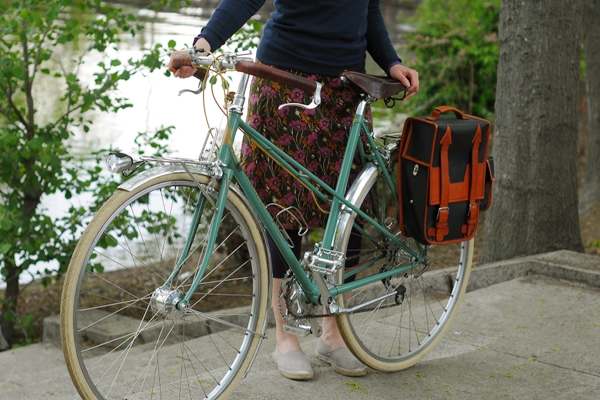
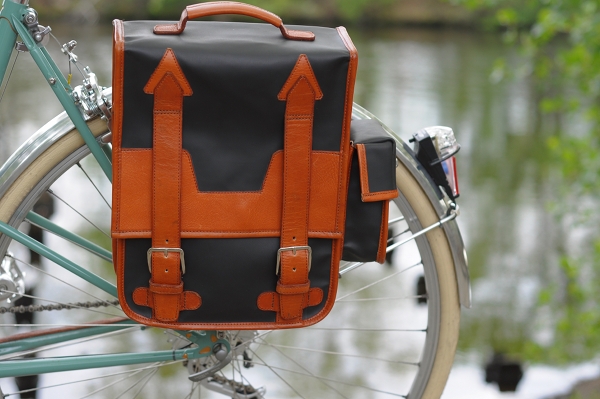
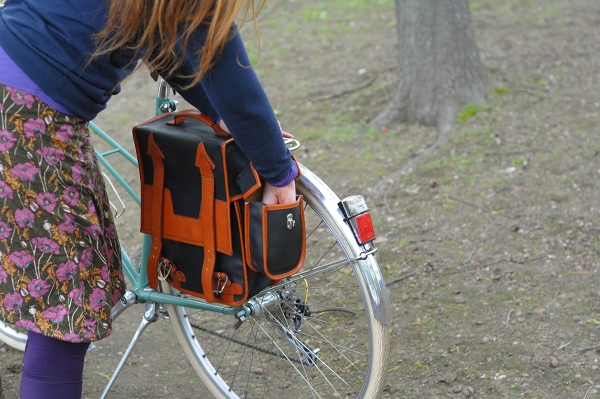
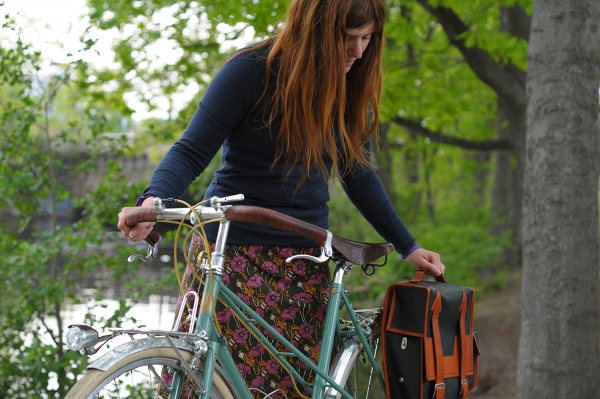
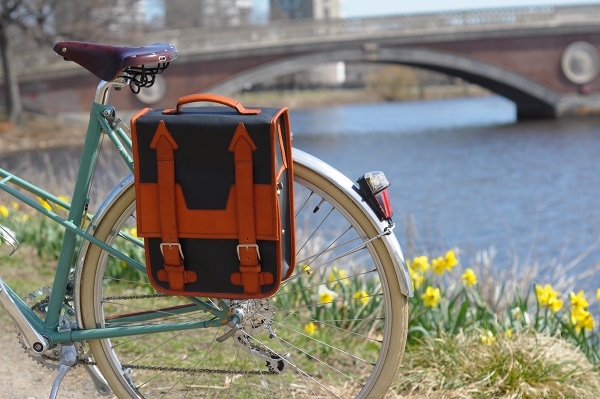
Cristobal panniers are custom-made by hand by traditional artisans in Mexico. They are made of leather and covered with a thin layer of weatherproof and UV-resistant synthetic fabric. Although standard models are available, the nicest thing about Cristobal is the possibility for customisation. I asked for a pannier that would fit my MacBook without inducing heel strike when used on my mixte. I sent measurements of my bike's chainstays and rear rack, we discussed dimensions, and I also indicated how high I wanted the pannier to sit. Shortly thereafter I received the cute, boxy Cristobal with honey leather and removable side-pocket. It fits my MacBook with much room to spare without a hint of heel strike.

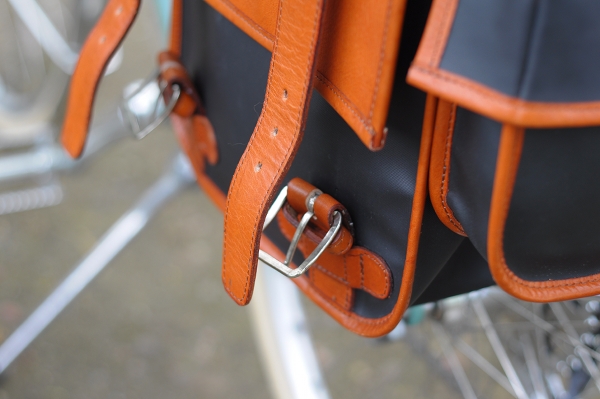
Having used a variety of leather satchels in the past, I would describe the Cristobal pannier as exceptionally well made. The leather is of high quality and the stitching is precise. There are no loose threads, no botched edges. 

The underside of the leather is soft to the touch. There is an option to get a flap that will cover the rivets holding up the hooks on the back of the pannier, and I asked for this feature - making the interior completely safe for my laptop and camera equipment. 

The removable pocket can be fitted to either side of the pannier via a built-in attachment system.

It is large enough to fit a mobile phone and a small digital camera at the same time, which is useful.

The extra long leather straps with metal buckles are designed to hold a jacket when closed.

However, I usually just leave mine open, because it takes too long to mess with them (a quick release design could work nicely here). 

The attachment system consists of straps with buckles and two hooks. The open hooks go over the rack's tubing to keep it stable, and the straps are used to secure it. The hooks are standardly sized - similar to those used by Arkel - and will not fit racks with thick tubing, such as heavy duty Dutch bike racks. 

A lower pair of straps attaches to the rack's stays for greater stability. You can see in the pictures that the straps are easily moveable via the slots in the leather, which makes it possible to adjust the pannier to fit different bikes. You could also remove the lower straps altogether if you do not feel them to be necessary.

I found the Cristobal pannier convenient to use in that it makes for a great carry-all. With its rigid boxy shape, it is like a bottomless trunk that I can keep stuffing and stuffing with my personal belongings and groceries. On the other hand, the pannier takes some time to affix and detach, and its hooks are only compatible with some of my bicycle racks. Without a more versatile quick release system, I consider this to be more of a touring pannier than a commuter's pannier. Cristobal is willing to use alternative attachment systems upon customer's request, and I suggest getting something like the R&K Klickfix if you need an easy on-off feature that is compatible with a wide variety of racks (I didn't opt for that, because I was curious what the standard attachment system was like).

It is also worth noting that while leather is more durable than cloth, it is also heavier. If you value durability, waterproofness and craftsmanship over weight, then this shouldn't bother you. But if you are seeking the lightest set-up possible, leather is generally not the way to go. 

Cristobal panniers are starting to appear in bicycle shops across the US, and can be ordered directly from the manufacturer with various degrees of personalisation. Prices vary depending on dimensions and the amount of custom work, so please inquire with them directly. I am impressed with the craftsmanship and design of the pannier, and will consider retrofitting mine with a quick release system. 

Monday, April 25, 2011

On Living Locally and Seeking Continuity

I was having a political discussion with a friend over email, and in response to something I wrote he replied: "You know, it's really starting to show that you haven't been out of the US in almost a year." Ouch... But the "insult" aside, I realised he was correct: I haven't been out of the country since last July, which is unusual for me. Moreover, we have been without a car since December, making our travel radius limited to cycleable distances. Without explicitly being aware of it, I have transitioned from living "globally" to living "locally," and my friend's insinuation was that this has made me narrow-minded and provincial. Has it? I think not, but I also realise that I don't really care. My quality of life has improved as a result of the changes I've made since last year, and that's difficult to argue with.

We could go on forever debating the "moral" and "social responsibility" implications of living locally vs globally. On the one hand, those who lead lifestyles that rely on air travel are doing a great deal of damage to the environment. On the other hand, one could argue that some international jobs are "important" in their contribution to society, and the scale of this contribution outweighs the degree of environmental damage. But the trouble with these arguments, is that they inevitably lead us to a slippery slope. Who determines what's important? Who has the right to pass that judgment on others, and using what criteria? Are UN workers "good," but fashion reporters "evil"?  Is it "wrong to endanger the environment" by traveling to Shanghai just for fun, or is that outweighed by the positive effect of experiencing another culture, growing more tolerant and open-minded as a result? Impossible to say, without imposing our subjective sense of logic on others' sovereignty, which is not something I wish to do.

But the issue of living locally vs globally has personal, psychological implications as well, and these have been on my mind lately. I have an unusual personal history, and have basically never lived in any one place for more than several years at a time. As a result, my life has been fragmented and unstable, which I do not feel is ultimately good for me. When I remember things from my past, I sometimes get confused about the location of an event, and even about the language that was spoken. With my friends, relatives, experiences and memories scattered all over the world, it is difficult to maintain a sense of continuity and even a coherent sense of self. Forming healthy attachments to new people and places is challenging, and replacing the physical reality of personal interaction with virtual communications is isolating.

As we lose our sense of "continuous living," our notions of contact grow increasingly abstract - and not just contact with other people, but contact with our surroundings. I remember a post by Dottie at Let's Go Ride a Bike some time ago, where she describes the lifestyle of her family in the North Carolina suburbs as "traveling from pod to pod." The home is a pod. The workplace is another pod. The restaurant, also a pod. And because of the vast, highway-navigated distances between each, there is no clear sense of what happens in between; it is kind of a dead space, almost a virtual space. I found this imagery to be both frightening and relatable - a reflection of my own anxieties about what our lifestyles are doing to the way we connect with the physical world.

I thought that I might feel limited and stir-crazy once I stopped traveling abroad, and even more so once we began living without a car. Instead I am feeling as if some long-neglected human aspect of me is waking up. Living locally and all that it entails - seeing the same people, experiencing the change of seasons while staying put, and developing a feel for manageable distances - is giving me a sense of continuity that I have been lacking.

Sunday, April 24, 2011

Soma's Fab in 650B! A Test Ride of the Buena Vista Mixte

Last week I had the pleasure to extensively test ride a Soma Buena Vista mixte that our fellow bicycle-obsessionist Somervillain has just built up for his wife. This test ride was a rare opportunity that I gladly seized. First off, Soma only sells frames and not complete bikes, so finding a way to test ride their models is difficult. Moreover, this mixte is an especially rare specimen, as it is built up with 650B wheels. And finally, I was allowed to borrow the bicycle for an entire day - which, of course, was much more informative than a brief test ride. I hope this will be of use to those considering this bicycle.

Soma Fabrications is a small manufacturer of bicycle frames and components based in San Francisco. Their Taiwanese-built frames are steel and more or less classic, with modern elements. The Buena Vista model is a TIG-welded mixte with twin lateral stays, available in four sizes from XS (42cm) to XL (58cm). It is a versatile frame with "sports touring" geometry that can be built up either as a roadbike or as a city bike, either with a derailleur or with an internally geared hub, and either with 700C or with 650B wheels.

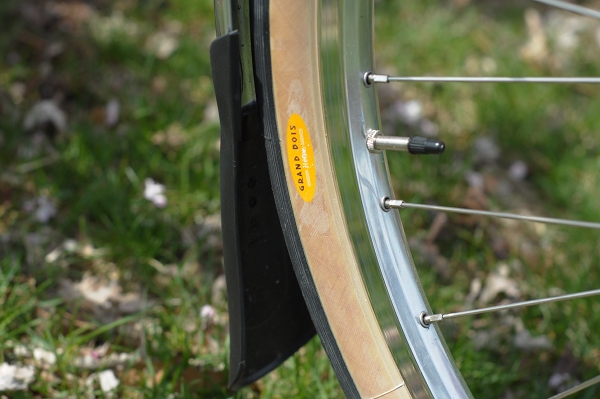
Though a 700C build is by far the more typical, Somervillain fitted this bicycle with 650B wheels. The 650B size allows for wider tires - specifically the fantastically cushy Grand Bois Hetres, which make for a very comfortable ride. Soma specifies a maximum 38mm tire width for 650B wheels on the Buena Vista, but their estimate is overly conservative: The 42mm Hetres fit fine, including fenders. That is a useful piece of information for those who like wide tires and are choosing between, say, the Soma Buena Vista and the Rivendell Betty Foy. These two frames allow for the same tire width.

An additional benefit of using 650B wheels on the Soma, is that it is a useful trick to eliminate toe overlap - at least on the 58cm frame. Keep in mind also that when you put 650B wheels on a frame, you can go with a larger size than what you normally ride. While a 58cm frame is usually too big for me, I was able to fit this one because of the 650B wheels.

The Buena Vista is available in white or graphite, and this bicycle is obviously the latter. The graphite is a dark silver colour with some depth to it, not unlike a Tahitian pearl. The Soma headbadge and decals are embellished with splashes of red, which I think complements the frame nicely.

Gray and silver frames can be tricky to accessorise, and personally I prefer them paired with warm tones. This bicycle is fitted with all black accessories, which gives it a sporty/stealthy look. Ultimately, these choices are a matter of personal taste.

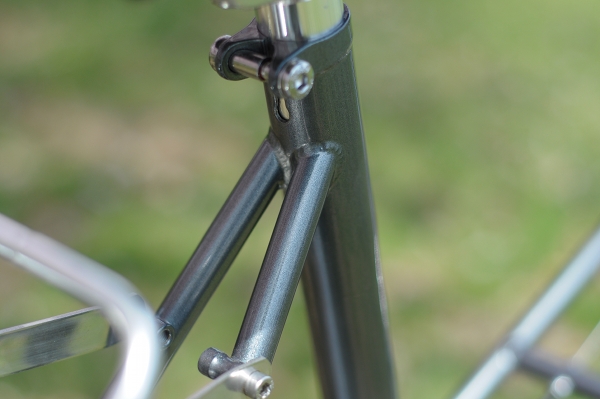
The Buena Vista frame is mostly welded, with the exception of the lugged fork crown and a few lugwork-like details - such as the connector between the stays and the seat tube.

The welding is relatively clean, though not quite as clean as on the Surly frames we recently examined. I think that welding marks are more noticeable on a mixte than on a diamond frame, simply because there are more joints to connect.

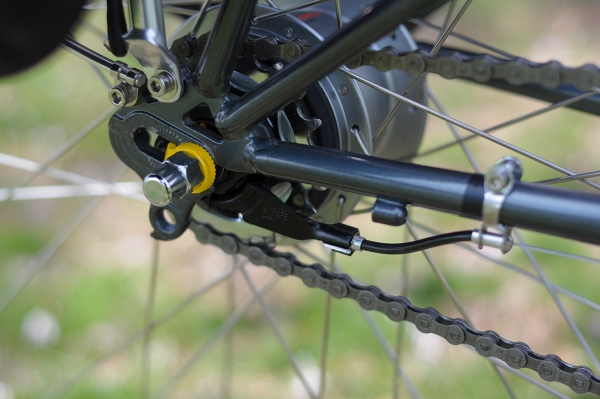
The horizontal dropouts are what makes the Buena Vista frame compatible with both derailleur and hub gearing. There are braze-ons for both racks and fenders.

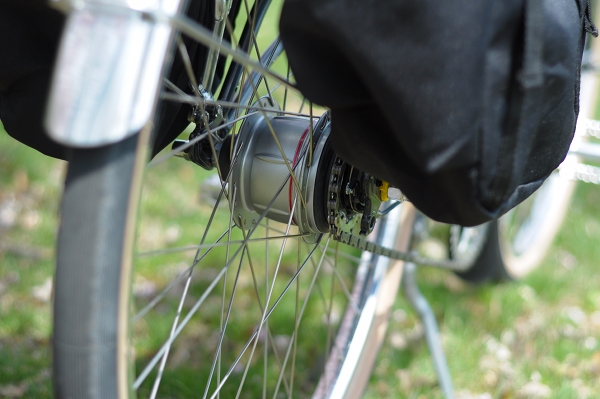
The wheelset is from Velo Orange, built around a Shimano Nexus 8-speed hub.

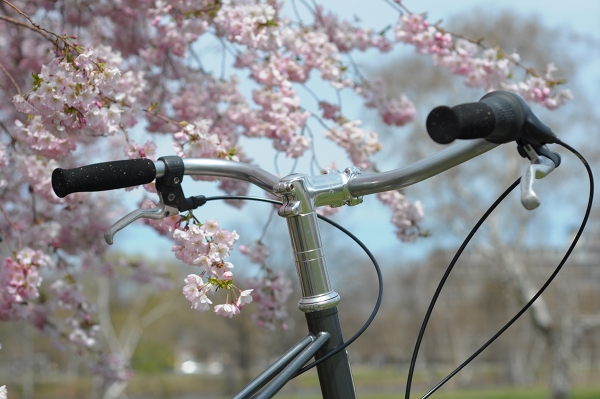
This particular twist shifter is unobtrusive and easy to use.

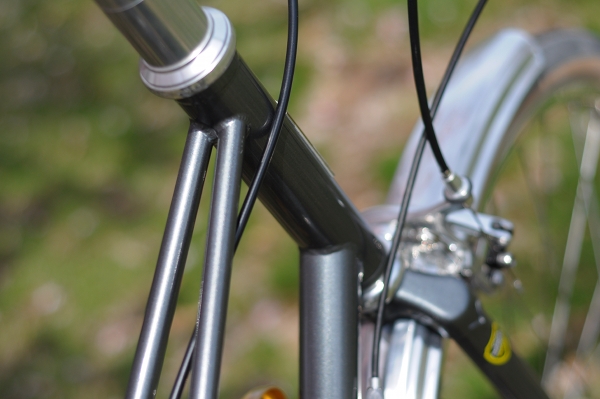
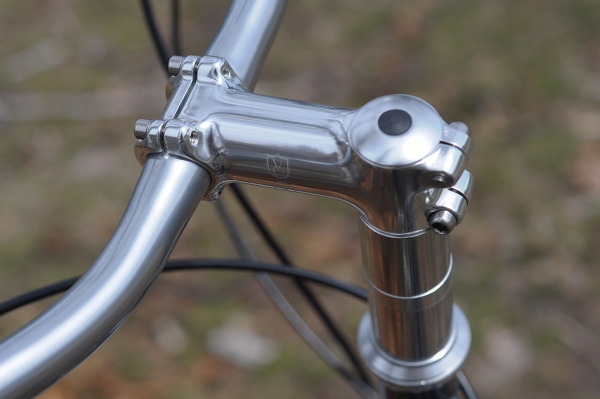
The Nitto Albatross handlebars are set high with the help of spacers - the stem being threadless. Vintage Shimano levers activate the long-reach caliper brakes.

Close-up of the Velo Orange threadless stem with spacers.

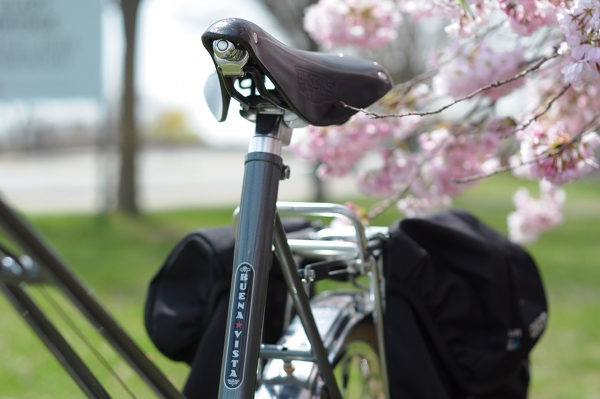
Brooks B17 saddle.

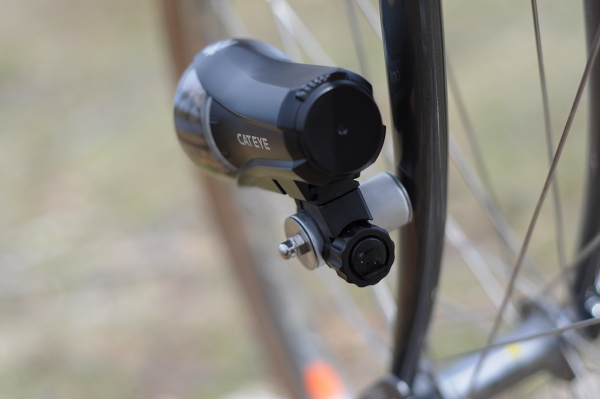
Battery-operated CatEye headlight, attached to the fork blade via a DIY mount.

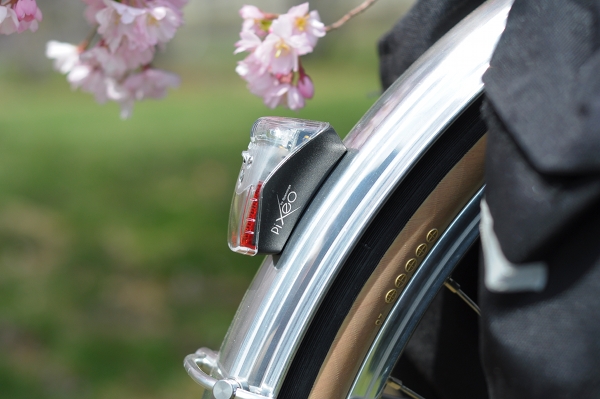
Spanniga Pixeo tail light, attached to the rear fender.

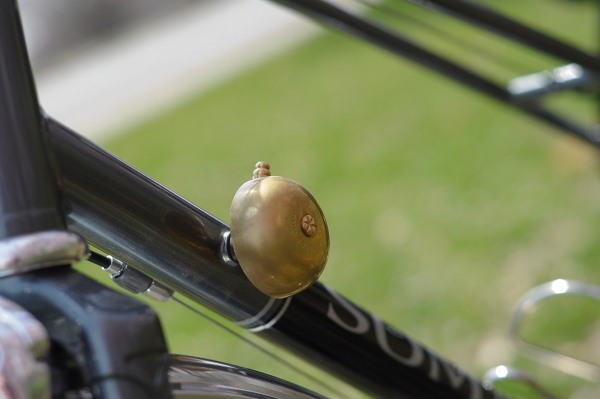
Brass bell mounted on the unused downtube shifter boss.

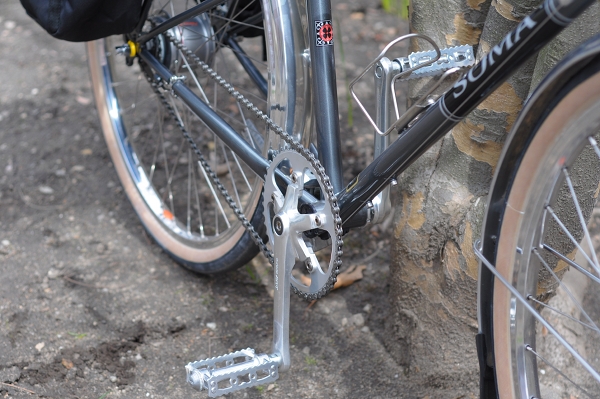
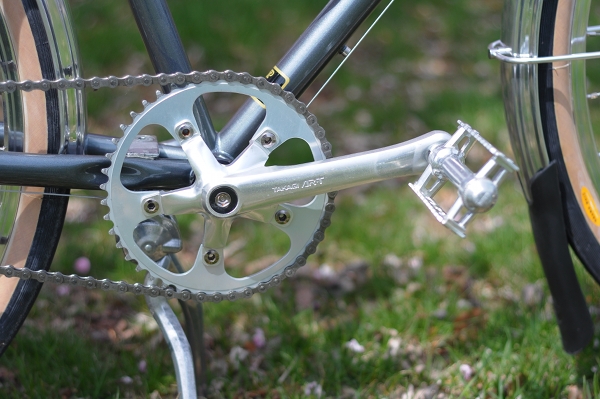
Vintage Takagi crankset, chosen for its ability to accommodate a Porteur-style chaincase that this mixte may be fitted with at a later stage.

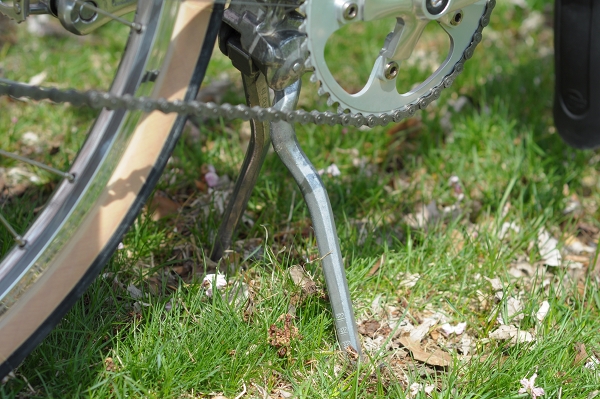
Pletscher double-legged kickstand.

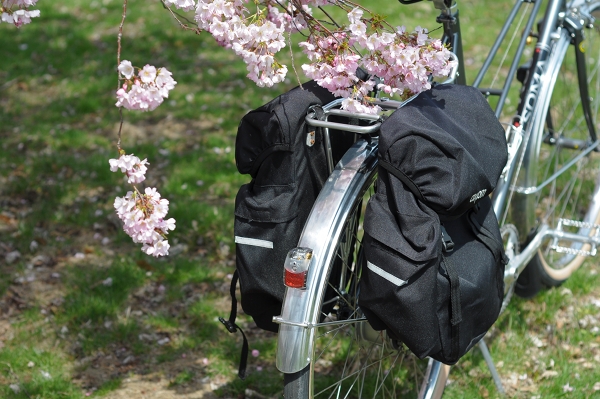
Burley Moosehead rear rack, necessary for attaching a "trailercycle."

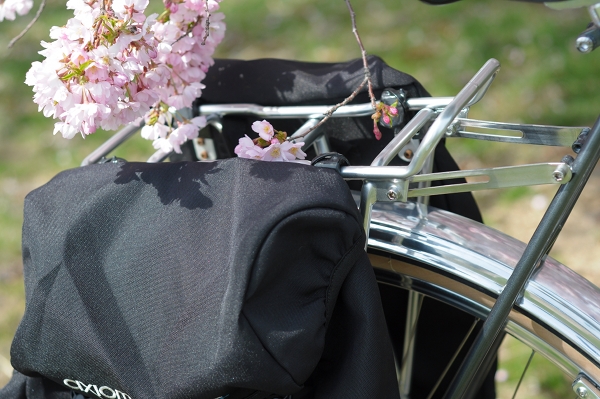
And a set of Axiom panniers, mounted permanently to the rack. Velo Orange fenders and Planet Bike mudflaps finish off the build.The total weight of the bicycle with this build is 28lb not including the rack and panniers, and 35lb including them. The significant difference is due to the hefty nature of the proprietary Burley rack, which was a must as Mrs. Somervillain will often commute with one of the children.

This particular Buena Vista was built up as predominantly a transportation/ utility bicycle, to be ridden mainly within greater Boston - while at the same time offering sufficient versatility to handle longer, recreational rides. Hub gearing was chosen for ease of maintenance and an upright posture was chosen for comfort - with the mixte's roadish geometry still offering sufficient speed and maneuverability.

I was in possession of this bicycle from 8:30am until 5:30pm on a weekday. During this time I rode it for transportation to various destinations, then took it on a 12 mile ride along the Charles River Trail towards West Newton and back. All together, I probably rode the Buena Vista for a total of 17 miles.

Based on Soma's online description, I expected the handling to be aggressive - but it was not. It did not handle like a "converted roadbike" as some mixtes do, but like an actual upright city bike. Given that I had the saddle lower than Mrs. Somervillain, the handlebars were too high for my taste and the front end felt lighter than I like. Still, I felt safe and confident riding this bicycle in traffic right away. The Buena Vista was maneuverable and responsive - but easy to control, and predictable. The frame felt stiff-ish, but the wide Grand Bois Hetre tires took the edge off, making for a comfortable ride on and off road. It must also be noted that this bicycle was put together impeccably - which greatly contributed to my feeling of safety and comfort on it.

As far as speed and hill-climbing go, I must say that I felt somewhat limited by the overly upright posture and the hub gearing. On flat terrain, I had trouble finding a "perfect" gear on the 8-speed hub and kept shifting back and forth. On hills, I thought the bicycle lost its momentum quicker than is typical for a bike with roadish geometry, and I had to downshift sooner and more frequently than I expected. Perhaps I am simply accustomed to mixtes that are set up more aggressively, or perhaps there is something about these multi-speed hubs that I find inefficient in comparison to derailleurs. But given how tamely this bicycle handled, I found myself wishing it were a loop frame - so that it would be more comfortable to mount and dismount. At the same time, given its mixte construction, I found myself wishing it were more aggressive, so that I could cycle faster long distance. In a way, I felt like I was neither here nor there - though I imagine others might describe this very same feeling as "the best of both worlds." Of course, it is entirely possible to fit the Buena Vista frame with a derailleur and to opt for an aggressive handlebar set-up, if that is what the owner prefers.
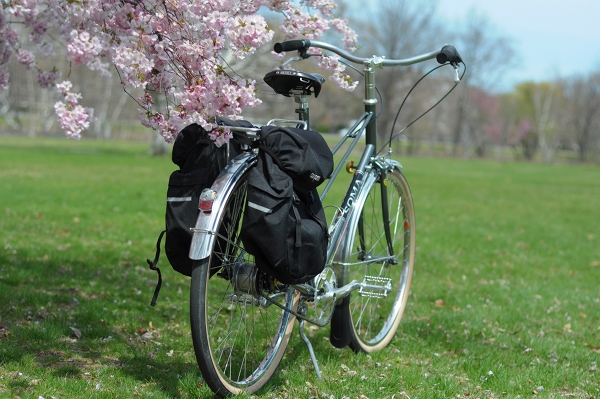
I have test ridden only two other modern-production mixte bicycles besides the Soma: the Rivendell Betty Foy and the Trek Belleville WSD. The Trek is not even in the same universe, and on just about every level I can think of the Soma is a better bike. The Rivendell, on the other hand, is a more comparable bicycle, and I even test rode the Betty Foy in the same frame size and with the same wheel size as the Buena Vista. Though over all, the Betty Foy is a more comfortable ride, the difference is not as great as I had anticipated. The Buena Vista is a bit harsher on bumps, and the stepover height of the mixte stays is a good inch or two higher than on the Betty Foy of the same size. But otherwise, they did not feel like radically different bicycles.

All in all, I found the Soma Buena Vista to be a solidly constructed, versatile frame with comfortable geometry and all the accommodations necessary to turn it into almost any sort of bike you wish. I like the proportions of the 58cm frame with the 650B wheels, though cannot speak for the other sizes. I like the multitude of braze-ons and the wide clearances that allow for my favourite tires. I like the rich graphite frame colour. On a mixte with such classic lines, I dislike the welding and the threadless stem, and for me personally this is a dealbreaker - but I recognise that this is a matter of taste. The Soma Buena Vista frame can be found starting at $400, and a complete bike with a build equivalent to the one shown here could cost as little as $1,200 (see here for the complete build). While everyone's idea of what constitutes "good value" differs, this could certainly fit the bill. More than anything, I recommend this bicycle for those seeking an economical way to build up a bike with 650B x 42mm tires. In that sense, the Buena Vista is a rare and excellent find.