Showing posts with label bicycle industry. Show all posts

Monday, May 9, 2011

New England Bicycle Expo!

Last weekend we visited the New England Bicycle Expo - held right here in Somerville, MA. We weren't sure what to expect: Would it be a handmade bicycle show? or a trade show of larger manufacturers? Turns out, it was a bit of everything: a mix of local framebuilders, artisans, manufacturers, and various cycling-related organisations. The show was relatively small and had a "country fair" feel to it - which was pleasant and personable.

The Expo was held at the Armory - an old military structure, refashioned into a community arts center.  I did not have the right lens on my camera to photograph the entire building, but you can see it here. The Armory basically looks like a cartoon castle, and I always get excited upon seeing it in what is otherwise a normal, residential neighbourhood. It's just so unexpected: House, house, house...castle!

Booths were set up pretty much all over the place, making use of the interior's pre-existing structures. Some areas were well-lit, while others were cavernous, which created interesting contrasts and a sense of mystery, but made it all darn difficult to photograph.

Some exibitors set up their spaces inside tents, which contributed to the country fair vibe. Wandering around the tents, I found myself craving a corndog on a stick. Ciclismo Classico had a large information tent.

Geekhouse booth - shaped like an actual house, with an actual geek in it. Those guys do not disappoint.

Royal H. Cycles took the stage - literally. There is a stage in the Armory, and that's where he set up. Naturally, the crowd kept expecting a performance.

Instead, they got to look at Bryan's beautiful bikes, including the Randonneur we are collaborating on.

Those curious about framebuilding got to see a frame in progress, with filing marks visible and flux still caked onto it.

Icarus shared the stage, the delicate details stunning anyone who examined the flawlessly fillet-brazed frames.

The finishing on Icarus frames is just amazing.

Tiny stainless steel feather details in unexpected locations on the frame and fork are his trademarks.

Folk Engineered displayed a very memorable bicycle that was designed to look like it was stitched together.

Like this!

The seams are not painted on; this is a fully tactile experience. And I believe that's a rendering of New Jersey on the seat tube.

ANT had some new mixte basket-bikes built up, with lots of nice custom touches. A few of us rode one of the bikes and I will write about that at some point in the future.

An aerial view of "ANT Bike Mike" (the framebuilder Mike Flanigan), looking very cool in his shades and cap.

And another local framebuilding legend, Christopher Igleheart.

I was impressed with the Igleheart bicycles we saw on display - in particular this unique Randonneur, built especially for Paris-Brest-Paris.

Notice anything unusual here? Hint: Look at the handlebars. There are two sets of shifters, enabling the cyclist to shift both while on the hoods and in the drops, without changing hand positions. You would think such a set-up would be clunky, but here it is executed so elegantly, that nothing even seems out of the ordinary until you look closely.

Two sets of shifter cables, neatly routed.

Another interesting feature this bicycle had was this button built into the stem. It's a switch for regulating the headlight beam. I want!

More Igleheart work. How about these dropouts!

Dynamic chainless bikes were giving presentations.

These bicycles use shaft drives and have enormously wide bottom brackets. People were test-riding them outside, but we didn't have a chance to.

Alongside the framebuilders and bicycle manufacturers were makers of cycling accessories. I really liked the Alchemist wool jerseys.

2nd Suit cycling caps were on display, made of thrifted garments.

I found the colour and textural combinations they used appealing.

Very popular at the Expo was this belle of bicycle helmets. Belle helmets are handpainted in acrylic, with the coolest motifs. Although you may have noticed that I neither promote nor wear this particular accessory, I can't help but want to promote a fellow artist.

There is one painted like an apple. An apple!

An apple(!!) The ridiculously realistic rendering is just awesome. It makes me imagine some giant accidentally biting off a cyclist's head.

Speaking of edibles, Zipcar was at the expo, giving away mints. I reviewed my experience with Zipcar here earlier.

And a cafe was set up by the entrance, selling coffee and surprisingly healthy food.

Lots of people brought their own interesting bikes to the show as well.

Owners of the above Bullitt- Brian P. of Bummels and Jaunts, with family.

Interesting wooden trailer, belonging to another family.

Vintage cruiser advertising a gas and oil company.

And a true piece of history - an 1895 Eagle with curved seat tube.

Wooden grips and spoon brake. There are many more picture of this bicycle here, if you're curious; it's really something.

Expo organiser, Rob Hill. This was a great event he put together, and I hope it continues for years to come.

If I have to assess how the expo turned out, I would describe it as small, friendly and low-key. The upside of that, is that the atmosphere was comfortable, open and inviting. The downside, is that it was perhaps too small and low-key for what the name of the event suggested. Frankly, I think the expo could have been promoted more extensively, and could have benefited from more media coverage. Boston has a huge cycling culture, and I saw only a small fraction of it reflected among the attendees. Many people I told about it locally simply did not know it was happening, but would have loved to go. Perhaps that is something to consider for next year - and I hope very much that there will be a next year! This was an exciting and promising beginning that I would love to see become a local tradition.

Additional images of the New England Bicycle Expo can be viewed here. There are more coming, and they will be added to the same location.

Monday, April 11, 2011

The Unicrown Fork

Those who have been reading this blog for some time, are no doubt familiar with my rants against unicrown forks. "The bike is nice... if it weren't for that unicrown fork," and so forth. When the topic comes up, some agree, others question my fixation on this detail, and others still want to know what a unicrown fork is. Now that I am temporarily living with a unicrown forked bike, the time seems right to elaborate.

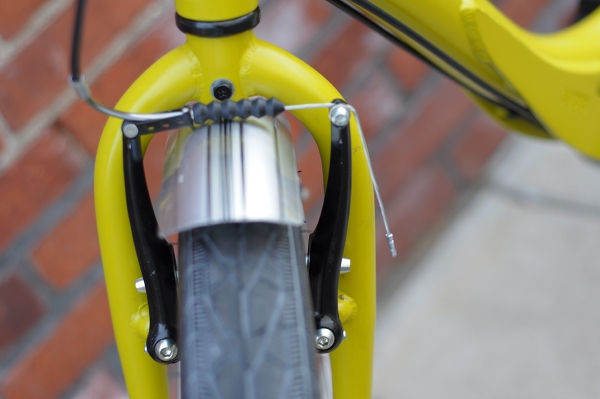
A vey basic primer in bicycle fork construction: A traditional fork on a traditional lugged steel bike is made up of two blades and a crown, whereby the blades and crown are brazed together - just like the tubes and lugs on the frame itself. There are many fork crown designs in existence, but the general concept is the same. Now, a unicrown fork is constructed differently in that there is no crown. The two fork blades are bent towards each other at the top, then (typically) welded together at the steerer tube. A unicrown fork is simpler and less expensive to make than a lugged crown fork, which is why it has become so ubiquitous among contemporary bicycle manufacturers.

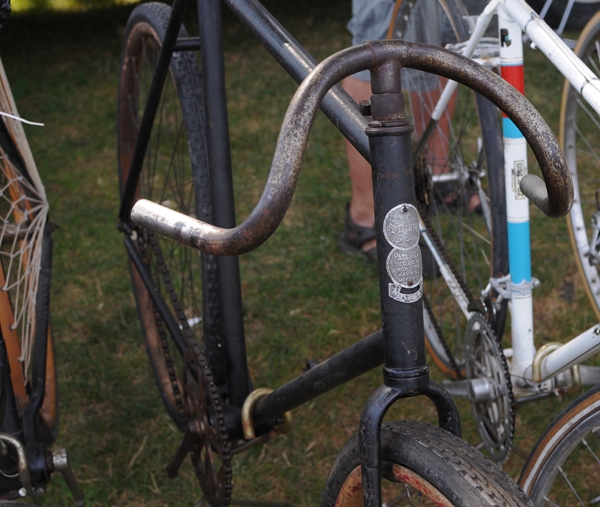
For some time now I've been trying to figure out the history of the unicrown fork, and I keep reading about the first mountain bikes, BMX bikes, and the quest for rigidity - suggesting that its origins were in the 1980s. But then I see antique bicycles  - like this ancient Sterling pathracer at the Larz Anderson show last summer - which to me look like they are sporting hundred year old versions of unicrown forks. I have also seen what I can only describe as antique crownless flat-top forks - which appear to be similarly constructed, but are squared-off, rather than round. Would someone care to educate me on their history?

The thing about unicrown forks, is that I don't actually dislike them per se, at least not in of themselves. What I dislike is when they are incongruent to the overall design of the bicycle. On a welded frame, a unicrown fork looks perfectly natural - integrating harmoniously with the bicycle frame. Just like I prefer lugged frames to welded frames, I similarly prefer lugged forks to unicrown forks. But objectively speaking, a unicrown fork looks fine on a welded frame - like on the D2R Boogie above.

Unicrown fork on a welded DBC Swift, also looks appropriate.  The frame joints and the unicrown fork match, and all are filed equally smoothly. 

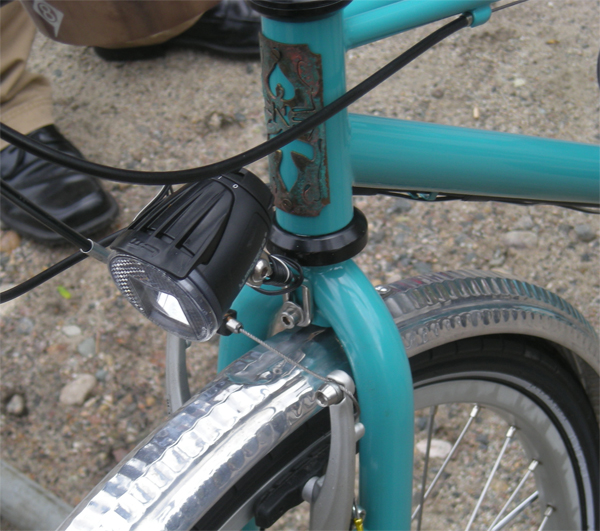
Unicrown fork on an ANT mixte. Now, if I were getting an ANT, I would opt for his segmented fork or his dual-plate crown fork - just because I prefer those styles and they are kind of his specialties. But I don't think there is anything inherently wrong with ANT using unicrown forks on TIG-welded bikes - again, the overall design is harmonious.

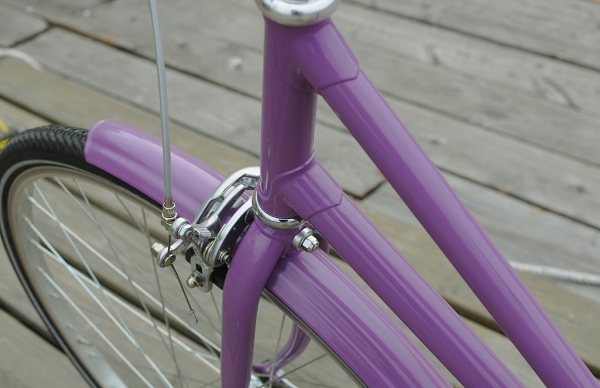
The only time a unicrown fork actually bothers me, is when it is attached to a lugged frame - which is done quite frequently nowadays. Azor/Workcycles puts unicrown forks on their lugged frames, as do Batavus, Velorbis (balloon tire models only) and Abici (above), just to name a few. The reason is most likely a cost-cutting measure, undertaken perhaps with the hope that most customers simply won't notice. And it bothers me, not because I think that unicrown forks in themselves are "bad," but because I feel that a traditional lugged bicycle - especially when the manufacturer takes pride in describing it as such - calls for a traditional lugged fork. When the frame is lugged but the fork is not, the overall look of the bike comes across as disjointed to me; it doesn't "flow." It's only my opinion, but I think it's a fairly simple and logical notion as far as design goes.

Do you care what kind of fork your bicycle has? What do you think of unicrown forks - in of themselves, and in combination with lugged frames?

Thursday, March 31, 2011

Design for Use versus Posturing

[image via thefixfixfix]

For some time now, there has been debate as to whether the rise of "cycling culture" is positioning the bicycle as primarily a fetish object, with functionality a mere afterthought. As with any trend, the marketing industry harvests the readily identifiable, superficial aspects of a phenomenon, enhances them to the point of vulgarity, then sells to the eager public an attractive empty shell, devoid of any actual substance. BikeSnobNYC has been waxing lyrical on this topic since the start of his blog, satirizing a "bike culture" where sullen boys walk their brakeless neon fixies to the nearest cafes while airhead girls pedal their 70lb Dutch bikes at 5mph against traffic in billowing designer frocks - all of them laden with hundreds of dollars worth of cycling-specific accessories. 

[image via republicbike]

While I am accustomed to the Snob's endearing rants on this topic, reading Rivendell's version of the same complaint the other day was more novel. In several recent posts, Grant Petersen describes going to a bicycle trade show and being taken aback by the abundance of over-designed and impractical objects, such as rhinestone-encrusted lugs, heavy leather saddlebags and absurdly complicated toe clips. "A bag that weighs more empty than the contents it carries is quite a bag. A rack that shows off its beauty and never covers itself with a bag or basket is quite a rack. A bike and every part on it should serve a function." Agreed. But the irony of it - and I am sure Mr. Petersen is not blind to this irony - is that Rivendell played a role in these fancy/useless things being on the market today. Creating an interest in elaborate lugwork, leather, twine, and "old timey aesthetics" was a key part of Rivendell's marketing from the start. Now, it seems that the message has gotten away from them. Form is being imitated without substance.

[image via bornrich]

"A bike should look only so fancy," Petersen writes.  "There's a line. It's easy to cross it." Problem is, who draws that line, and where? Is it just one of those things where we know it when we see it? I am not  against extravagance in the bicycle industry per se: Ultimately I think it's marvelous if "luxury bicycles" become status symbols instead of luxury cars and electronic gadgets. But I guess for me, it's important that the bicycle be designed for actual use and with longevity in mind first and foremost. If I see a diamond encrusted bike and it's a good bike - quality construction and finishing, comfortable, great handling - then its excess does not annoy me. It amuses me, but I don't get mad thinking "how dare they make a diamond encrusted bike." On the other hand, if I see a bike where all the money went into the embellishments and the bicycle itself is shoddy or ill-conceived, that does bother me quite a bit: At that point it's not a bicycle, but a "BSO" (Bike Shaped Object). It may be expensive, but to my eye it is no different from those horrid things sold for $60 at big box stores: not a functional bike, but a sad waste of resources and human labor.

[image via bikehugger]

Of course, all of this does not just apply to luxury bicycles. Often I see bikes in the $400-700 range, where it is so plain that the majority of the manufacturer's budget went into simulating the aesthetics of high-end bikes and then marketing the heck out of the product, while paying only scant attention to things like geometry, quality of construction, and component choice. These bicycles are designed to look good in catalogues, but not to benefit the cyclist. They are essentially disposable.

[image via wallbike]

And I think the theme of disposability is also what's behind my dislike of the recent proliferation of leather saddles that come in neon colours and wild motifs. Admittedly I am being hypocritical here, because the saddles are well-made and perfectly functional - what's the harm in them being flamboyantly colourful or embossed with skulls and bones? I guess I feel that the styling trivialises a product that is made from an animal and is meant to last a long time. My intent is not to be political with the animal thing, but on a personal level I do feel bad when I see these new models. Will a cyclist really keep a neon saddle for the rest of their lives? For the next several years even? It seems to me that the flamboyant styling introduces an element of built-in obsolescence into a product that is otherwise intended to last. It's a contradiction in design that I find jarring.

The point where a bicycle-related product stops being merely fancy or trendy and becomes offensive is different for everyone; we'll never agree. Still, it can be interesting to evaluate one's personal parameters and to hear others' opinions. What's your view?