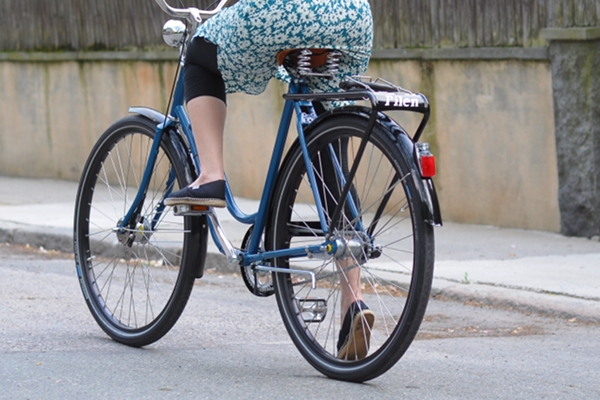
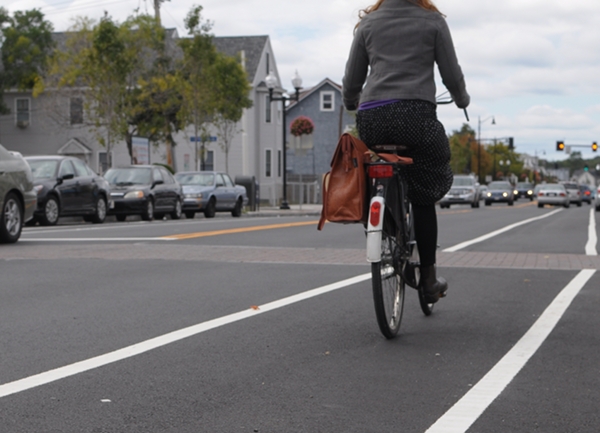
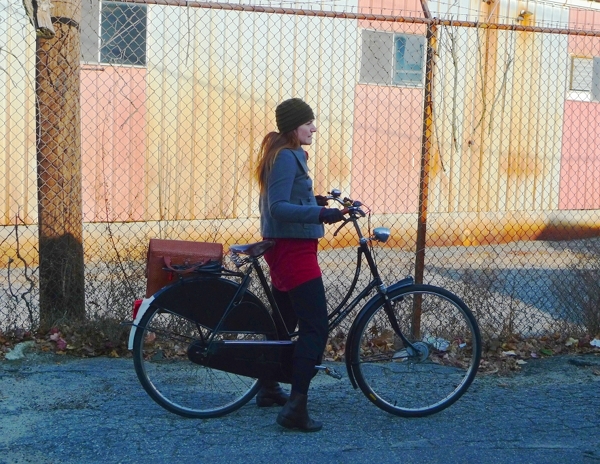
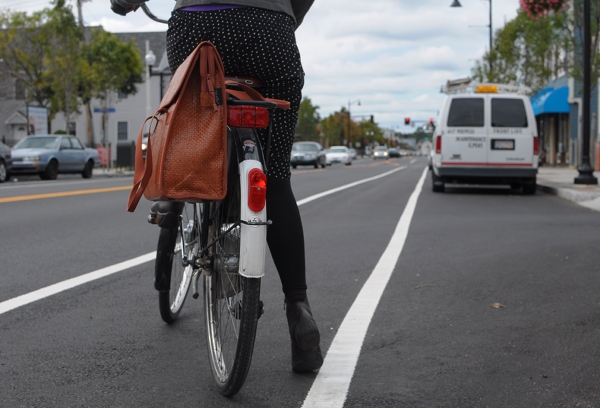
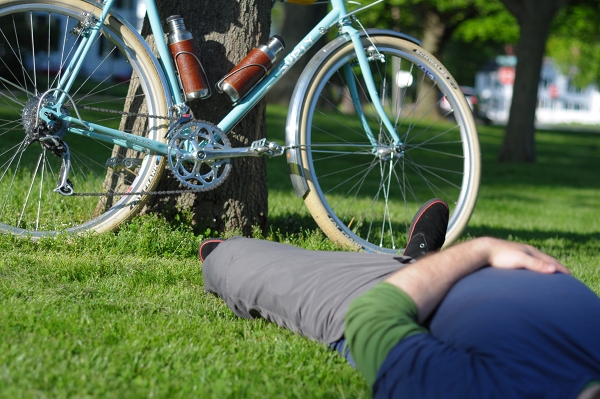
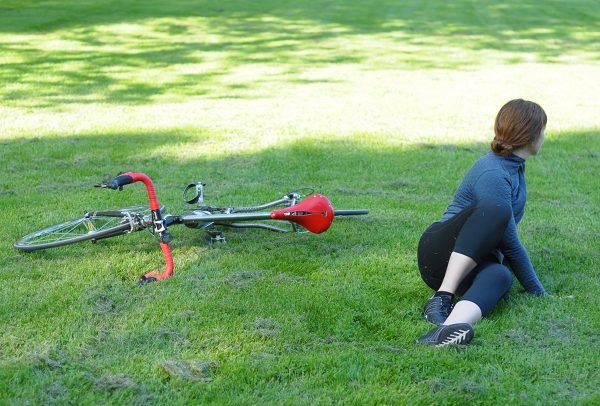
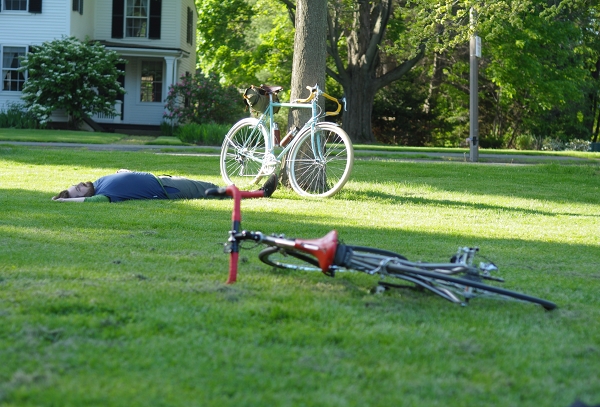
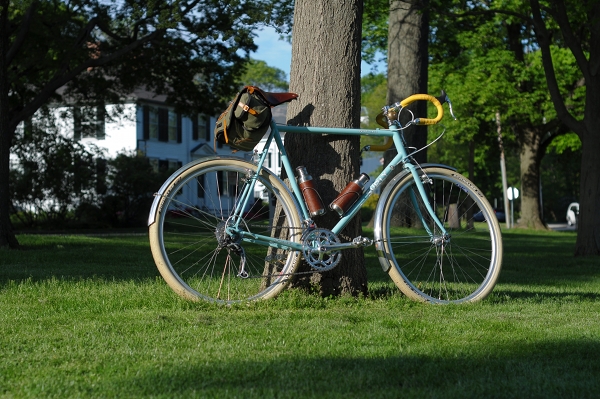
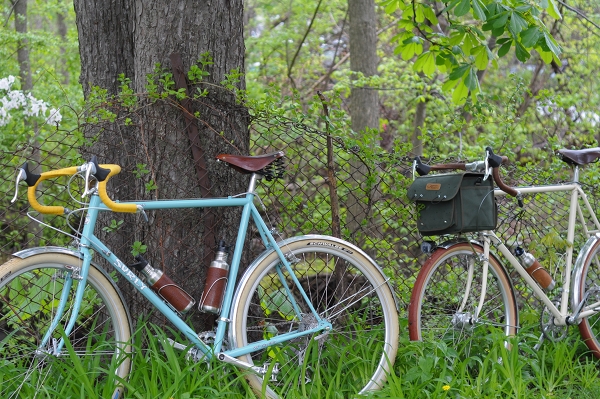
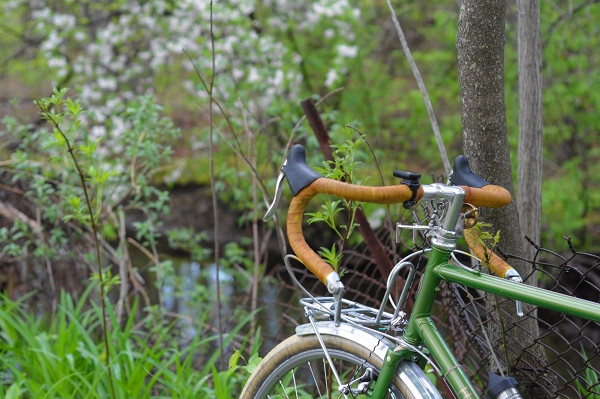
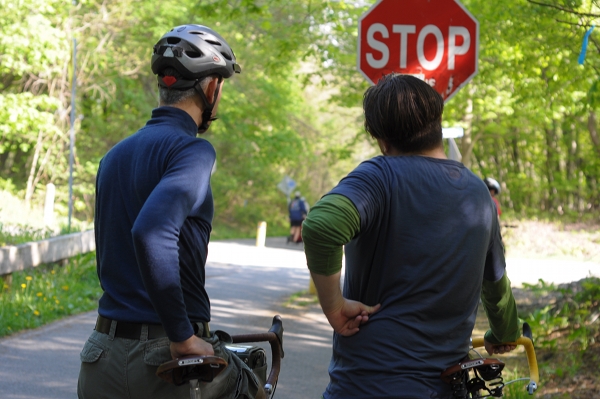
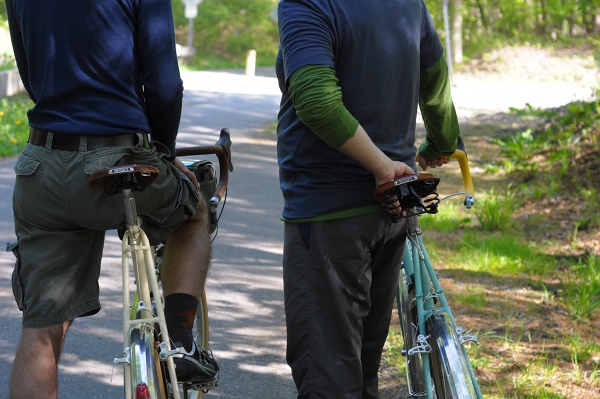
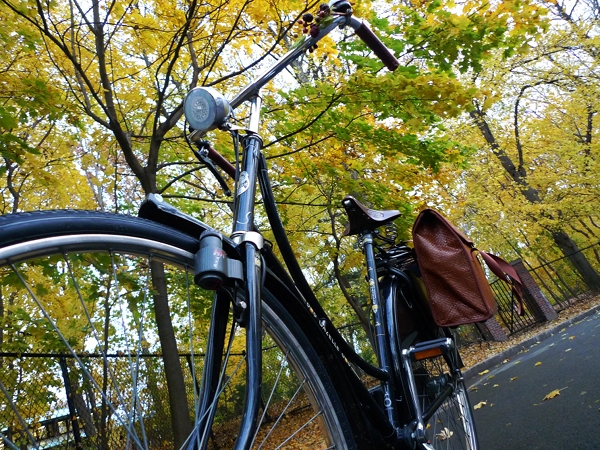
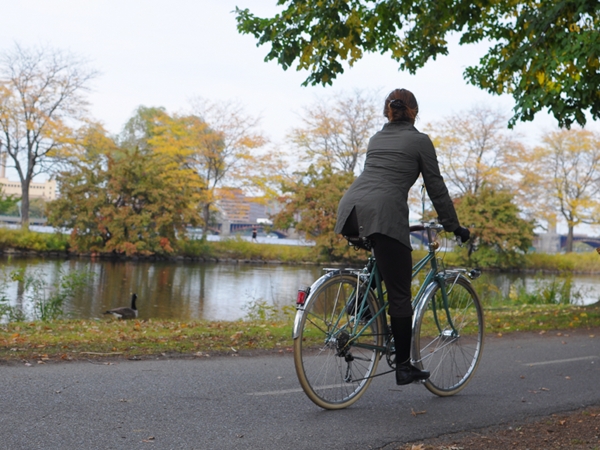
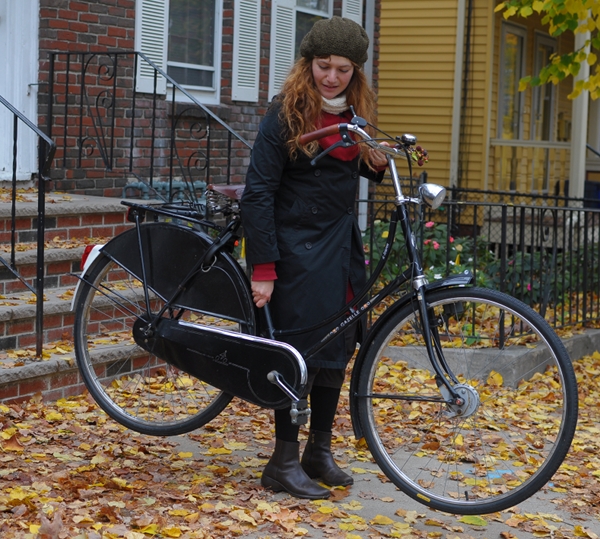
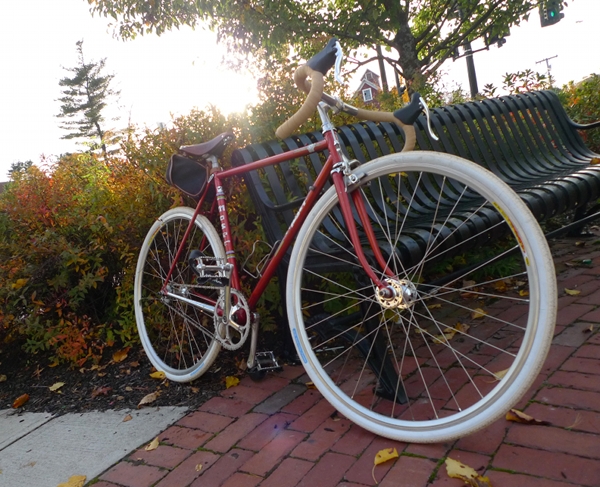
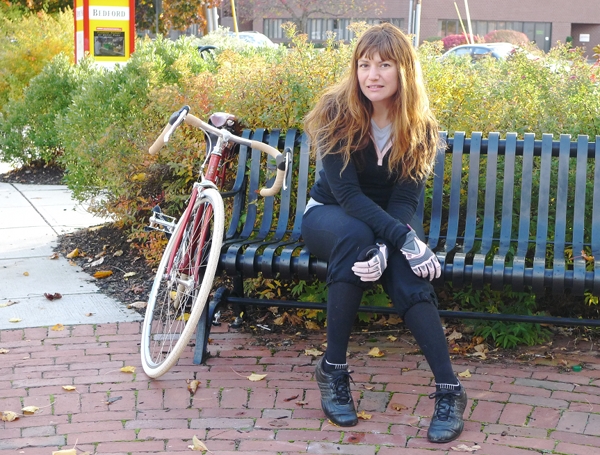
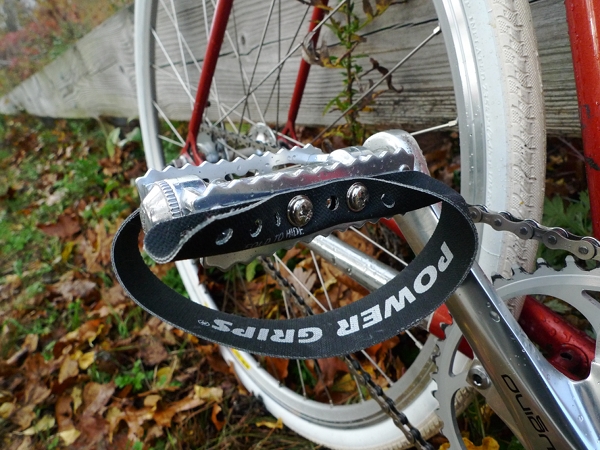
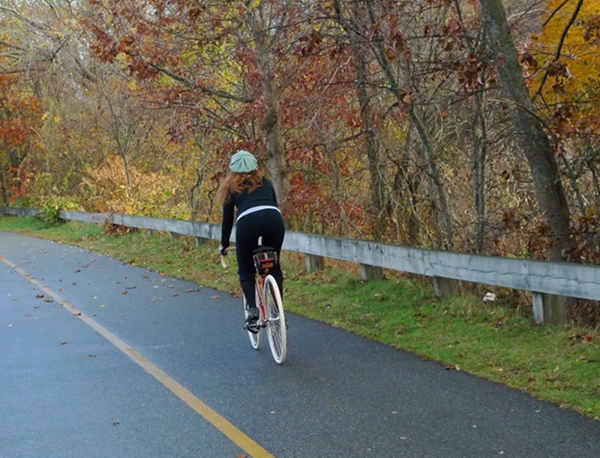
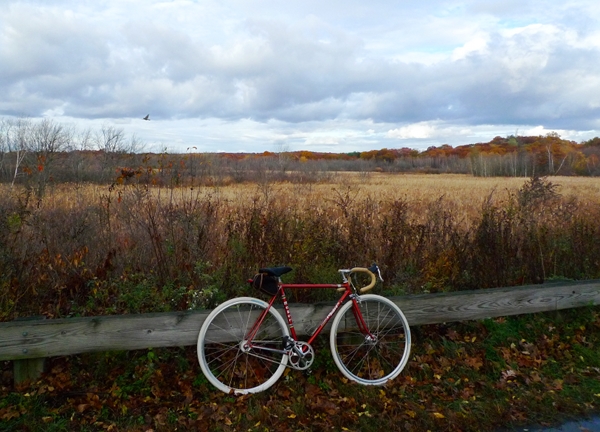
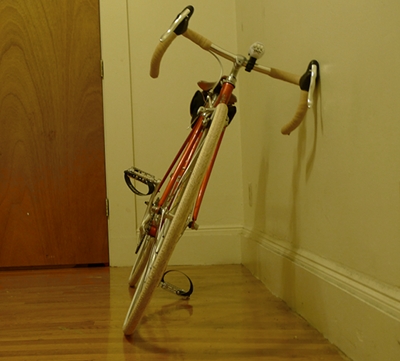
Almost every cyclist I'm friendly with loves to ride off road. And when I admit that I don't love it so much, the reaction is that of dismay. "What? But you like Rivendell! But you write about randonneuring! But you showed so much promise cycling on those scenic beach trails!" Well yes... And yet I prefer pavement.
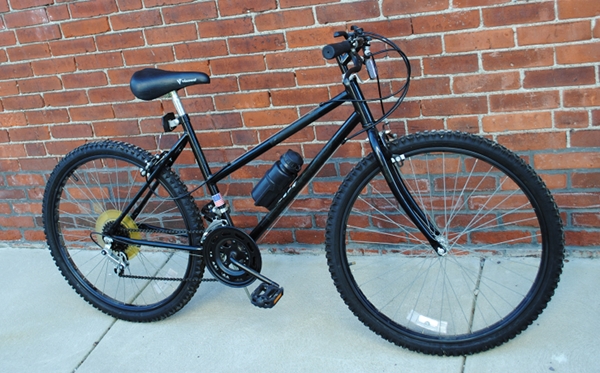
Of course, everyone has their own ideas of what "off road" is. For some, anything that's not paved qualifies. For others, only the really treacherous, narrow trails are worthy of the label. I tend to use the former definition, but often get corrected ("Oh, well that's not off road; that's just dirt roads!") - which of course only makes me feel more of a sissy. I can handle fire trails if they are packed dirt with occasional pebbles and roots, but I draw the line at loose gravel that slips out from under my tires, and trails fraught with large rocks and ditches that I need to navigate around at speed. It feels unsafe, and when I feel unsafe no amount of romantic photos or assurances that "it'll be fine!" from ride companions can induce me to go on. Maybe it'll be fine for them, but I need to think for myself and my brain screams "don't do it; you'll perish!"
But maybe I exaggerate. When we were in Rockport last weekend, the Co-Habitant lured me onto some trails ("we'll walk our bikes to the water") and I ended up riding on 23mm tires over dirt and gravel. I've also found myself intentionally taking my bikes on unpaved parts of local trails lately, maybe to test the waters.
As August approaches, people are talking about the D2R2 (Deerfield Dirt-Road Randonnée) - a notoriously hilly, strenuous ride through Western Massachusetts and Vermont, held entirely on winding dirt roads. I considered trying to do the "easy" (40 mile) route, but based on the stories I hear even that might be out of my league. It would be good to read a ride report from someone whose comfort zone is similar to mine, to get an accurate idea of what it is really like.
But wait a minute, why would I even want to go to something like the D2R2 if I don't enjoy cycling off road? Maybe because I want to like it, or keep hoping that I'll like it if I just give it another chance. There is so much beauty that can't be seen from paved roads, and it's a shame to miss it. Now if only I could learn to climb and descend on loose gravel without panicking and getting off my bike immediately!
Showing posts with label technique. Show all posts
Friday, July 8, 2011
Tuesday, June 28, 2011
The Clipless Ambush: a Tale of Failure
Well, my first encounter with clipless pedals occurred sooner than I anticipated. Last week the Co-Habitant decided to update his pedals, and the new set arrived in the mail today... which meant that he could gift me his old ones. I thought that surely this gifting would take place some time in the future - a distant, abstract future. But no. Cheerfully he attached them to one of our vintage roadbikes right then and there, so that I could give them a try. Don't get me wrong, I myself had expressed interest in this. But... I don't know, I just didn't expect it to happen immediately!
I already owned a pair of compatible shoes, having bought them on clearance last summer "just in case." With apprehension I watched him attach the cleats to the soles, trying to gauge the correct position. I then put them on and dragged the bike over to the kitchen sink, so that I could hold on to the edge with one hand as I tried to figure out how the contraptions worked.
I expected that clipping in would be relatively easy, but clipping out difficult. It was the opposite. At first I could not to clip in. I tried and tried, but my foot stayed on top of the pedal and the mechanism would not engage no matter how hard I pressed. I struggled to figure out what I was doing wrong, but the explanation turned out to be simple: I am a weakling. We had to loosen the tension almost to the max for my foot to engage the mechanism. Even after that, I still had trouble pressing down with enough force and in the exact position necessary for the cleat to catch. Clipping out, on the other hand, was intuitive: the sideways twist of the foot is exactly the same motion required to get out of Power Grips, so I found it natural. Transitioning from the kitchen sink to the trainer, I practiced for some time, clipping in and out successfully. I then decided it was time to go outside. I felt pretty confident at this point. Nothing to this.
It was around 10 pm and the small side street behind our house was well lit and empty of cars. Confidently, I carried the bike outdoors, swung my leg over the top tube, and clipped in my right foot. Now all I had to do was push off, coast for a bit, then put my left foot back down on the ground. That would be such an easy first step. No different from Power Grips. Just need to do it. Now. Go! But... it was not to be. Like some malfunctioning marionette, I kept clipping and unclipping my right foot, trying to mentally force myself to push off, but it wasn't working; nothing was happening. The amused Co-Habitant offered to stand at the end of the street and "catch me" if I found myself unable to unclip when I got there. But imagining that just made it worse. It began to feel as if I'd forgotten how to ride a bike entirely.
There is no redeeming ending to this story. After a good ten minutes I gave up and went back inside, my head hung low in shame. Obviously I am just not ready.
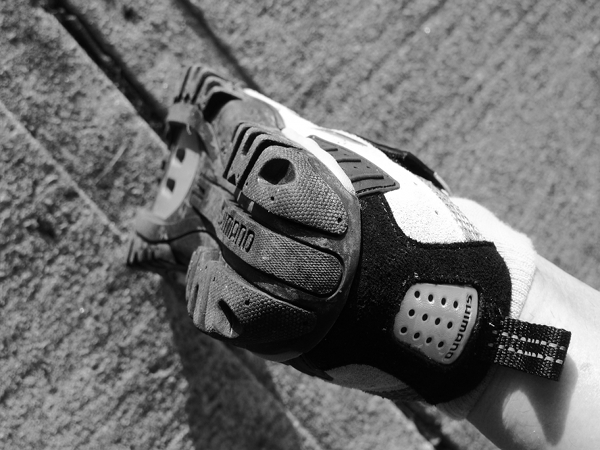
Aside from the tale of failure, I have some observations about the shoe and pedal set-up. I can't find the model name of the shoes, but in retrospect getting clipless shoes with laces was silly. Being stiff and unyielding, they are difficult to put on and tighten, and it's a pain to tuck the laces under the velcro. I am also not sure these pedals are right for me. They are Shimano SPD 520s: mountain bike style, double sided and with a very small surface area. I know that many love this type of pedal, but to me it felt like not enough of my foot was connected. Pedaling on the trainer, I had the sensation that there was too much pressure on the spot where the cleat meets the pedal and that a larger contact area would have been better. Maybe these particular shoes are not stiff enough, or maybe I would do better with a different style of pedals. There seems to be a consensus that the mountain bike clipless system is easier than the road system, but I wonder whether I might prefer the latter. Unfortunately, there is no way to try these things out.
Navigating the world of clipless shoes and pedals is complicated, and at the moment it seems best to postpone it... at least until I am brave enough to use the ones I have beyond the confines of my kitchen!
Labels:
roadcycling,
technique
Saturday, June 25, 2011
We All Fall Down?
Girl on Roadbike: So you've never worn clipless shoes?
Me: Nope.
GOR: Oh you should just do it! It's really easy, honest.
Me: Really?
GOR: Oh totally!
Me: So how did you get the hang of it?
GOR: Well, I fell down all the time at first!
Me: [horrified silence]
GOR: Yeah, it was pretty funny. I'd come to a stop and just go plop!
Me: Oh my God...
GOR: But don't worry, after a couple of weeks you'll be fine!
You see, that right there is what separates me from "normal people" who've grown up playing sports: I see being guaranteed to fall and being told not to worry as completely incompatible notions.
Hopefully I won't jinx myself by writing this here, but I've never fallen off my bike as an adult. When I tell this to experienced cyclists, their reaction is usually "Oh, that's not good. You need to get used to falling." The idea being that, if I have no concept of falling - and more importantly, of how to fall "correctly" - then when it actually happens (the use of "when" instead of "if" is in itself alarming), it's going to be bad. I've been given advice such as to go out and practice falling on some grass, but honestly I cannot imagine doing that unless someone holds a gun to my head... and even then, I'd probably be trying to talk my way out of it!
What exactly scares me about falling I don't know. I don't have a fear of pain, so that's not it (I sat though an emergency root canal without novocaine yesterday, which was honestly not so bad!). Maybe I have a strong self-preservation instinct, and the physical sensation of the fall triggers it. Either way, when I am told that a specific behaviour - like learning to ride clipless - is pretty much guaranteed to make me fall multiple times, I am highly motivated to avoid that behaviour.
How do you feel about the idea of falling off your bike? Is it something you view as an inherent part of cycling (be it for sport, recreation or transportation), or do you believe that it can (and should) be avoided?
Labels:
technique
Monday, June 13, 2011
Putting Your Foot Down
Enough people have asked me about this now that I thought it worth writing about: How do I put a toe down in traffic while remaining on the saddle, and also manage to get full leg extension on the downstroke? I will try to explain.
First off, let me clarify that I get "more or less" full leg extension, and obviously my leg would be even straighter if I had the saddle higher. So there is a bit of give and take to it. But the idea that your leg needs to be arrow-straight on the downstroke with the toe on the pedal and the heel raised, is not one that everyone subscribes to - especially not cyclists in cities where riding a bike for transportation is common. In Vienna, I would say that about half the cyclists I saw had their saddles adjusted so that they could touch the ground with a toe. Based on the pictures here, this seems to be the case in Copenhagen as well. When riding in cities with frequent intersections and stop signs, it can be tedious to get on and off the bike every 3 minutes. Being able to put a toe down makes things easier.
Another point, is that some bicycles' geometries work better for this than others: Typically, Dutch-style city bicycles have very relaxed seat tube angles, which increases the distance between the saddle and the pedals while keeping the saddle height constant. A lower bottom bracket helps as well, though not as much as a slack seat tube. You can watch this video of Dottie starting and stopping on her bike to get a better idea of how this works on a Dutch bike.
Finally, this may not be sufficiently noticeable in pictures, but I lean my bike to the side in order to reach the ground with a toe. I also keep my other foot on the pedal for balance. I cannot reach the ground with both toes, and I cannot even really reach with one toe unless I lean. This is something that becomes instinctive if you do it often enough. Alternatively, you could set the saddle lower. I've basically raised mine as far as I possibly can, while still managing to reach with one tip-toe while leaning.
Adjusting your saddle so that you can stop with a toe down is mainly about convenience. Some cyclists prefer this method, while others feel that not having their leg 100% straight on the downstroke robs them of power. How do you stop in traffic when cycling for transportation? And is it the method you've always used, or did you develop it after some trial and error?
First off, let me clarify that I get "more or less" full leg extension, and obviously my leg would be even straighter if I had the saddle higher. So there is a bit of give and take to it. But the idea that your leg needs to be arrow-straight on the downstroke with the toe on the pedal and the heel raised, is not one that everyone subscribes to - especially not cyclists in cities where riding a bike for transportation is common. In Vienna, I would say that about half the cyclists I saw had their saddles adjusted so that they could touch the ground with a toe. Based on the pictures here, this seems to be the case in Copenhagen as well. When riding in cities with frequent intersections and stop signs, it can be tedious to get on and off the bike every 3 minutes. Being able to put a toe down makes things easier.
Another point, is that some bicycles' geometries work better for this than others: Typically, Dutch-style city bicycles have very relaxed seat tube angles, which increases the distance between the saddle and the pedals while keeping the saddle height constant. A lower bottom bracket helps as well, though not as much as a slack seat tube. You can watch this video of Dottie starting and stopping on her bike to get a better idea of how this works on a Dutch bike.
Finally, this may not be sufficiently noticeable in pictures, but I lean my bike to the side in order to reach the ground with a toe. I also keep my other foot on the pedal for balance. I cannot reach the ground with both toes, and I cannot even really reach with one toe unless I lean. This is something that becomes instinctive if you do it often enough. Alternatively, you could set the saddle lower. I've basically raised mine as far as I possibly can, while still managing to reach with one tip-toe while leaning.
Adjusting your saddle so that you can stop with a toe down is mainly about convenience. Some cyclists prefer this method, while others feel that not having their leg 100% straight on the downstroke robs them of power. How do you stop in traffic when cycling for transportation? And is it the method you've always used, or did you develop it after some trial and error?
Labels:
loop frame,
technique,
urban cycling
Friday, June 10, 2011
Understanding Rest and Recovery
For the past month I've been cycling about 120 miles per week, not counting transportation. And as someone who is completely new to the concept of "training" (i.e. cycling with the goal to become faster, better uphill, and so on) I've been struggling with how to structure my rides. Last year the very notion of structure would have seemed completely ridiculous: I would simply go off on my bike whenever I had the time. But last year I never cycled the way I do now, never exerted myself to such an extent repeatedly. Now everything is different, and I feel completely lost in this new territory.
One thing I've realised, is that if I do strenuous rides for more than two days in a row, on the third day my performance starts to get worse rather than better. Even if I don't think that I feel tired, it's as if my legs stop working properly. If you're an athlete, you are probably thinking "well, duh!" but to me this was a novel discovery. The idea of needing to rest and recover in order to improve did not have meaning until I physically experienced it.
What I am trying to figure out now is, what exactly does resting and recovering entail? Some advise that on days off, you absolutely must do "recovery rides" - 15-20 mile rides at an easy pace on fairly flat terrain - and that not doing them will result in stiff muscles and make it even more difficult to ride the next day. Others advise that on days off, you need to stay off the bicycle completely and just basically lounge around and eat so that your system can fully recover. Unless I am misinterpreting (which is entirely possible), these two points of view seem at odds with one another. So which is applicable under which circumstances?
Having tried both methods, I am still not sure which works better. I am also not sure whether transportation cycling (on an upright bike) is considered a type of recovery ride, or whether it's considered not cycling at all. Given that it activates a different set of muscles I suspect the latter, but I could be wrong. None of this stuff is intuitive for me, which makes it both frustrating and fascinating.
One thing I've realised, is that if I do strenuous rides for more than two days in a row, on the third day my performance starts to get worse rather than better. Even if I don't think that I feel tired, it's as if my legs stop working properly. If you're an athlete, you are probably thinking "well, duh!" but to me this was a novel discovery. The idea of needing to rest and recover in order to improve did not have meaning until I physically experienced it.
What I am trying to figure out now is, what exactly does resting and recovering entail? Some advise that on days off, you absolutely must do "recovery rides" - 15-20 mile rides at an easy pace on fairly flat terrain - and that not doing them will result in stiff muscles and make it even more difficult to ride the next day. Others advise that on days off, you need to stay off the bicycle completely and just basically lounge around and eat so that your system can fully recover. Unless I am misinterpreting (which is entirely possible), these two points of view seem at odds with one another. So which is applicable under which circumstances?
Having tried both methods, I am still not sure which works better. I am also not sure whether transportation cycling (on an upright bike) is considered a type of recovery ride, or whether it's considered not cycling at all. Given that it activates a different set of muscles I suspect the latter, but I could be wrong. None of this stuff is intuitive for me, which makes it both frustrating and fascinating.
Labels:
roadcycling,
technique
Thursday, June 9, 2011
Paceline Ride, Take 2... or How I Psyched Myself Out, Then Had Fun After All
After two weeks of cancellations due to inclement weather and a week skipped due to injury, I finally did my second paceline ride. Because so much time passed since the previous one, the whole thing had gotten completely blown out of proportion in my mind, and I was even more nervous than before. I was now convinced that it wasn't being on a touring bike that made the ride strenuous for me last time - it was just me, being hopelessly out of my league. Was I prepared to face the embarrassment of arriving on my 110% appropriate loaner Seven just to have the same experience as before?
But moreover, as time passed I began to question whether pacelines were really a good idea for "someone like me." Since my write-up about the first ride, I've been warned by readers and acquaintances alike about how unsafe pacelines are, how ruthless the members of this particular cycling team supposedly are, and how there was no need to go to extremes - why not join a nice social group ride instead? I've even received links to videos of paceline crashes, just to make sure it sunk in what sort of danger I was exposing myself to. Though I took it all with a grain of salt, I would be lying if I said it didn't get to me. When I arrived to the meeting point for the ride, I was so nervous that I had to practically shove myself toward the group of women sitting on the grass. I can't believe that I managed to psych myself out to that extent. I did the ride, and it was great.
To clear up a misinterpretation of my previous post on the part of some readers, I never meant to suggest that the atmosphere of the last paceline ride was anything but welcoming. The leaders told me I had the wrong bike not because they were being unfriendly, but because I did have the wrong bike for that type of ride. This was an introduction to a sport and I basically showed up with inappropriate equipment. This handicapped me in comparison to the other participants, and they were simply letting me know that. My description of doing the previous ride on a touring bike was meant to show the humour of the whole situation, and not to criticise the nature of the ride or its organisers - for whose guidance and time I am genuinely grateful.
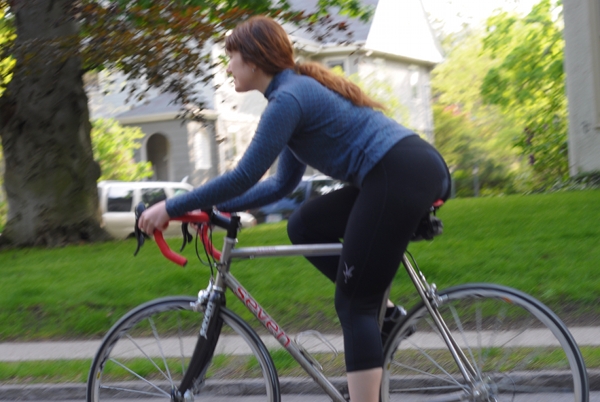
This time around, the difference in speed was so obvious that it is hardly worth discussing. Yes, a Seven Axiom set up for racing is faster than a Rivendell Sam Hillborne set up for touring, and to frame this as some profound realisation would be absurd. Still, I was tremendously relieved to have real evidence and not just assurances that "the right bike" would make such a difference. The right bike does not have to be a Seven of course. But it needs to be a light, aerodynamically set-up roadbike with closely spaced gearing and modern combination levers. When that's what every single other person in the group has, then that's what you need to have in order to be on equal footing.
Our group was larger this time and by the middle of the ride it was evident that a gap kept forming in the same spot. So we split into two groups and I ended up in the faster one. This was fantastic. I was mostly in the big ring for the rest of the ride, took more turns in the front, and practiced rotating while going full speed downhill. One of the leaders made sure to pull up alongside me and cycle as closely on my left as possible on the descent, having noticed that I am scared of that kind of proximity. With no way of escaping, I thought I'd lose my marbles and crash into a tree out of sheer fear of sensing her elbow 1" away from mine. "Oh my God, you're too close to me!" I pleaded. "No I'm not. Keep going. You need to get used to this." And I guess she had the right idea for how to deal with me: I got used to it.
At this point I am probably horrifying some of you again and making you wonder what on earth attracts me to this type of cycling. Honest answer: I don't know. But something definitely does. I like the speed. I like being in a paceline. I like receiving straightforward feedback about what I am doing wrong. I am relieved to know that my speed and endurance are up to par. My technique needs a lot of work, because I am still somewhat scared of the bike, scared of downhill speeds, and not entirely comfortable with constantly shifting gears. But all of that can be improved if I am willing to practice. The funny thing about human psychology, is that we tend to do what feels good without really knowing why, then construct elaborate rationalisations of our actions after the fact. But right now I'm too tired and confused to rationalise. I don't fully understand why I like the paceline rides. But I know that I want to keep doing them.
But moreover, as time passed I began to question whether pacelines were really a good idea for "someone like me." Since my write-up about the first ride, I've been warned by readers and acquaintances alike about how unsafe pacelines are, how ruthless the members of this particular cycling team supposedly are, and how there was no need to go to extremes - why not join a nice social group ride instead? I've even received links to videos of paceline crashes, just to make sure it sunk in what sort of danger I was exposing myself to. Though I took it all with a grain of salt, I would be lying if I said it didn't get to me. When I arrived to the meeting point for the ride, I was so nervous that I had to practically shove myself toward the group of women sitting on the grass. I can't believe that I managed to psych myself out to that extent. I did the ride, and it was great.
To clear up a misinterpretation of my previous post on the part of some readers, I never meant to suggest that the atmosphere of the last paceline ride was anything but welcoming. The leaders told me I had the wrong bike not because they were being unfriendly, but because I did have the wrong bike for that type of ride. This was an introduction to a sport and I basically showed up with inappropriate equipment. This handicapped me in comparison to the other participants, and they were simply letting me know that. My description of doing the previous ride on a touring bike was meant to show the humour of the whole situation, and not to criticise the nature of the ride or its organisers - for whose guidance and time I am genuinely grateful.
This time around, the difference in speed was so obvious that it is hardly worth discussing. Yes, a Seven Axiom set up for racing is faster than a Rivendell Sam Hillborne set up for touring, and to frame this as some profound realisation would be absurd. Still, I was tremendously relieved to have real evidence and not just assurances that "the right bike" would make such a difference. The right bike does not have to be a Seven of course. But it needs to be a light, aerodynamically set-up roadbike with closely spaced gearing and modern combination levers. When that's what every single other person in the group has, then that's what you need to have in order to be on equal footing.
Our group was larger this time and by the middle of the ride it was evident that a gap kept forming in the same spot. So we split into two groups and I ended up in the faster one. This was fantastic. I was mostly in the big ring for the rest of the ride, took more turns in the front, and practiced rotating while going full speed downhill. One of the leaders made sure to pull up alongside me and cycle as closely on my left as possible on the descent, having noticed that I am scared of that kind of proximity. With no way of escaping, I thought I'd lose my marbles and crash into a tree out of sheer fear of sensing her elbow 1" away from mine. "Oh my God, you're too close to me!" I pleaded. "No I'm not. Keep going. You need to get used to this." And I guess she had the right idea for how to deal with me: I got used to it.
At this point I am probably horrifying some of you again and making you wonder what on earth attracts me to this type of cycling. Honest answer: I don't know. But something definitely does. I like the speed. I like being in a paceline. I like receiving straightforward feedback about what I am doing wrong. I am relieved to know that my speed and endurance are up to par. My technique needs a lot of work, because I am still somewhat scared of the bike, scared of downhill speeds, and not entirely comfortable with constantly shifting gears. But all of that can be improved if I am willing to practice. The funny thing about human psychology, is that we tend to do what feels good without really knowing why, then construct elaborate rationalisations of our actions after the fact. But right now I'm too tired and confused to rationalise. I don't fully understand why I like the paceline rides. But I know that I want to keep doing them.
Labels:
paceline,
roadcycling,
seven,
technique
Tuesday, May 24, 2011
I am Curious, Yellow
Obscure film references aside, the past week for me has been dominated by equal parts anticipation and anxiety. I've ridden my loaner roadbike for 120 miles in preparation for the next paceline ride... which, ironically, was cancelled for the second time in a row due to rain. The more time passes, the more my anticipation builds and the more exaggerated my anxieties become.
The Co-Habitant and I did two fast-paced, hilly rides over the weekend - he on his Surly Cross Check and I on the borrowed Seven. We went over the same hills where he has previously passed me nonchalantly regardless of which bikes we were both riding... only this time our positions were reversed dramatically. I shot past him while exerting little effort, continued to merrily cycle uphill, and then waited for him to catch up as I sipped water and sniffed flowers.
Of course we expected that a racy roadbike would be faster than a heavier and more relaxed cyclocross bike with wide tires and a saddlebag. But since he is a stronger cyclist than I am to begin with, I thought that the discrepancy would level the playing field between us. Neither of us thought that it would make me this much faster uphill.
The interesting thing is that on downhills and flats there was not much difference between us; it was uphill that the bike really began to matter. This parallels my experience of the paceline ride on my Rivendell, where it was specifically on the uphill portions that I felt a disadvantage to the others.
But while I am now confident in the bike's climbing ability, this is tempered by a fear not only of its speed on descents, but also of my relative unfamiliarity with its handling. After putting nearly 2,000 miles on my Rivendell I pretty much know how it behaves across a wide range of situations. The 120 miles on the Seven are just not sufficient for that kind of comfort to develop. I don't mind admitting that I'm plain scared when riding it at 25mph+ downhill - scared of the narrow tires, scared of the carbon fork, and scared of its precise but aggressive cornering. The fear saps away my confidence, making me squeeze the brakes and cycle more conservatively than I am capable of.
Being 100% comfortable with a bicycle is not something I can force; it takes time. My curiosity is a strong motivator to keep riding and practicing, specifically seeking out those situations that still make me nervous.
While the bike is in my possession I've fitted it with my own saddle, which has made it more comfortable to ride long distances. I've also installed my pedals (the narrow MKS Streams) and PowerGrips. This looks silly on a bike that is typically ridden clipless, but I don't care: I need to ride it in a way that makes me comfortable. I've also now raised the saddle another 5mm from how it's shown in this picture, which almost makes it look like the standover is not too high. Almost. The length of the toptube and the handlebar set-up work well for me (the Ride Studio Cafe matched the configuration to one of my own bikes) and it's only the seat tube height that's off. The result is that the bike fits me extremely well when I am riding it, but looks too big when I am not. Ideally, the frame would have the same virtual top tube length, with the actual top tube just a little bit sloped in order to reduce standover. Given the available demo models I prefer this set-up over a smaller frame, because I don't like toe overlap. All in all I feel good on this bike, which is what matters.
I really hope they don't cancel the paceline ride next week; the anticipation is getting ridiculous. In the meantime, all I can do is keep riding.
The Co-Habitant and I did two fast-paced, hilly rides over the weekend - he on his Surly Cross Check and I on the borrowed Seven. We went over the same hills where he has previously passed me nonchalantly regardless of which bikes we were both riding... only this time our positions were reversed dramatically. I shot past him while exerting little effort, continued to merrily cycle uphill, and then waited for him to catch up as I sipped water and sniffed flowers.
Of course we expected that a racy roadbike would be faster than a heavier and more relaxed cyclocross bike with wide tires and a saddlebag. But since he is a stronger cyclist than I am to begin with, I thought that the discrepancy would level the playing field between us. Neither of us thought that it would make me this much faster uphill.
The interesting thing is that on downhills and flats there was not much difference between us; it was uphill that the bike really began to matter. This parallels my experience of the paceline ride on my Rivendell, where it was specifically on the uphill portions that I felt a disadvantage to the others.
But while I am now confident in the bike's climbing ability, this is tempered by a fear not only of its speed on descents, but also of my relative unfamiliarity with its handling. After putting nearly 2,000 miles on my Rivendell I pretty much know how it behaves across a wide range of situations. The 120 miles on the Seven are just not sufficient for that kind of comfort to develop. I don't mind admitting that I'm plain scared when riding it at 25mph+ downhill - scared of the narrow tires, scared of the carbon fork, and scared of its precise but aggressive cornering. The fear saps away my confidence, making me squeeze the brakes and cycle more conservatively than I am capable of.
Being 100% comfortable with a bicycle is not something I can force; it takes time. My curiosity is a strong motivator to keep riding and practicing, specifically seeking out those situations that still make me nervous.
While the bike is in my possession I've fitted it with my own saddle, which has made it more comfortable to ride long distances. I've also installed my pedals (the narrow MKS Streams) and PowerGrips. This looks silly on a bike that is typically ridden clipless, but I don't care: I need to ride it in a way that makes me comfortable. I've also now raised the saddle another 5mm from how it's shown in this picture, which almost makes it look like the standover is not too high. Almost. The length of the toptube and the handlebar set-up work well for me (the Ride Studio Cafe matched the configuration to one of my own bikes) and it's only the seat tube height that's off. The result is that the bike fits me extremely well when I am riding it, but looks too big when I am not. Ideally, the frame would have the same virtual top tube length, with the actual top tube just a little bit sloped in order to reduce standover. Given the available demo models I prefer this set-up over a smaller frame, because I don't like toe overlap. All in all I feel good on this bike, which is what matters.
I really hope they don't cancel the paceline ride next week; the anticipation is getting ridiculous. In the meantime, all I can do is keep riding.
Labels:
Co-Habitant,
diamond frame,
roadcycling,
seven,
Surly,
technique
Friday, May 13, 2011
Surviving a Paceline Training Ride

It was overcast and threatening to rain all afternoon, but I checked the team's website before leaving the house, and the ride was on. The meeting point was in Lexington, MA - which is 8.5 miles from where I live. I rode my bike there, taking care to go at a leisurely pace so that I wouldn't already be tired upon arrival. I was so nervous, that I needed all of those 8.5 miles just to calm down.
I spotted the meeting location immediately. There was a crowd of several dozen women in roadie attire and as many bikes lying on the grass and propped up against trees. My heart sank as I saw them. I guess I had expected more of a mix: Some women on modern carbon fiber and others on old 10-speeds; some in clipless shoes and others not; some in lycra and others in gym shorts. But no: Every single person there had a super-light modern roadbike with "brifters." Every single person there was wearing clipless shoes. Not a soul had a kickstand, fenders or racks on their bike but me. Not a soul had a bag attached to their bike. No one else had, um, a twined stainless steel water bottle. And all wore lycra - the club-affiliated cyclists readily distinguishable by their team kit. Thankfully, at least I wore my cycling knickers and jersey (albeit all wool) and not something more casual. Reluctantly, I approached.
Greeted by a woman in team kit who looked like one of the leaders, I was pointed to a bench where everybody was signing waivers. I made the mistake of starting to read the waiver, but the things described there were so horrible that I stopped and just signed it. When I returned to the spot I'd left my bike, two other women-in-charge were gathered in front of it. Was this my bike? Yes... The one I was planning to ride? Yes... They examined my Rivendell as if it were a 100-year-old antique or a creature from outer space. There was some debate as to whether it would be allowed: My bicycle was extremely heavy, the tires were too wide, and I did't have the right shifters. I would have trouble doing the ride. Was this even a roadbike? Only roadbikes were allowed. Finally, the senior-most woman was called to resolve the issue. In the end my bicycle was deemed allowable, but not a good idea. I would have trouble doing the ride; I needed a different bike. I tried not to let myself get scared by this. The group I planned to join was described as "paceline learning skills for beginners, 12-15mph." I could ride at that speed on the Rivendell with my eyes closed (just a figure of speech, don't worry), so all I had to do was focus on the skills. And so I stayed.
The crowd was split into groups and the beginner's group consisted of eight of us: six newcomers and two leaders. The leaders gave us a brief explanation of what it meant to ride in a paceline: The group cycles in a single-file procession, staying close to each other's wheels in a straight line. When the person in front gets tired, they move over to the left and drift to the back of the line, then merge with the paceline in the rear. This gets repeated every few minutes. One thing that makes perfect sense but I hadn't realised in advance, is that you cannot coast in a paceline. Whether going fast or slow, cyclists must keep pedaling at all times, because that is how members of the paceline are able to maintain uniform speed - they synchronise their leg movements. So, coasting is forbidden. Hard braking is also forbidden, as it can cause the person behind to crash into you. To slow down, you need to keep pedaling while "feathering" the brakes. Finally, there is a system of signals that members of a paceline must use - from the person in front indicating that they will move to the left now, to warning about potholes, to asking to merge into the middle of the paceline if you are drifting back on the left and there is a car coming. We were quickly shown all of these, and without further ceremony we set off on our 20 mile ride through rolling hills.
At this point I will confess that I am apparently an extremely poor judge of my own strengths and weaknesses when it comes to cycling. I had thought that my biggest and only problem with these rides would be technique. I expected to experience debilitating fear when cycling 6" behind someone's wheel, to be dangerously clumsy at executing paceline maneuvers, and to be slow on the uptake whenever instructions were given. On the other hand, I expected myself to have no problem at all with the pace and terrain of the ride: I mean, 12-15mph? Please!
Instead, the exact opposite happened: I found the paceline training itself to be natural and had no problems with technique. I did not experience fear. I behaved predictably and signaled appropriately. I didn't coast and I feathered the brakes, modulating my speed smoothly (thank you, fixed gear!). I reacted quickly and calmly when instructions were given to me. I never once swerved or did anything crazy out of fear or incompetence. In short: all my worries about being poorly coordinated and getting flustered around other cyclists were completely unfounded. I still can't believe it.
As for being fine with the pace... Um, not so much. I nearly died of exhaustion and I wish I could say it's the bike's fault. I don't know how to explain it. Maybe it was the no-coasting thing that did me in, combined with the fact that 15mph was the typical speed on flats, with 12mph being the uphill speed and 25mph the downhill speed (while still trying not to break the paceline). Anyhow, I was just not physically fit enough for the uphill portions of the ride. It was a shameful struggle trying not to lose the wheel of the person in front of me on the ascents, as the leader cycled alongside attempting to reassure me: "You see now?... You're at a real disadvantage with that bike... But you're doing well... Breathe... That's right... Good... Next time, different bike..."
Truthfully, I don't know whether it was the poor bike's fault or mine. All the other girls on the ride were athletes of some sort - runners or "spinners" (i.e. at the gym, on stationary bikes), looking to transition to roadcycling as a new sport to try. My background is very different. I am not an athlete and have never been an athlete. And I have done zero exercise all winter other than riding upright bikes for transportation. So maybe it's really a case of "next time, stronger leg muscles." I would be curious to try the same ride on a modern roadbike and see whether it's any less difficult, but I am skeptical.
Still, there are other problems with using my bike on these rides: Namely, the shifters, brake levers and possibly even handlebars. With my friction bar-end shifters, I was at a distinct disadvantage to the other girls, who could shift instantaneously thanks to their indexed "brifters." It was a little ridiculous actually. Moreover, moving my hand to the edge of the right handlebar in order to shift was problematic, because it is a similar gesture to the signal used for indicating pulling over to the left (you have to wiggle your right elbow). In that sense, using bar-ends in a paceline where no one knows what they are has the potential to cause an accident if the person behind me interprets my changing gears as inviting them to move forward. Do I want to be responsible for that?... As for the brake levers: I cannot modulate my brakes well from the drops because of how my handlebars are shaped, and so I only brake from the hoods. When going downhill, the leader wanted us all to get in the drops for maximum "aerotuck." She kept telling me to do this, but I refused because it wasn't a safe position for me to feather the brakes from. So I stayed on the hoods, but bent my elbows so much that my chin was practically on my handlebars, achieving the aerodynamic positioning they wanted. I explained this to the leader later and she was okay with it under the circumstances... but it was yet more evidence of my needing a different bike - with shallow drops and with brake levers I could modulate from all positions.
If all of this sounds like a miserable, degrading struggle, then I've done a good job of describing it. It went on for an hour and a half as we cycled past farms, forests and highways practicing paceline maneuvers. But there were a few minor advantages to my bike as well. At some point it began to rain, and the group leaders grew alarmed - contemplating shortcuts back in case the rain continued. At first I could not understand what the problem was, but eventually realised that their bikes were prone to "wiping out" on wet terrain. Thankfully, that is one problem I don't have on my Rivendell. There was also a fear of sand. Sand on the road was signaled down the paceline as if it were a pothole to avoid. Not something I normally worry about. While these advantages were fairly minor compared to the disadvantages I experienced, they provided at least some relief.
We arrived back at the meeting point just as it was growing dark, and the girls began taking their bikes to their cars. When they learned that I had cycled from Somerville and now planned to cycle back, several of them offered to give me a lift. But I opted for a quiet ride home on the (now pitch-black) Minuteman Trail, to review the evening'e events in my head and relax. I cycled slowly as the lights on my bike illuminated my path. It was a beautiful night, and when the rain started up again the smell of the surrounding meadows grew pleasantly strong. I never, ever had to do the paceline ride again if didn't want to, but could just quietly cycle in the dark like this on my own forever. And yet?...
Labels:
paceline,
roadcycling,
technique
Monday, May 9, 2011
First Group Ride!
Yesterday, I went on my first group ride. Yes, there were only three of us and we're all friends. But those who were reading this blog last summer understand what an accomplishment this is for me.
Ever since I began to ride a roadbike, I've been whining about wanting to learn how to ride in a group... yet refusing to go on group rides. Yes, it was paradoxical. But you see, I wanted to learn the skills of riding in a group, while at the same time being afraid of it - convinced that I would perish in a high speed crash, images of the most gruesome bicycle race pile-ups flashing through my mind. I toyed with the idea of joining the women's training rides offered by a local cycling team, but ultimately the entire summer passed and I did not do it - opting for solitary rides and occasional rides with the Co-Habitant instead. I had to be coaxed into joining yesterday's ride, and I did try to back out as usual... but in the end something just clicked in my head and I went. And I'm very glad. Yes, I know you told me so!
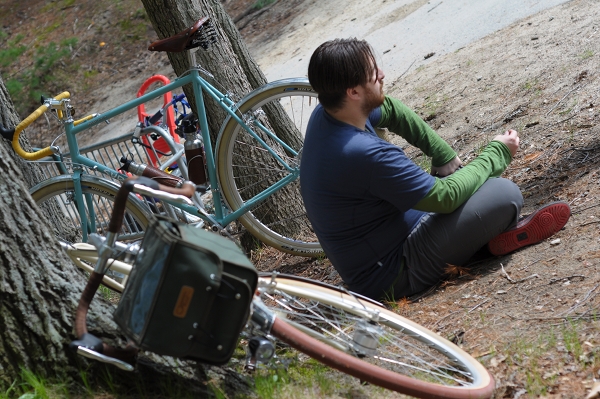
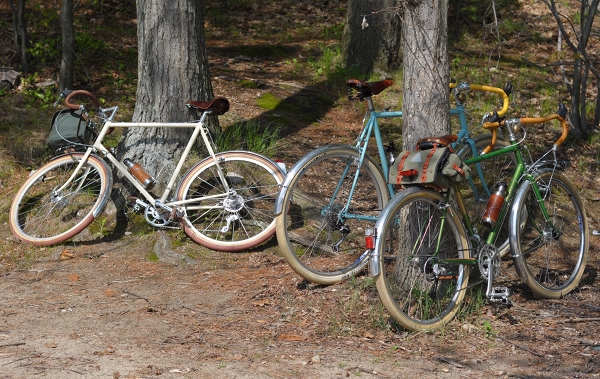
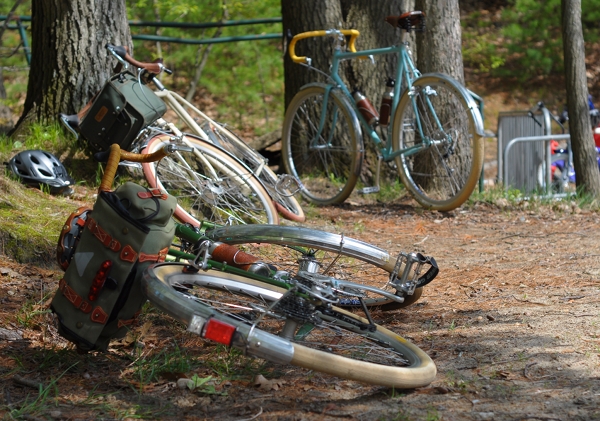
My cycling partners were the Co-Habitant on his nearly-finished Surly Cross-Check (notice the fenders!) and our neighbour Somervillain on his vintage 650B conversion.
I was on my Rivendell Sam Hillborne. How happy he was to be out amidst the cherry blossoms!
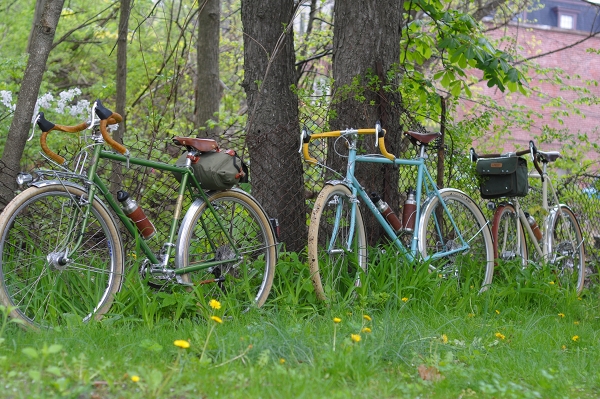
Though we were riding different bikes, the aesthetic was amusingly similar. We all had candy-coloured frames with fat tires, cantilever brakes, aluminum fenders, leather saddles, classic bar wrap, and even twined water bottles. All three of us were also wearing wool. We looked like a team of eccentric bicycle obsessionists. The plan was to go on a roughly 40 mile loop - starting on the Minuteman Trail, then going through the hilly parts of Lexington, and arriving in Concord, MA - where we would stop before returning along a similar route.
Any nervousness I had about the ride dissipated as soon as the three of us set off in city traffic on the way to the Minuteman Trail. I expected this to be stressful - keeping pace with the others while paying attention to cars and negotiating treacherous intersections - but instead it was easy. Easier than cycling in traffic alone and easier than cycling in traffic with just the Co-Habitant. I still need to think this through in order to understand why, but possibly because three cyclists really do constitute a group in the eyes of motorists and are thus given more space. Maybe. Whatever the reason, it was great.
For the first part of our ride, we went in an unchanging single file procession - with the Co-Habitant first, Somervillain second, and me last. We cycled fairly closely behind one another, which I did not find problematic. It took me some time to get used to the rhythm with which Somervillain started from a stop, and to time my own starts the same way so that I wouldn't run into him. But otherwise, it was all very intuitive. I did not have trouble pacing myself to maintain the same speed consistently. And I also liked it that they hand-signaled every move they would make on the road. When we cycle alone, the Co-Habitant and I don't do this - which sometimes results in miscommunication.
We went along the Minuteman Trail at 14-16mph, then headed for the hills in Lexington. We've had an especially long winter and rainy spring this year, and I had not done major hills like this since last Fall. I was physically unprepared for them. I also forgot how steep and long this one particular hill was. We began climbing it, and almost immediately I was spinning in a low gear and my speed dropped to 7mph. I just couldn't do any better. It was at this point that we dispersed, so that the stronger riders would not lose momentum. Somervillain took off uphill and the Co-Habitant followed him at a slower pace, but still faster than me. I eventually made it, but the climb was such a huge shock to my system that even the downhill decent that followed made me unable to catch up with them. As soon as the distance between us decreased, came another uphill and I would lose them again. While I found this frustrating, I also appreciated having a true sense of the differences in our abilities. And I certainly preferred them going ahead to slowing down for me - that would have made me feel excruciatingly self-conscious. We cycled over a series of hills in a similar style - the distance between us decreasing on the descent, then increasing again on the ascent - until finally the elevation changes lessened and we were able to cycle in a single file again. I did not have trouble keeping up on flats and mild hills, so that was a relief. The day had been beautiful and sunny up until then, but now it started to rain, which was a relief as well. The raindrops cooled me down.
We stopped in the Concord town center to have lunch and coffee. The sun came out again by then, and the small town looked ridiculously picturesque - blue skies, green grass and cherry blossoms everywhere.
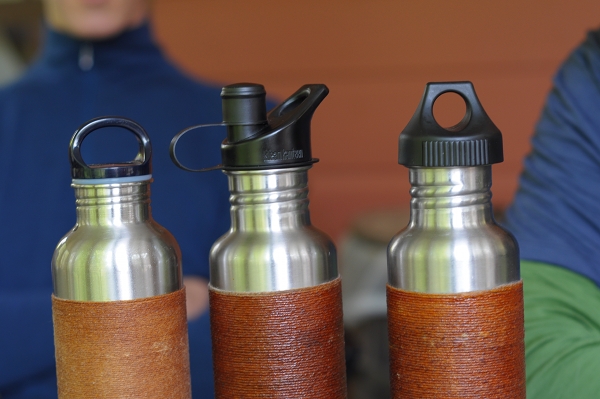
We filled up our water bottles.
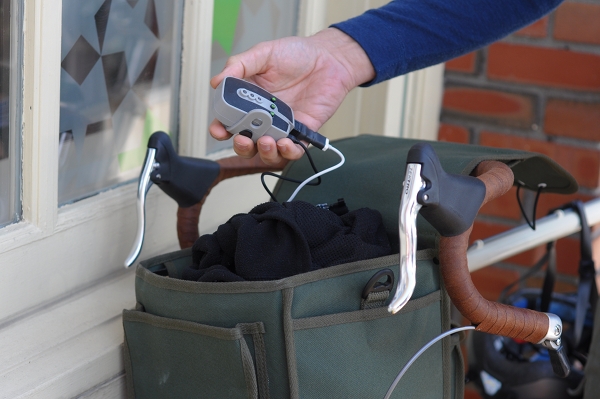
And Somervillain showed us his clever iphone-charging system.
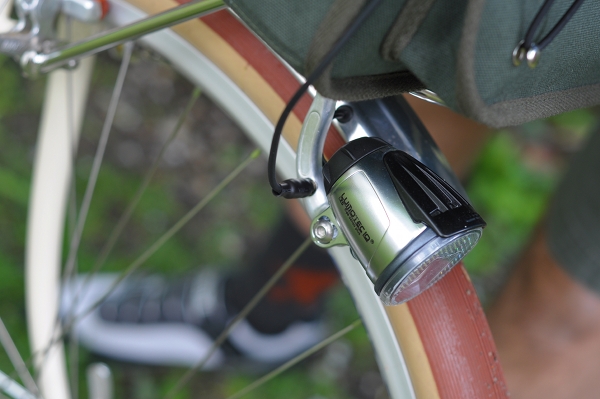
The socket is built into the light mount and derives its power from the dynamo hub. He made it himself. I don't own an iphone, but still want this on my bike!
At some point in the course of the ride, the Co-Habitant's brakes suddenly became stronger, solving his brake dilema. Looks like they just needed to wear in.
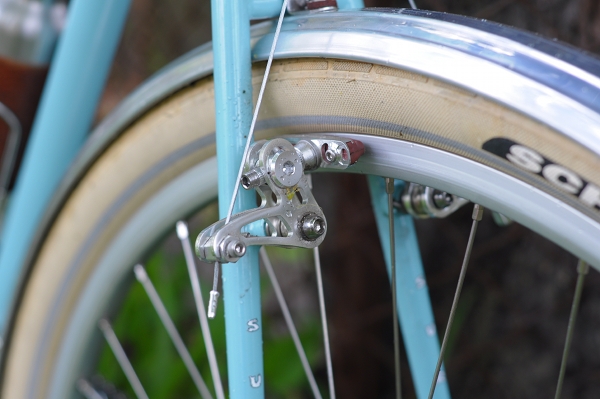
My writing skills are not strong enough to make the canti-comparison conversation that followed sound interesting, but I'll show you Somervillain's Mafac brakes.
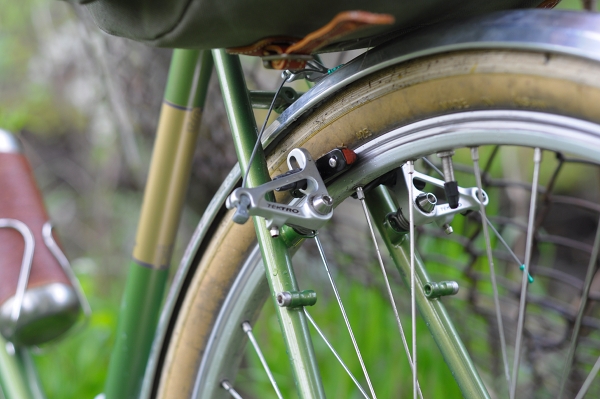
And my Tektro brakes. After a thorough examination of my bike, we may now have a diagnosis for my complaint about the drivetrain fussiness: bent derailleur hanger, possibly. So I will have to take care of that.
After the town center, we cycled a bit further and stopped by Walden Pond.
Even with lots of people there on a Sunday, it is still such a quiet, meditative place.
We chose a slightly less hilly route home, and the return part of our loop was more casual. We switched places in line frequently, and at times cycled in a cluster instead of a procession - all of which I was fine with. I got a sudden burst of energy on the way back and did not feel tired.
It is fair to conclude that my first group ride was a success. I enjoyed cycling in a procession at a controlled speed, and I did not have problems riding in close proximity to the others. I guess my sense of incompetence in this respect was exaggerated. The losing them on hills aspect I will have to work on, but I think it is to be expected given the differences in physical strength between us.
I looked up the schedule for the women's training rides this summer, and the first one of the season is this Tuesday - tomorrow! Before I lose my nerve, I think I need to just force myself to show up. Will make my best effort - now off to shop for a certain required accessory!
Ever since I began to ride a roadbike, I've been whining about wanting to learn how to ride in a group... yet refusing to go on group rides. Yes, it was paradoxical. But you see, I wanted to learn the skills of riding in a group, while at the same time being afraid of it - convinced that I would perish in a high speed crash, images of the most gruesome bicycle race pile-ups flashing through my mind. I toyed with the idea of joining the women's training rides offered by a local cycling team, but ultimately the entire summer passed and I did not do it - opting for solitary rides and occasional rides with the Co-Habitant instead. I had to be coaxed into joining yesterday's ride, and I did try to back out as usual... but in the end something just clicked in my head and I went. And I'm very glad. Yes, I know you told me so!
My cycling partners were the Co-Habitant on his nearly-finished Surly Cross-Check (notice the fenders!) and our neighbour Somervillain on his vintage 650B conversion.
I was on my Rivendell Sam Hillborne. How happy he was to be out amidst the cherry blossoms!
Though we were riding different bikes, the aesthetic was amusingly similar. We all had candy-coloured frames with fat tires, cantilever brakes, aluminum fenders, leather saddles, classic bar wrap, and even twined water bottles. All three of us were also wearing wool. We looked like a team of eccentric bicycle obsessionists. The plan was to go on a roughly 40 mile loop - starting on the Minuteman Trail, then going through the hilly parts of Lexington, and arriving in Concord, MA - where we would stop before returning along a similar route.
Any nervousness I had about the ride dissipated as soon as the three of us set off in city traffic on the way to the Minuteman Trail. I expected this to be stressful - keeping pace with the others while paying attention to cars and negotiating treacherous intersections - but instead it was easy. Easier than cycling in traffic alone and easier than cycling in traffic with just the Co-Habitant. I still need to think this through in order to understand why, but possibly because three cyclists really do constitute a group in the eyes of motorists and are thus given more space. Maybe. Whatever the reason, it was great.
For the first part of our ride, we went in an unchanging single file procession - with the Co-Habitant first, Somervillain second, and me last. We cycled fairly closely behind one another, which I did not find problematic. It took me some time to get used to the rhythm with which Somervillain started from a stop, and to time my own starts the same way so that I wouldn't run into him. But otherwise, it was all very intuitive. I did not have trouble pacing myself to maintain the same speed consistently. And I also liked it that they hand-signaled every move they would make on the road. When we cycle alone, the Co-Habitant and I don't do this - which sometimes results in miscommunication.
We went along the Minuteman Trail at 14-16mph, then headed for the hills in Lexington. We've had an especially long winter and rainy spring this year, and I had not done major hills like this since last Fall. I was physically unprepared for them. I also forgot how steep and long this one particular hill was. We began climbing it, and almost immediately I was spinning in a low gear and my speed dropped to 7mph. I just couldn't do any better. It was at this point that we dispersed, so that the stronger riders would not lose momentum. Somervillain took off uphill and the Co-Habitant followed him at a slower pace, but still faster than me. I eventually made it, but the climb was such a huge shock to my system that even the downhill decent that followed made me unable to catch up with them. As soon as the distance between us decreased, came another uphill and I would lose them again. While I found this frustrating, I also appreciated having a true sense of the differences in our abilities. And I certainly preferred them going ahead to slowing down for me - that would have made me feel excruciatingly self-conscious. We cycled over a series of hills in a similar style - the distance between us decreasing on the descent, then increasing again on the ascent - until finally the elevation changes lessened and we were able to cycle in a single file again. I did not have trouble keeping up on flats and mild hills, so that was a relief. The day had been beautiful and sunny up until then, but now it started to rain, which was a relief as well. The raindrops cooled me down.
We stopped in the Concord town center to have lunch and coffee. The sun came out again by then, and the small town looked ridiculously picturesque - blue skies, green grass and cherry blossoms everywhere.
We filled up our water bottles.
And Somervillain showed us his clever iphone-charging system.
The socket is built into the light mount and derives its power from the dynamo hub. He made it himself. I don't own an iphone, but still want this on my bike!
At some point in the course of the ride, the Co-Habitant's brakes suddenly became stronger, solving his brake dilema. Looks like they just needed to wear in.
My writing skills are not strong enough to make the canti-comparison conversation that followed sound interesting, but I'll show you Somervillain's Mafac brakes.
And my Tektro brakes. After a thorough examination of my bike, we may now have a diagnosis for my complaint about the drivetrain fussiness: bent derailleur hanger, possibly. So I will have to take care of that.
After the town center, we cycled a bit further and stopped by Walden Pond.
Even with lots of people there on a Sunday, it is still such a quiet, meditative place.
We chose a slightly less hilly route home, and the return part of our loop was more casual. We switched places in line frequently, and at times cycled in a cluster instead of a procession - all of which I was fine with. I got a sudden burst of energy on the way back and did not feel tired.
It is fair to conclude that my first group ride was a success. I enjoyed cycling in a procession at a controlled speed, and I did not have problems riding in close proximity to the others. I guess my sense of incompetence in this respect was exaggerated. The losing them on hills aspect I will have to work on, but I think it is to be expected given the differences in physical strength between us.
I looked up the schedule for the women's training rides this summer, and the first one of the season is this Tuesday - tomorrow! Before I lose my nerve, I think I need to just force myself to show up. Will make my best effort - now off to shop for a certain required accessory!
Labels:
bike friends,
Co-Habitant,
Rivendell,
roadcycling,
somervillain,
Surly,
technique
Tuesday, November 16, 2010
Got Skills? Riding a Bicycle without Knowing How
I tend to think of myself as having begun cycling when I got into it as an adult. But technically, that is not so. I learned to ride a bike when I was a child, and rode one all through junior high and most of high school. There was a nice post today on ecovelo, where Alan mentioned having "lived on his bike" as a kid, and in a sense it was similar for me. My friends and I did not race each other through wheatfields or pop wheelies, but we did use our bikes to get around our small town. Even once old enough to drive, most of us somehow still stuck with bicycles: It just seemed easier and even kept us off our parents' radar (for example, they could not look at the odometer to determine whether we had gone out when we were told not to).
But during all those years of riding bikes as a child and teenager, I knew absolutely nothing about "technique." At some point I was given a 2-wheel bike, and I used it as a push-bike for a few laps around the park until suddenly I was able to pedal without the bike falling over. To me, that meant that I was pretty much done learning "technique." In the years that followed, I rode with the saddle low, never learned how to start and stop "properly" or to pedal while standing, and was not aware that turning involved leaning and balancing, rather than using the handlebars. Heck, I never even learned how to shift gears, because the shifters on my low-end bike were jammed!
When I think about how it feels to cycle today - and particularly, how it felt when I first started doing it as an adult - I am confused and frustrated by all those younger years spent riding a bike without knowing how to do it properly. It's odd that I did not naturally pick up any skills what so ever during that time. (How can that be? Surely no one is that unathletic?) Moreover, my friends must have been just as clueless, because no one ever made fun of me or told me I was "doing it wrong." And it's frustrating that those skills were so much easier to learn as a child than as an adult - so by not having learned them early, I am at a disadvantage that may take me some effort to overcome.
I first discovered the concept of leaning on turns by reading about it, and after that it took months before I physically became aware of it enough to gain some control over the process. Of course when I did, I was ecstatic - to the amazement of the Co-Habitant who had not realised the extent to which I never learned these things.
As for saddle height, it is an ongoing fiasco: It took over a year of gradually raising it until I was able to have it at more or less the height where it needs to be for good leg extension... But I still cannot mount a bicycle properly and have to do a graceless little lean-and-hoist maneuver to get myself onto that raised saddle. Terrified of falling, I am highly resistant to being taught, and watching videos of others doing it over and over has not helped. At least I am now finally able to pedal while standing: After months of riding fixed gear, I finally got it (at first I could do it only on the fixed gear, then the skill gradually transferred onto freewheel bikes). I have to say, that was not easy for me to "get". In my head I understood what to do, but my body refused to balance.
It seems absurd to me that I can ride a roadbike at 25 mph, handle long climbs and hilly descents, ride a fixed gear racing bike "for fun" - yet still lack some of the most rudimentary cycling skills after almost two years of trying to master them. Will I ever be able to handle a bike like a "real" cyclist? Who knows - maybe I can still learn. Or maybe I should just accept that my early years of "doing it wrong" ruined me for life. Is the way you cycle now different from how you did it as a child? And if you are a parent, at what age did you teach your children to ride a bike and how did they take to it? I wonder how many others there are who feel this way - as if they are riding a bike without knowing how.
But during all those years of riding bikes as a child and teenager, I knew absolutely nothing about "technique." At some point I was given a 2-wheel bike, and I used it as a push-bike for a few laps around the park until suddenly I was able to pedal without the bike falling over. To me, that meant that I was pretty much done learning "technique." In the years that followed, I rode with the saddle low, never learned how to start and stop "properly" or to pedal while standing, and was not aware that turning involved leaning and balancing, rather than using the handlebars. Heck, I never even learned how to shift gears, because the shifters on my low-end bike were jammed!
When I think about how it feels to cycle today - and particularly, how it felt when I first started doing it as an adult - I am confused and frustrated by all those younger years spent riding a bike without knowing how to do it properly. It's odd that I did not naturally pick up any skills what so ever during that time. (How can that be? Surely no one is that unathletic?) Moreover, my friends must have been just as clueless, because no one ever made fun of me or told me I was "doing it wrong." And it's frustrating that those skills were so much easier to learn as a child than as an adult - so by not having learned them early, I am at a disadvantage that may take me some effort to overcome.
I first discovered the concept of leaning on turns by reading about it, and after that it took months before I physically became aware of it enough to gain some control over the process. Of course when I did, I was ecstatic - to the amazement of the Co-Habitant who had not realised the extent to which I never learned these things.
As for saddle height, it is an ongoing fiasco: It took over a year of gradually raising it until I was able to have it at more or less the height where it needs to be for good leg extension... But I still cannot mount a bicycle properly and have to do a graceless little lean-and-hoist maneuver to get myself onto that raised saddle. Terrified of falling, I am highly resistant to being taught, and watching videos of others doing it over and over has not helped. At least I am now finally able to pedal while standing: After months of riding fixed gear, I finally got it (at first I could do it only on the fixed gear, then the skill gradually transferred onto freewheel bikes). I have to say, that was not easy for me to "get". In my head I understood what to do, but my body refused to balance.
It seems absurd to me that I can ride a roadbike at 25 mph, handle long climbs and hilly descents, ride a fixed gear racing bike "for fun" - yet still lack some of the most rudimentary cycling skills after almost two years of trying to master them. Will I ever be able to handle a bike like a "real" cyclist? Who knows - maybe I can still learn. Or maybe I should just accept that my early years of "doing it wrong" ruined me for life. Is the way you cycle now different from how you did it as a child? And if you are a parent, at what age did you teach your children to ride a bike and how did they take to it? I wonder how many others there are who feel this way - as if they are riding a bike without knowing how.
Labels:
technique
Monday, November 8, 2010
Up-lifting Experiences
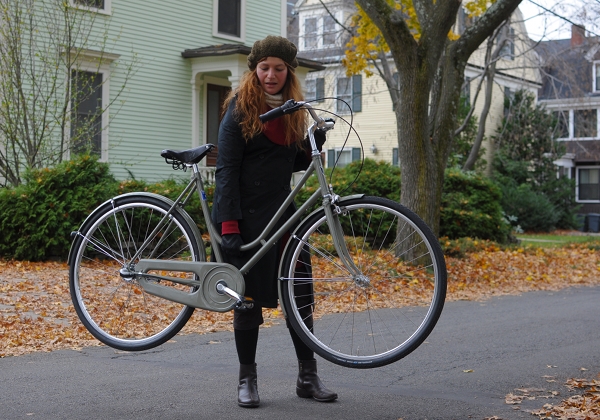
While a diamond-frame bicycle can be easily lifted by the top tube, a step-through frame does not have one - posing the question of how to hold the bike when picking it up. This becomes especially important when the bicycle is on the heavy side and frequently needs to be carried up and down the stairs. In the course of owning a number of loop frames, I have found that different bicycles require different approaches in this regard.
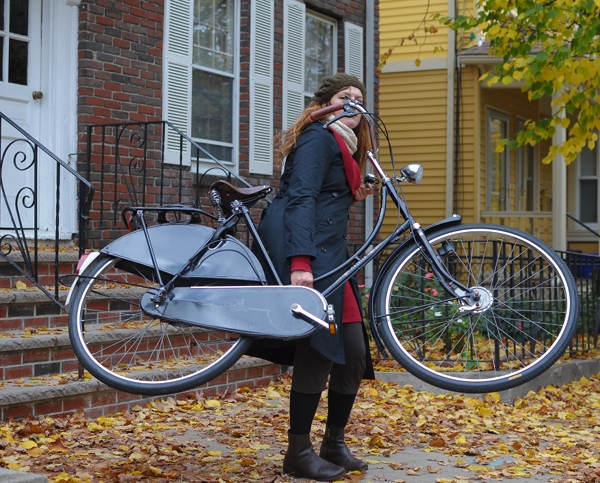
My Bella Ciao bicycle likes to be picked up by the rear portion of the curved top tube. This is such a stable position that I can even carry it with one hand without the bicycle buckling. When held in this manner, I feel that the bike's center of gravity is directly under my hand, which is probably what accounts for the stability of this position. Also, my hand is snugly stuck in that little space between the upward sweep of the curve to one side and the top-downtube connector on the other - an important factor, because this way my hand cannot slip, even if the bicycle is wet from rain.
By contrast, this is what happens when I attempt to lift my Gazelle in the same manner. It's not that the bicycle feels too heavy - in fact, lifting it by that loopy spot makes it feel lighter than otherwise. But something is off in the balance, and the Gazelle tries to flip over sideways, onto me, when held in this manner. It feels as if the center of gravity is not under my hand, but somewhere else. With the Pashley Princess I previously owned, this effect was even more pronounced - when lifted by this portion of the frame, the bicycle seemed to twist in my arms and threaten to bring both of us down. On the other hand, the vintage Steyr Waffenrad I rode in Austria was amenable to being picked up by the top tube of its "swan" frame. For reference, my Pashley was somewhere in between the weight of the Gazelle and the Bella Ciao, and the Steyr was as heavy as the Gazelle - so again, it is not merely a matter of weight.
This is how the Gazelle wants to be lifted: by the seat tube. It stays stable and does not buckle when grasped in this position, despite feeling heavier than in the previously shown method. Could it be that for bicycles that prefer this method, the center of gravity is more toward the rear?
To get my bicycles home I must carry them up the porch stairs, through a narrow doorway, and then through another narrow doorway, after turning around in a cramped hallway. That may not seem like a big deal to those who have several flights of stairs to negotiate, but consider that I am a female with limited upper body strength and a bicycle like a Gazelle or a Pashley is half my weight once it's loaded with bags. Getting a good grip on the frame is key if I don't want to drop the bike or, worse, have it fall on top of me. If you own a heavy step-through bicycle, how do you lift it and how do you carry it up the stairs?
Labels:
Bella Ciao,
Gazelle,
loop frame,
technique
Friday, October 29, 2010
Happy Feet
Today was the first time I felt well enough to ride a roadbike since having gotten sick last month. It was only 26 miles, but it felt great to have my full lung capacity and energy back.
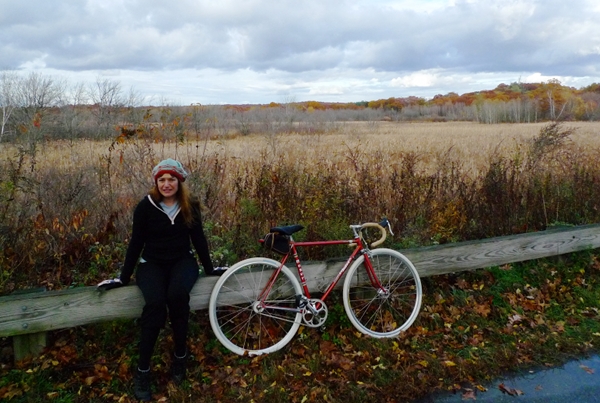
Continuing with the Italian theme, I took Francesco - my fixed gear stallion. How happy he was, basking in the precious minutes of sunshine in between thunderstorms.
Riding a fixed gear roadbike is an experience that fills me with a special kind of enjoyment - I think because it combines the sensations of walking and flying (fly-walking?).
I was worried that I might be too out of shape to make it, but I had forgotten how comfortable Francesco is. The 26 miles of pedaling felt like a stroll in the park. Although, I have learned by now that even if I feel "fine" riding fixed gear while I am actually doing it, it does take more out of me than a free-wheel bicycle. I usually sleep longer after such a ride, and sometimes I am sore the following day.
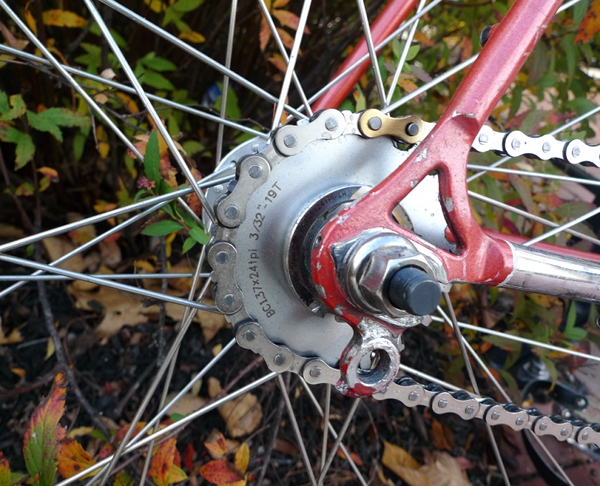
One thing that has improved my comfort level with fixed gear cycling considerably, are these "fixie" Power Grips. I wrote about the standard Power Grips here, and since my initial review I have become addicted to these things. The fixed gear version differs from the standard model, in that it makes it easier to insert and remove your feet while pedals are in motion. I cannot tell what it is about the design that makes this possible, but none the less it seems to work. I insert my right toe at the starting position and start cycling slowly while nudging the left pedal with my left toe - then swiftly insert the toe into the left grip on the first stroke. After some practice this became a familiar and instinctive sequence of movements - though it definitely helped that I was already comfortable using this system on a free-wheel bike prior to trying it on a fixed gear.
Now that I am able to use foot retention on this bicycle, I am no longer apprehensive about cycling over bumps and potholes or going downhill at high speeds. The experience is pretty much perfect and very enjoyable. One thing in particular I have noticed, is how easy it is for me to ride "in the drops" - Francesco almost seems more stable when the handlebars are held this way than higher up. Is that possible?
And another interesting thing: I find it much, much easier to get out of the saddle and pedal standing up on Francesco than I do on my other bicycles. Is it the fixed-gearness that is facilitating this or the geometry? As I've mentioned before, I have a terrible sense of balance, and that is what I believe normally prevents me from pedaling while standing up. But on this bicycle, it seems not to matter.
It rained on and off for the duration of our ride, and the colourful leaves strewn over the trail turned into a mess of a slippery carpet. Was I so excited to be riding Francesco that I began to imagine things, or is it easier to ride in slippery conditions on a fixed gear bike? I have read comments about traction before, but I admit that I don't understand them. Could somebody explain it in layman's terms?
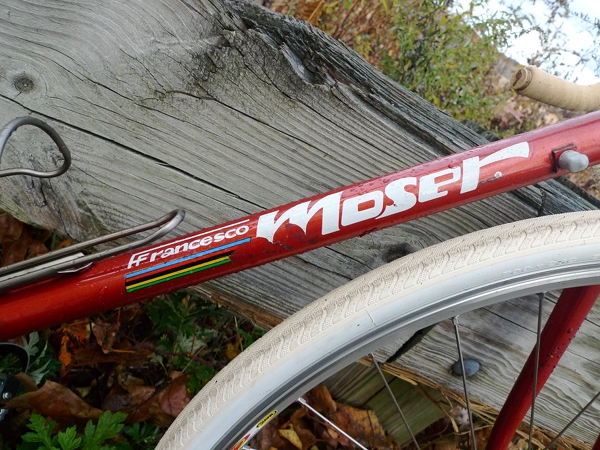
As I prepare for some more pruning of my bicycle overgrowth, it is clear to me that I "need" a fixed gear roadbike. So while I am now considering selling my Trek - which has been fun, but not essential - I will definitely be keeping the Francesco Moser.
In the long run, however - maybe a couple of years from now - I will probably want to replace it with a "real" fixed gear bicycle. Mainly, this is because the Moser's bottom bracket is not as high as it should be - and even though my lean on turns is not aggressive enough to warrant worrying about pedal strike yet, it would be better if this wasn't even a potential issue.
But for now, Francesco is my dashing Italian gentleman and I thank him for my happy feet.
Continuing with the Italian theme, I took Francesco - my fixed gear stallion. How happy he was, basking in the precious minutes of sunshine in between thunderstorms.
Riding a fixed gear roadbike is an experience that fills me with a special kind of enjoyment - I think because it combines the sensations of walking and flying (fly-walking?).
I was worried that I might be too out of shape to make it, but I had forgotten how comfortable Francesco is. The 26 miles of pedaling felt like a stroll in the park. Although, I have learned by now that even if I feel "fine" riding fixed gear while I am actually doing it, it does take more out of me than a free-wheel bicycle. I usually sleep longer after such a ride, and sometimes I am sore the following day.
One thing that has improved my comfort level with fixed gear cycling considerably, are these "fixie" Power Grips. I wrote about the standard Power Grips here, and since my initial review I have become addicted to these things. The fixed gear version differs from the standard model, in that it makes it easier to insert and remove your feet while pedals are in motion. I cannot tell what it is about the design that makes this possible, but none the less it seems to work. I insert my right toe at the starting position and start cycling slowly while nudging the left pedal with my left toe - then swiftly insert the toe into the left grip on the first stroke. After some practice this became a familiar and instinctive sequence of movements - though it definitely helped that I was already comfortable using this system on a free-wheel bike prior to trying it on a fixed gear.
Now that I am able to use foot retention on this bicycle, I am no longer apprehensive about cycling over bumps and potholes or going downhill at high speeds. The experience is pretty much perfect and very enjoyable. One thing in particular I have noticed, is how easy it is for me to ride "in the drops" - Francesco almost seems more stable when the handlebars are held this way than higher up. Is that possible?
And another interesting thing: I find it much, much easier to get out of the saddle and pedal standing up on Francesco than I do on my other bicycles. Is it the fixed-gearness that is facilitating this or the geometry? As I've mentioned before, I have a terrible sense of balance, and that is what I believe normally prevents me from pedaling while standing up. But on this bicycle, it seems not to matter.
It rained on and off for the duration of our ride, and the colourful leaves strewn over the trail turned into a mess of a slippery carpet. Was I so excited to be riding Francesco that I began to imagine things, or is it easier to ride in slippery conditions on a fixed gear bike? I have read comments about traction before, but I admit that I don't understand them. Could somebody explain it in layman's terms?
As I prepare for some more pruning of my bicycle overgrowth, it is clear to me that I "need" a fixed gear roadbike. So while I am now considering selling my Trek - which has been fun, but not essential - I will definitely be keeping the Francesco Moser.
In the long run, however - maybe a couple of years from now - I will probably want to replace it with a "real" fixed gear bicycle. Mainly, this is because the Moser's bottom bracket is not as high as it should be - and even though my lean on turns is not aggressive enough to warrant worrying about pedal strike yet, it would be better if this wasn't even a potential issue.
But for now, Francesco is my dashing Italian gentleman and I thank him for my happy feet.
Labels:
diamond frame,
fixed gear,
Italian bicycles,
roadcycling,
technique
Subscribe to:
Posts (Atom)