Showing posts with label vintage. Show all posts

Friday, July 8, 2011

Adjustable Stem!

Randonneur, Adjustable Stem
When I wrote about wanting a longer stem on one of my bikes, several people suggested I get ahold of a vintage adjustable stem. I did not know that such a thing existed, but clearly there is much I don't know.

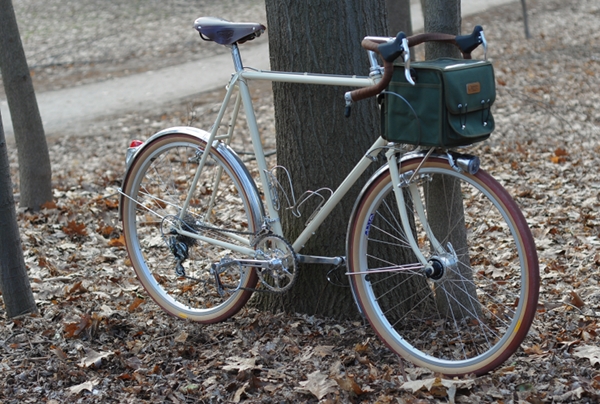
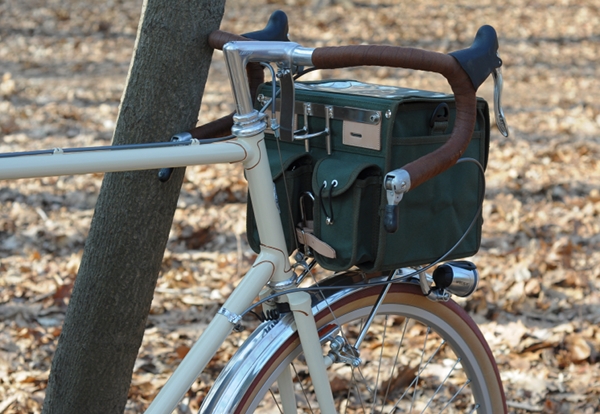
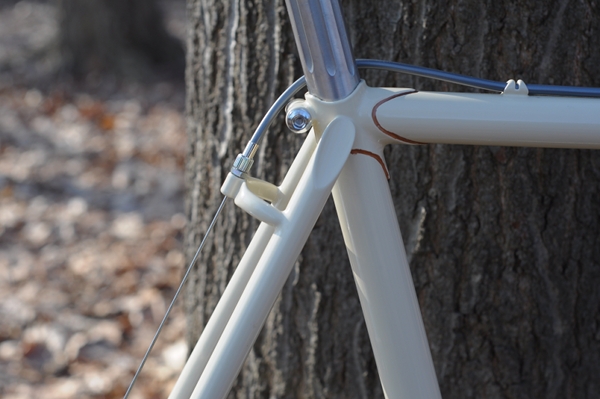
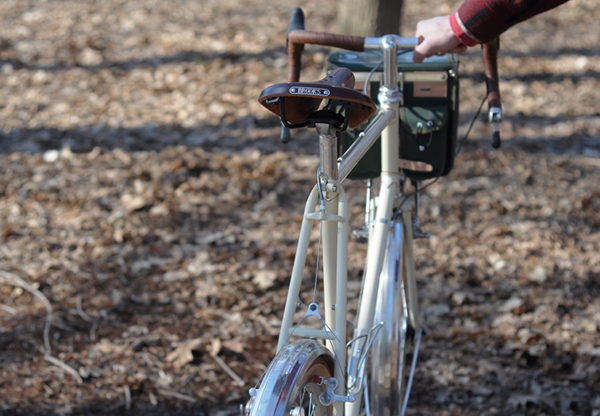
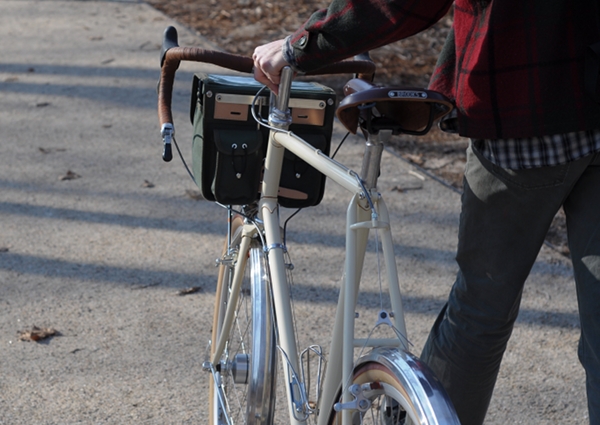
Long story short, I am now in the temporary possession of a 3ttt Record Regolabile adjustable stem, on loan courtesy of Jan Heine of the Bicycle Quarterly. I decided to use it not on my own bike, but on the Royal H. randonneur collaboration - it just looked so appropriate.

Produced in the 1970s by Tecno Tubo Torino of Italy, this elegant stem adjusts from (I think) 6 cm to 12 cm. Here is more information about it and some close-up pictures. The beauty of this system is that it combines the vertical adjustability of the quill stem with the horizontal adjustability of the threadless stem (with the latter you can swap out stems without redoing your handlebar set-up). Why are things like this not being made anymore? Those of us who constantly change our minds about handlebar positions would find it extremely useful. Right now I have it adjusted for 8 cm, but who knows what the future holds - I am looking forward to playing around with this! 

Monday, May 23, 2011

On Sentimentality and Retiring Old Bikes

When we got the Co-Habitant's Surly Cross-Check frame, it was supposed to be an off-road-capable supplement to his vintage roadbike, not a replacement. But after he built up the Surly and took it on several rides, the old Motobecane was soon put away. We had expected that the modern cross bike with wide tires would be more comfortable, but slower and less agile than the vintage roadbike. Instead, it is more comfortable in addition to being just as agile and also faster - not to mention more stable and entirely lacking in shimmy on descents. 

The Co-Habitant is a wee bit disillusioned in vintage bikes at the moment. All the lugs and "patina" in the world are not worth it to him, if a reasonably priced, good quality new TIG-welded frame fitted with decent components offers a better ride. That is not to say that a mass produced mid-tier Motobecane from 1976 represents all vintage bikes. But sometimes experimenting with vintage until you find a good frame can be more expensive than buying new.

Nonetheless, "Myles" the Motobecane was the first roadbike he'd ridden as an adult, and the one and only roadbike he's been riding for the past two years. It was old and crusty and we made it beautiful. It was rickety and we updated it with nicer components. That bike got him through multiple trips to Maine and Cape Cod just fine, before he knew that "just fine" could feel even better. It seems almost a betrayal to get rid of it so unceremoniously.

We've considered turning the Motobecane into a beater city bike, but that idea was eventually dismissed. Ultimately, he likes wide tires and stable handling for city riding, and a twitchy 1970s French roadbike is just not his idea of a good time in our pothole-ridden neighbourhood. Fair enough.

So, what to do with a retired bike? One option is to sell it as a complete bicycle. The other option is to strip all the good components, keep them for future projects or trades, and sell just the frame. In the past, we've always gone with the former, even though financially it makes less sense. This time we are considering the latter, but ultimately still leaning toward the former out of sheer sentimentality - if Myles is kept intact, at least he would still be "alive." But of course that's ridiculous.

Later in the summer I will face a similar dilemma with my vintage Moser fixed gear conversion. It feels too small. But more importantly, despite having been reassured about the low bottom bracket issue I've now actually experienced pedal strike on this bike and that's enough to convince me that I need a fixed-gear specific road frame. In the case of the Moser, I plan to move its wheelset and some of the other components to the new frame when I get it, and just hang on to the Moser frame as a keepsake. I got in in Austria and the memories associated with it are worth more to me than whatever money I could get for the frame. Maybe some time later I will give it away to a friend as a gift, but I just don't feel that it's sellable.

What do you do with bicycles that you replace or retire? Does sentimental attachment get in the way of reason?

Monday, April 18, 2011

Intrigued by the Pedersen

While most of the time my reactions to bicycles are love or hate at first sight, my interest in the Pedersen developed slowly. I do not even remember the first time I saw one: It could have been 8 years ago in England, or 15 years ago in a book. It's sort of always been there, in a distant corner of my awareness - a lovely absurdity that I categorised somewhere in the realm of antique bicycle designs that have no place in practical, everyday cycling.

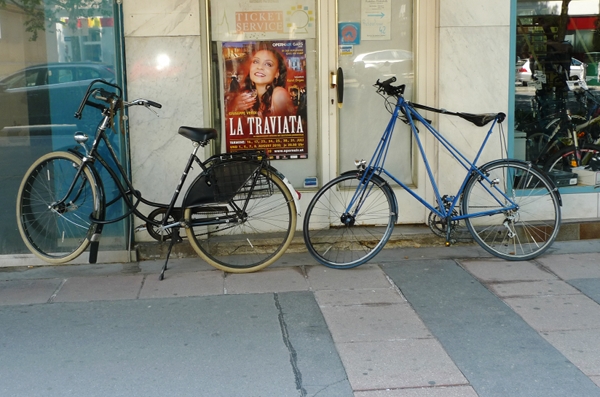
That began to change, as I watched Wolfgang casually pull up on a Pedersen on one of the days we met up last summer in Vienna. I knew that he had one in his collection. I just didn't know that he actively rode it, or even that it could be ridden in the same manner as a regular bicycle - in traffic, at commuting speed. Turns out I knew nothing at all about these machines. Still produced in Europe and even imported in the US, the Pedersen is a Danish design that, its proponents boast, is the most comfortable bicycle in existence. A bold claim, but they seem to mean it!

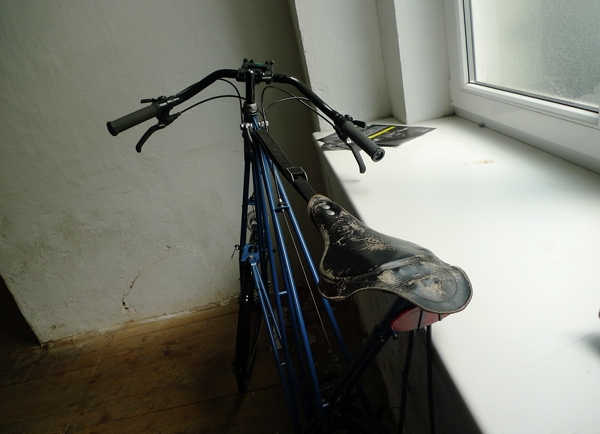
The multiple-stay frame construction provides suspension. The hammock saddle, even more so. The result is an upright, cushy ride, that Pedersen enthusiasts describe as downright regal in comparison to standard bicycles. Wolfgang's bike was too tall for me to ride, so I cannot say whether I agree. But I find myself wondering more and more and would very much like to try one.

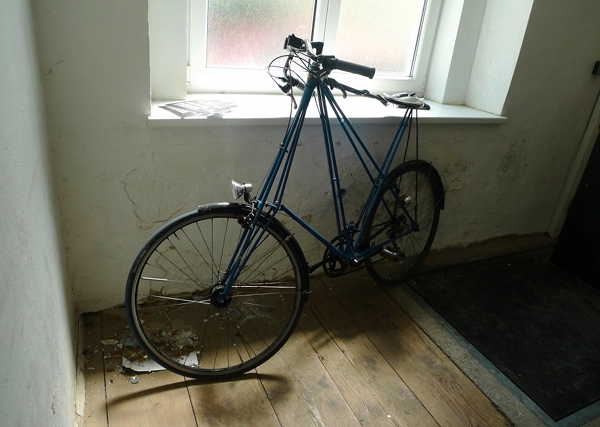
Though I do not remember the first time I saw a Pedersen, I do remember the last time: a couple of weeks ago in the garage of the office building where the Co-Habitant works. Yes, someone who works in his building commutes on a Pedersen and leaves it locked up with all the other bikes. I suppose they are all used to seeing it there by now and no longer process it as anything out of the ordinary, but I was terribly excited to discover it. And it seemed to be in my size. Perhaps I should leave a note...

If you are curious to know more about Pedersen bicyles, there is a history page here, and a great article in Bicycling Magazine by Florence Williams about hunting for one in Copenhagen. Feedback from owners is, of course, most welcome: Are they feasible as commuter bikes? How on Earth do you mount and dismount them?

Thursday, March 31, 2011

Good-Bye 'Blueskies' ...Hello Blueprints

A couple of days ago, Seymour Blueskies packed up his things and went home with a very nice couple. I bid him farewell as I fondly recalled our times together.

From the start, my intent had been not to keep the vintage Trek, but to learn what I could from it, then move on to explore other bicycles. It was around this time that I recognised having two categories of bikes: a few that I "truly owned" and others that I considered transient and experimental. But experimental for what?

It took me some time to acknowledge that I was "seriously" interested in bicycle design, and acquiring the Trek last summer coincided with that realisation. I began to learn about bicycle history and frame geometry in a more systematic manner, to formulate ideas about the relationship between form and function, and to apply my previous training (in psychology and neuroscience, as well as art and design) to the realm of bicycles and cycling. I realised that the reason I keep acquiring more bikes, is not because I necessarily want to own them personally, but because I want to try out new ideas and to learn new things - then share the results with others. I enjoy the process of conceptualising a bicycle, then bringing about its existence and the result being successful. Now if only there was some way to do that over and over again, without ending up in financial ruin or with a hoarding disorder... Oh, I know: I could design bikes for other people.

After saying good-bye to Seymour Blueskies, I stopped by to see Bryan at Royal H. Cycles - with whom I am now collaborating on a bicycle. How on Earth did that happen? Well, funny story... You see, in this post about a month ago, I expressed a desire to try a bicycle with traditional randonneuring geometry (à la Jan Heine), and received some suggestions as to how this could be accomplished. There wasn't an easy way; these bicycles are rare. But one idea was that I could design the bike myself - and an intrepid reader was prepared to commission just such a bicycle from Royal H should I feel up to the task. And so here we are. The plan is that I come up with the specs, we discuss, Bryan builds, and we'll see what happens.

As this project begins and the Bella Ciao project nears completion, I am filled with nervous energy and self-doubt all around. I know my weak points: I am not an engineer and I am not a framebuilder. But I am perceptive and increasingly knowledgeable in other ways that are essential to bicycle design, and I do feel that I can collaborate with others to create something special. It's possible that I am over-reaching, that it's all too soon. But life is short and you never know unless you try. So I'm trying.

Friday, March 18, 2011

Creamy, Dreamy 650B Conversion

With his latest project, our neighbour Somervillain is quickly establishing himself as Vintage Bicycle Refurbisher Extraordinaire. This dreamy creature began life as a 1984 Shogun 1500 - a good, yet unremarkable touring bike. It has now been transformed into something quite exquisite.

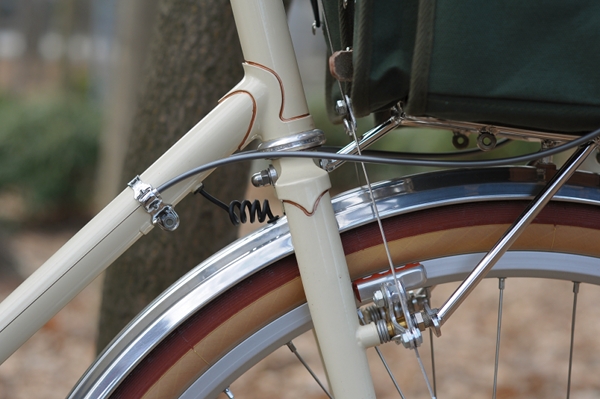
The 25" frame was stripped of its original paint and powdercoated a creamy "almond," the lugwork then outlined in copper.

I think that it's pretty difficult to get the perfect shade of cream: If it's too pale, the bicycle looks bland and if it's too saturated the bicycle looks yellow. This shade looks just right to me: classic, soft and a little mysterious.

The Shogun frame had a high bottom bracket and sufficient clearance for wide tires with fenders, making it a great candidate for a 650B conversion. However, the cantilever bosses had to be relocated in order to accommodate the new wheel size. Both this and the powdercoating were done by Sugarcoat/ Geekhouse. Notice also the internal routing for the dynamo lighting.

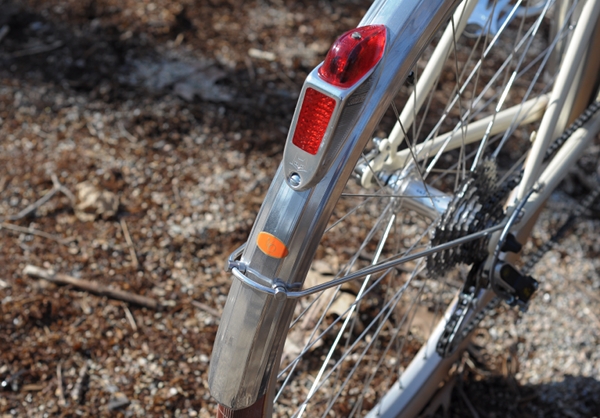
Internal routing exit for the tail light. I will not even try to describe the routing, but Somervillain shows the step-by-step process here.

Rear cantilever bosses, Mafac brakes, KoolStop brake pads.

The headlight is the Bausch & Mueller Lumoteq IQ (I have this light on two of my bikes and love it), and the DIY bracket is fashioned out of a caliper brake.

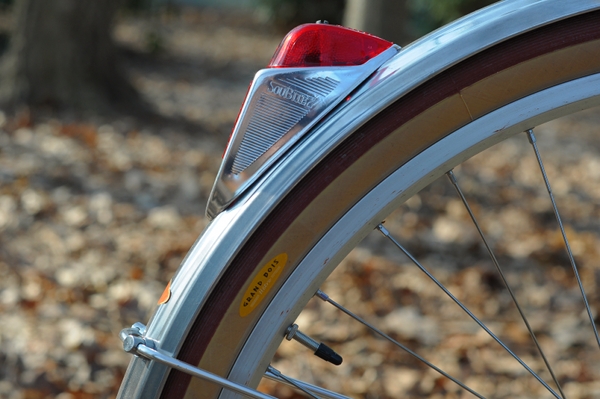
The tail light is a vintage Soubitez converted to LED with Bausch & Mueller innards.

Tires are the red Grand Bois Hetres, with Zeppelin fenders from Velo Orange. I have this same set-up on my Rivendell, only with the cream version of the tires. The Grand Bois Hetres are absolutely magical in their cushiness and a 650B conversion is worth it just for them alone.

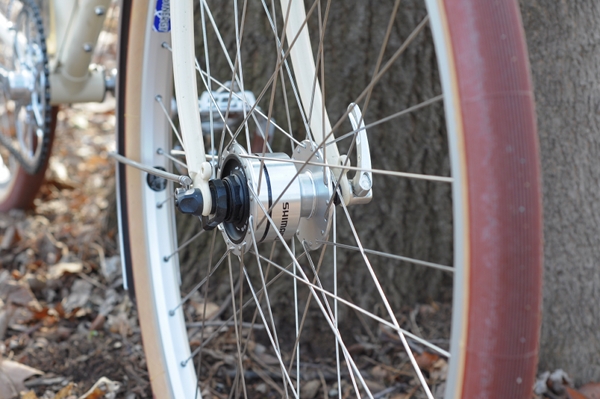
Shimano dynamo hub (which Somervillain says causes slight vibration at high speeds when the light is on, so he is considering changing it to a Schmidt SON).

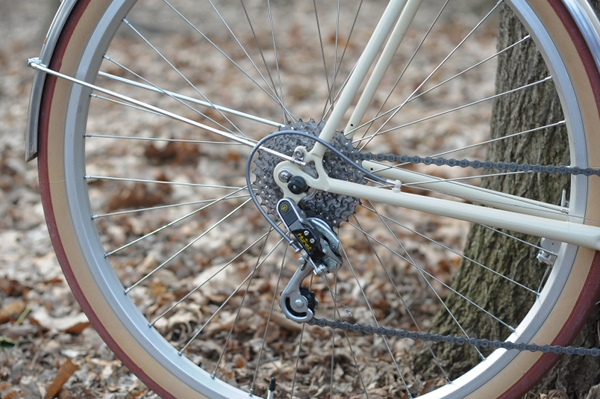
Huret rear derailleur. I forgot the details of the cassette, so perhaps Somervillain will remind me or post the specs.

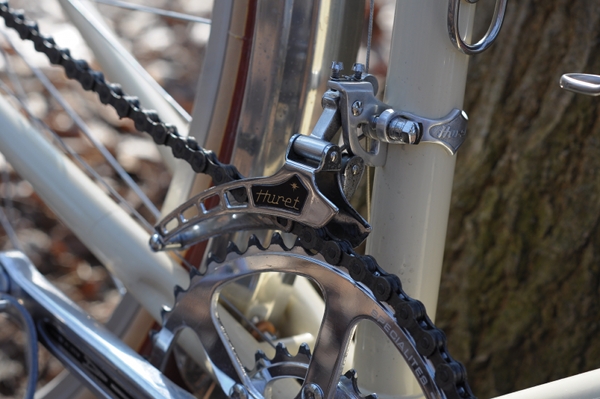
Huret front derailleur.

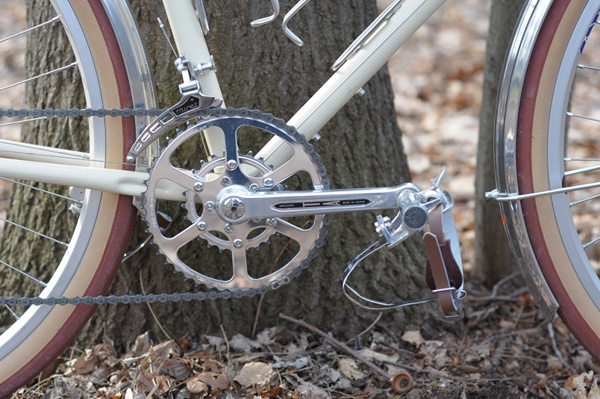
Beautiful TA crankset.

VO Moderniste bottle cages.

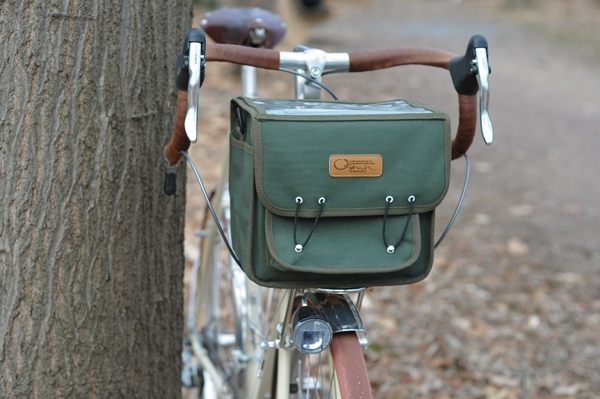
Belleri Randonneur bars, VO Pass Hunter front rack, Ostrich handlebar bag.

And Brooks B17 saddle.

Perhaps Somervillain would like to go into further detail in the comments, but one interesting thing about this build is that many of the components - or at least the manner in which they are installed - are modified in a way that makes them better integrated with the frame. The result is an exceptionally clean and harmonious look.

Having tested this bicycle out on a metric century ride last weekend, the owner is well pleased with its comfort and performance. Sadly, I am not tall enough for this 25" frame, so I will have to take his word for it. Given that Somervillain has other beautiful bicycles, I am curious how this one compares and what role he ultimately sees it occupying. Will it be his long-distance tourer? Time will tell. Either way, this project was a major accomplishment in its marriage of vintage and custom elements. The frame, the modifications, colour, the components - simply dreamy.

Monday, March 14, 2011

Component Porn... Film Noir Style

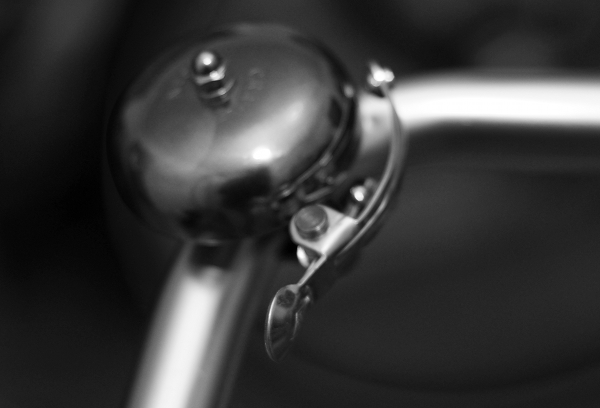
When we talk about "bike porn," all too often the attention is on the obvious stuff: the frames, the lugs, the cranksets, the handlebars. But what about the more subtle components? I know what you're thinking: I must be into some fancy, handmade, outlandish stuff. But I am really a girl of simple tastes at heart. Take, for instance, the little brass bell. Round, shiny and boisterous, I cannot get enough of these perfect little creations. All the world reflects in their polished surface, and they have seen everything your bicycle has seen. Sometimes I will be rolling along, and I catch a glimpse of the sky and trees reflected in my bicycle bell. How delightful to see my surroundings in miniature form, right on my handlebars.  

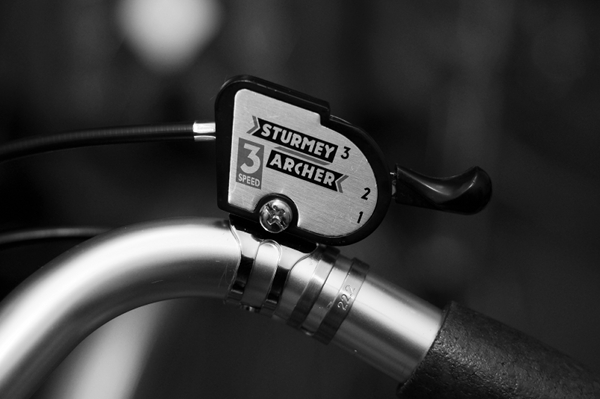
And then there is my excessive affection for the classic Sturmey Archer 3-speed trigger shifter. God, I mean look at it! Something about the shape, the font, and the overall design just says "stare at me, touch me, use me!" That little notch on the trigger so eager for me to shift gears. No other shifter has inspired such emotion within me. Am I being weird?

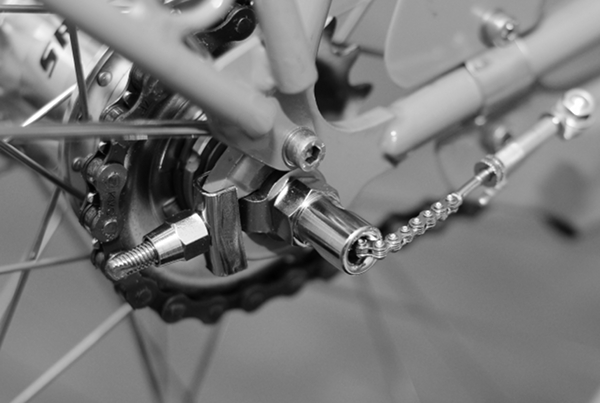
Although if you want weird, I will admit that I also have a thing for indicator chains. That's right:  those little bits of chain stretching from the hub. Oh how I yearn for glimpses of their jewel-like elegance - unobstructed by the horrendous plastic enclosures in which they are often housed today. Please, manufacturers: Free the indicator chains!

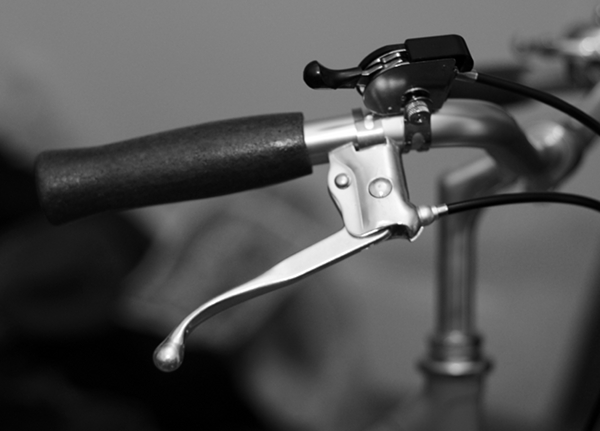
And I must not forget my longing for classic brake levers. I have tried to cope with standard modern ones, but how can I forsake the curves of these VO classics? The gentle tapering and the ball at the tip... A cold sleek modern lever cannot hope to offer the same tactile experience.

With all of these things now installed on the same bicycle, the overall effect is overwhelming. And it makes me realise that I am more taken with the looks of simple 3-speed components than with anything more complicated. Having a visible indicator chain on a hub is more important to me than the kind of derailleur I use, and my preference for the trigger shifter is by far more passionate than my admiration of bar-ends on roadbikes. Give me a classically outfitted 3-speed, and I will swoon with delight. What is your component porn of choice?

Sunday, February 27, 2011

Moultons, Modern and Vintage

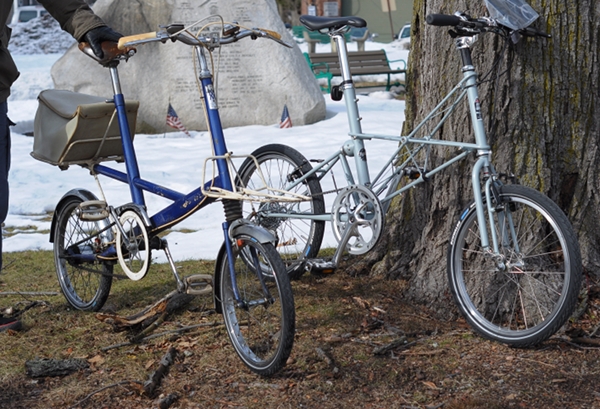
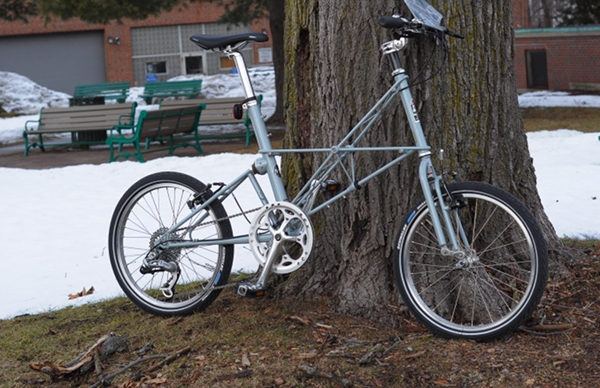
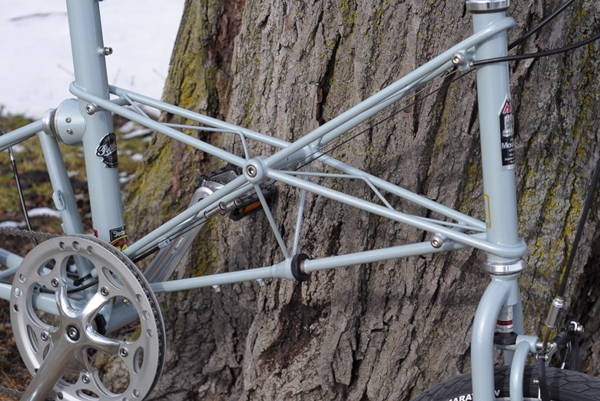
Harris Cyclery (a sponsor) has begun carrying Moulton bicycles, and I had not seen one up close until now. They had a dove gray one in the window that called out to me, so I took it outside for a closer examination and test ride.  Jon Harris then brought out another Moulton - one of his personal bikes made in the 1960s, that had once belonged to Sheldon Brown. It was informative to see the two models side by side.

The new Moulton is the TSR 9 model, manufactured by Pashley-Moulton.

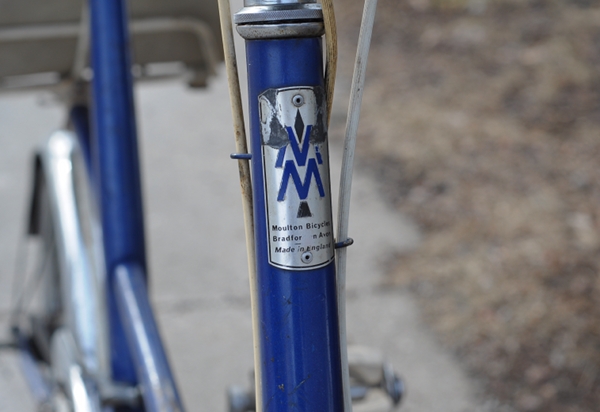
Moulton bicycles have a complicated history. Production initially began in 1962, then ceased in the 1970s and resumed in the 1990s - with some models produced under license by Pashley.

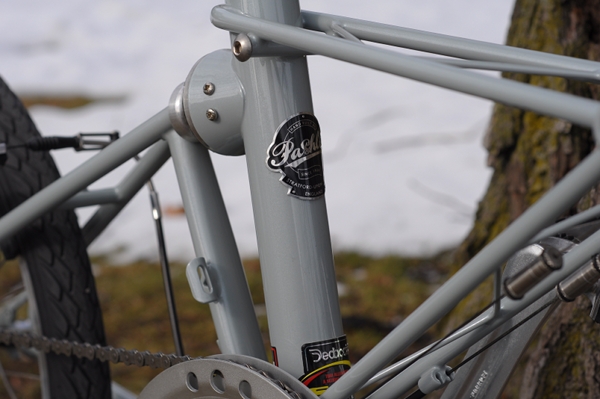
This bicycle has a Moulton headbadge on the head tube and a Pashley headbadge on the seat tube.

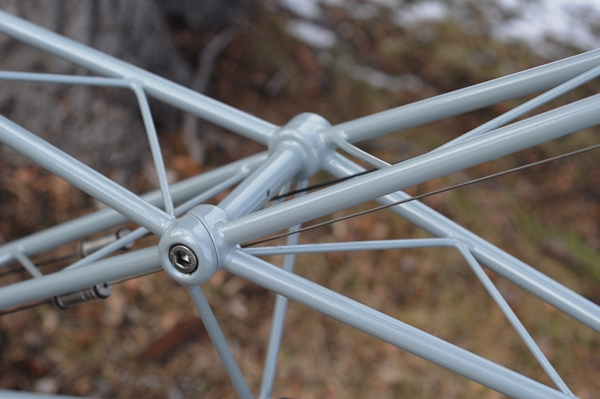
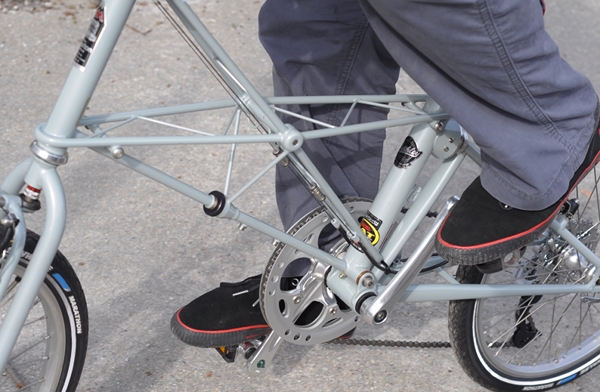
The frame design is called a space frame, and it allows for greater rigidity and lighter weight in comparison to traditional steel frames.

Moultons are not folding bicycles, but are "separable" and can be disassembled for travel.

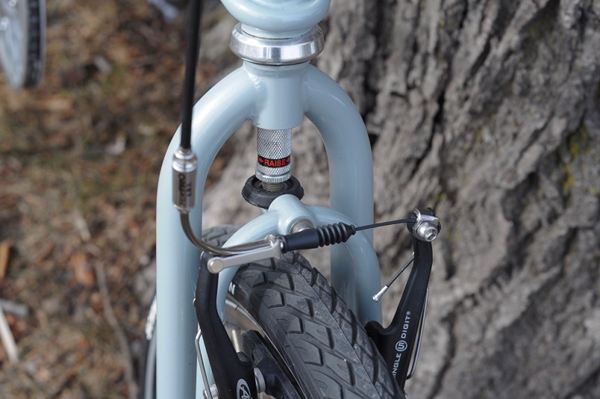
In addition to their unique geometry and small wheels, Moultons are distinguishable by their suspension system - which they had originally implemented decades before it would become common.

Components on the Pashley-Moulton models are modern and off-the-shelf, which keeps the price "reasonable" (this one is just over $2,000) compared to the higher-end models.

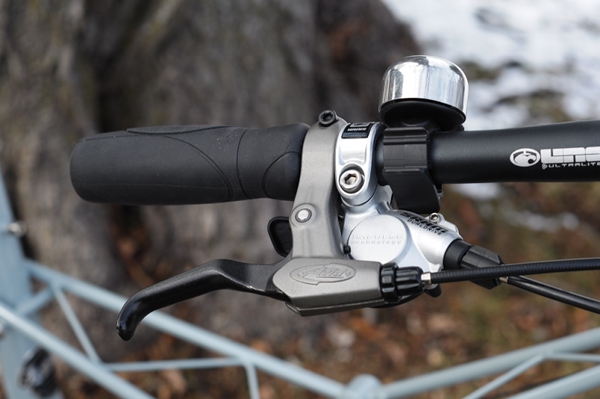
My impression of the space-frame Moulton is somewhat confused. I find it architecturally interesting and beautifully constructed. However, I do not quite understand what makes it a good bicycle. I mean, is one expected to buy it because it is unusual looking and has a cool history, or does it have unique characteristics that make it superior to other bicycles? By moderns standards, it is not a lightweight bike by any means (26 lb without pedals), which somewhat defeats the small wheel construction. And the complicated frame structure - while beautiful to look at - makes me worry that I'll get my foot stuck somewhere in there while attempting to step over it. It just doesn't seem like a very practical design to me. Also, to my eye the handlebar set-up on this model clashes with the frame, and it seems to me that some effort could have been made to keep the price down while finding more elegant components.

I tried to ride the bicycle, but the front suspension felt so powerful that I did not feel comfortable test riding it in the winter. The Co-Habitant rode it briefly and did not feel stable on it, which may have to do with the suspension as well - neither of us is used to it. The conditions on this day were not ideal for properly test riding bikes, so I'd like to try it again when it gets warmer. But on first impression, the Moulton space frame bike did not feel entirely welcoming.

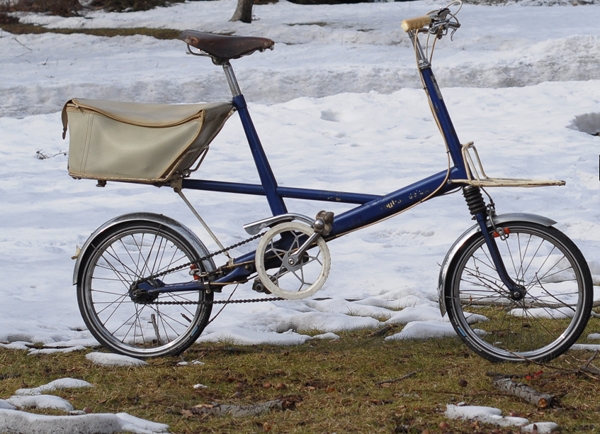
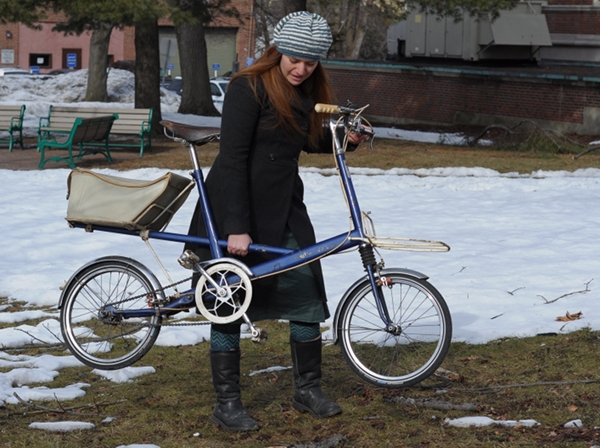
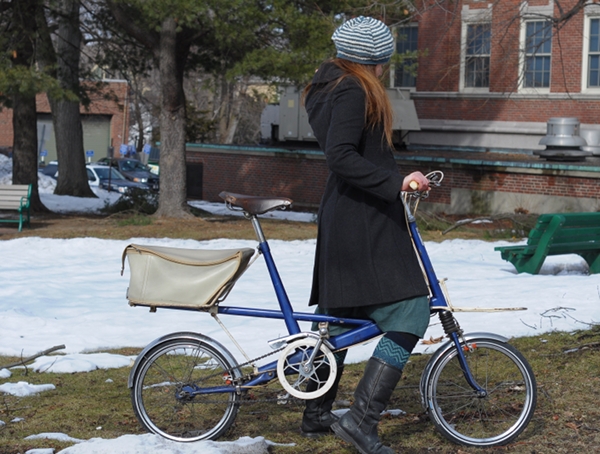
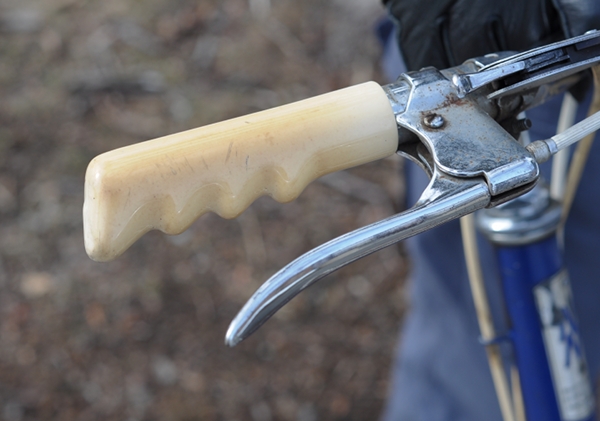
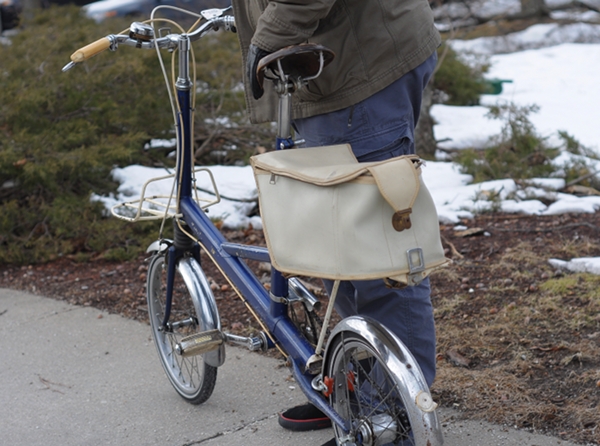
On the other hand, I was surprised by how friendly and accessible the vintage "F-frame" model felt in comparison. This is one of the original models, introduced in the early 1960s - the Major Deluxe. It came with a 4-speed hub, front and rear rack, and a large bag mounted on the rear. Here is a neat promotional video from when these bikes first came out.

Despite being somewhat heavier than the currently produced space-frame, I found the vintage f-frame easier to lift and carry.

The step-over is considerably lower as well. In other ways too, the vintage Moulton just felt like a better fit for my proportions; it felt very natural.

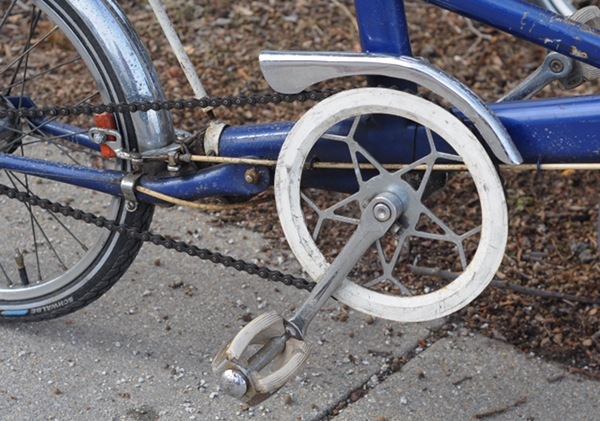
And of course the classic components are absolutely charming.

The North-roadish handlebars are more comfortable than the straight bars on the modern production bikes.
The fenders and racks are extremely useful, and the bag is huge. In essence, it is a small, practical bike - not as visually striking as the later space-frame, but more user-friendly.
I appreciated the opportunity to have a closer look at the Moultons, and would like to properly test ride the modern production bicycle once Spring arrives. While I can see myself owning and riding the vintage F-frame model, I find the newer space-frame model intimidating and somewhat impractical, though visually compelling. Moulton owners and enthusiasts are welcome to contribute their impressions.