Showing posts with label urban cycling. Show all posts

Wednesday, June 29, 2011

What Does 'Commuting' Mean to You?

Some of us have conventionally structured jobs, where we ride our bikes to the office, stay there for a given period of time, then ride home. Others might move from site to site throughout the day, or work from home, or go to the office and back several times. I've had lots of conversations with friends in both job categories, and it's clear that there are benefits and drawbacks to each: With a conventional schedule, you get a sense of structure, and once you leave the office you are done. On the down side, sitting in the same building for an entire day can feel constricting. With a non-conventional schedule, there is a greater sense of freedom and you can organise your time to suit your needs. On the down side, it can feel as if the work never really ends and that you are chained to your laptop or phone 24/7.

Most of my jobs have fallen somewhere in the second, unstructured category. Even while working in a university setting - probably my most "normal" employment - it was always a back and forth between different locations on and off campus. Now that I have transitioned entirely to freelance work, it is up to me how to organise my time - which is nice in theory, but can work against me if I am not careful.

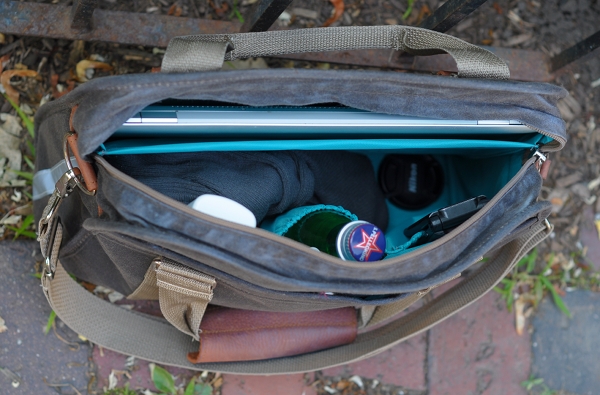
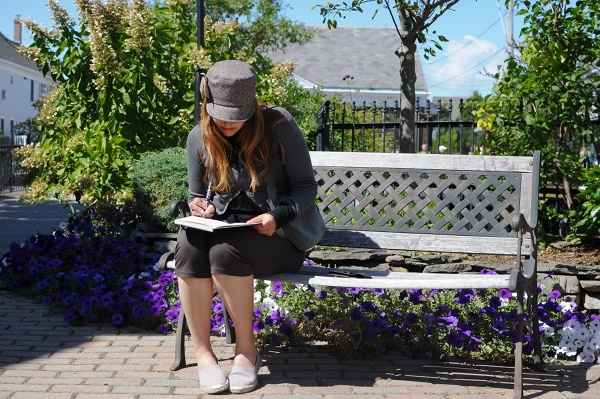
Finding it nearly impossible to work from home, I like to leave the house for the day and transition between one setting and another - coffee shop, studio, supply store, meeting, park bench. My laptop perpetually in tow, the nomadism is my means of staying both sane and focused.

Cycling back and forth between these locations and home is my version of commuting - though it is disheartening when those with structured jobs say things like "Oh, but then you don't have to commute, do you." I know what they mean to say: There is no pressure for me to arrive somewhere at exactly 9am every day. While this is mostly true, I do have meetings where I am expected to be on time. I also make more trips per day than they do and don't really have a concept of week-ends. But it is not a competition and I think that whatever one considers to be "commuting" is valid for that person. The term is a strange one for non-English speakers anyhow, as they struggle to understand why a special word is needed for traveling to and from work!

For those who do commute in a nomadic fashion, and do so by bicycle, there are some helpful posts about establishing a mobile office (via Girls and Bicycles) and an outdoor office (via Simply Bike). And for those who work 9-5 jobs, there are some great posts by Dottie from Let's Go Ride a Bike on how to take a refreshing joyride on your lunch hour. Cycling can function both to infuse a conventional job with a sense of freedom and to bring structure into a more chaotic work situation. What does commuting mean to you, and how (if at all) has it been affected by cycling?

Monday, June 13, 2011

Putting Your Foot Down

Enough people have asked me about this now that I thought it worth writing about: How do I put a toe down in traffic while remaining on the saddle, and also manage to get full leg extension on the downstroke? I will try to explain.

First off, let me clarify that I get "more or less" full leg extension, and obviously my leg would be even straighter if I had the saddle higher. So there is a bit of give and take to it. But the idea that your leg needs to be arrow-straight on the downstroke with the toe on the pedal and the heel raised, is not one that everyone subscribes to - especially not cyclists in cities where riding a bike for transportation is common. In Vienna, I would say that about half the cyclists I saw had their saddles adjusted so that they could touch the ground with a toe. Based on the pictures here, this seems to be the case in Copenhagen as well. When riding in cities with frequent intersections and stop signs, it can be tedious to get on and off the bike every 3 minutes. Being able to put a toe down makes things easier.

Another point, is that some bicycles' geometries work better for this than others: Typically, Dutch-style city bicycles have very relaxed seat tube angles, which increases the distance between the saddle and the pedals while keeping the saddle height constant. A lower bottom bracket helps as well, though not as much as a slack seat tube. You can watch this video of Dottie starting and stopping on her bike to get a better idea of how this works on a Dutch bike.

Finally, this may not be sufficiently noticeable in pictures, but I lean my bike to the side in order to reach the ground with a toe. I also keep my other foot on the pedal for balance. I cannot reach the ground with both toes, and I cannot even really reach with one toe unless I lean. This is something that becomes instinctive if you do it often enough. Alternatively, you could set the saddle lower. I've basically raised mine as far as I possibly can, while still managing to reach with one tip-toe while leaning.

Adjusting your saddle so that you can stop with a toe down is mainly about convenience. Some cyclists prefer this method, while others feel that not having their leg 100% straight on the downstroke robs them of power. How do you stop in traffic when cycling for transportation? And is it the method you've always used, or did you develop it after some trial and error?

Thursday, June 9, 2011

Skirt Police


Yesterday there seemed to be an unusual number of disconcerting bicycle stories floating around. Among the more bizarre were the news that a woman was stopped by the NYPD for wearing a skirt on her bike. Says a representative of the New Amsterdam Bicycle Show:
Our friend Jasmijn was stopped in SOHO by NYPD for riding in a skirt! The officer said she could distract drivers and cause an accident...and should go home and put pants on.
Cycling in a skirt is, of course, perfectly legal. So when this sort of thing happens, one has to wonder how best to respond to it. After all, it has been shown that just because the officer is technically in the wrong, does not mean that the cyclist will not be ticketed, or even arrested and tried.

But what's more, is that when this story was posted on twitter other women replied that they too have been stopped by police while cycling dressed up - seemingly for no particular reason other than for the officer to comment on their appearance. It happened to me last summer as well. A policeman gestured for me to pull over, only to ask some random question about my bike. When I politely replied, he proceeded to comment on my outfit. Nervously, I kept wondering what law I broke and when he was going to get to the point. Was I required to chat with him? Was there some protocol to treat me as hostile if I didn't? When I finally asked "Excuse me, but can I go now?" He seemed hurt and simply said, "Yeah, sure..." adding "Be careful out there!" half-heartedly. For a while I kept going over the incident in my mind and trying to make sense of it, but it seems he stopped me without any legal purpose what so ever.

On a bicycle we are more noticeable than we are inside a car, and at the same time we can be legitimately pulled over as vehicles. Does us cycling make it easier for the police to abuse their power by supplying them with a reason to pull us over? That's an uncomfortable thought.

How would you respond if a police officer stopped you to comment on your appearance, or to tell you that you can't ride a bike dressed as you are?

Sunday, May 29, 2011

Right of Way and Driver Education

Last night we were returning home on our bikes. As we approached an intersection where we needed to make a left turn, we signaled and moved to the leftmost part of the lane. A motorist approaching the same intersection behind us began to honk. We turned around, confused. The light had just turned red and all three of us were stopped at the intersection. She continued to honk. We asked what the problem was. She rolled down her window, and the conversation went something like this:

Motorist:  What the hell are you doing?!
We:  What do you mean?
Motorist: You're not supposed to be in front of me like that, you're blocking the road!
We: We're using the road just like you. Why are you honking?
Motorist: What the hell am I supposed to do when you're blocking my way?!
We: You're supposed to wait for us to turn.
Motorist: But you're not supposed to be there if I need to get by. You don't have the right of way!
We: What? Of course we have the right of way, we were here first.
Motorist: Unless you're in the bike lane, you do not have the right of way! You're supposed to let me get by!
We: Bicycles have the right of way just like any other vehicle.
Motorist: Not if you're not in the bike lane!
We: Yes. Check your facts.
Motorist: No! You check your facts!

I don't know how things would have gone had the light not turned green at that point, but it did. The motorist floored the gas pedal and veered around us in order to proceed straight as we made our left turn.

It's not so much the motorist's rudeness that I found alarming  (she was screaming at us), but the fact that she genuinely believed that cyclists did not have the right of way unless they were in the bike lane. In other words, she thought that if a cyclist needed to make a left turn, they must stand aside and wait for all the cars behind them to pass before they were allowed to proceed. This is blatantly incorrect, but that doesn't help any in situations like this.

In my view, lack of drivers' awareness about bicycling laws is largely responsible for cyclist-motorist confrontations. When I first began riding a bike in Boston, drivers would occasionally scold me for "breaking the law" (i.e. cycling on the road). Now that bicycles have become more common this seldom happens, but yesterday's encounter shows that misunderstanding of road rules still exists. I've read that in areas where this is especially bad, cyclists have taken to carrying copies of local bicycle laws and handing them out to motorists who harass them. That is further than I personally would want to go. But it seems to me that some driver's ed initiative is in order - especially if a city is actively striving to be more "bicycle friendly."

Saturday, May 14, 2011

Keeping Your Bike Outdoors

Last week I finally turned my Gazelle into an outdoor bicycle. It has become clear to me over time that parking a transportation bike where it is easily accessible - instead of maneuvering it in and out of doors and up and down stairs every time I need to go somewhere - increases its utility tremendously. Dutch transport bikes in particular were simply not designed to be kept inside apartments. They are heavy, unwieldy and also durable - with all their delicate parts covered from the elements. And while theft is a concern, I think that our fear of it - when it comes to heavy transportation bikes - is disproportional to its actual risk. Bike theft in the US is not nearly as bad as in places like the Netherlands and Denmark, yet in those places bikes are kept outdoors 24/7. Plus, I seriously doubt that a 45lb clunker would be on a bicycle thief's priority list. Why chose fear over convenience when statistics are on our side?

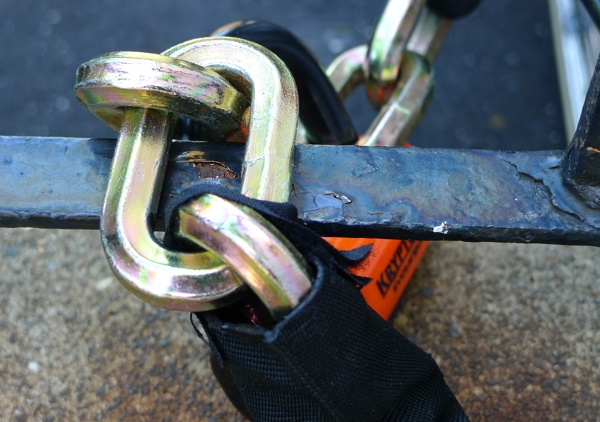
That is not to say that precautions should not be taken: My first order of business was to get one of those huge, heavy chains. I deliberated over Abus vs. Kryptonite and received feedback both for and against each of them. In the end, I think that either chain is sufficient. I chose Kryptonite because a local bike shop had them in stock. The chain is thick and the system is easy to use.

I keep the chain wrapped around an iron rail in a convenient spot at the back of our house. When the bike is parked there, I chain it up. When I use the bike, I leave the chain behind. The key to the little U-Lock that connects the chain is attached to my housekeys, and we have spares at home.

The space next to the railing is cramped, making it impossible to wrap the chain around the frame. So instead, I wrap it around the bicycle's rear wheel. If you are familiar with classic Dutch bikes (full chaincase, dressguards, bolted rear triangle), you will know that removing a rear wheel on these babies requires tools and takes about a half hour - so locking up this way is not much riskier than chaining it through the frame. I also put a cable lock through the frame and front wheel (the cable lock goes with me when I take the bike out). While no lock-up method is 100% secure, I feel comfortable with mine. I weighed the utility of this arrangement against what I perceive to be the risk of theft, and to me it's worth it.

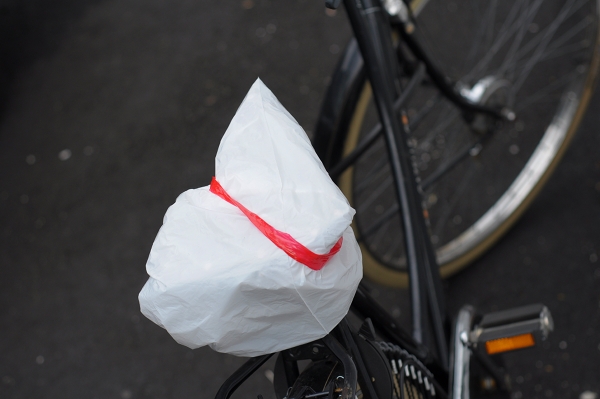
One thing I still need to get is a heavy-duty waterproof saddle cover; ideally something that doesn't look expensive. I have a bunch from Brooks and Rivendell, but they either do not fit the huge saddle properly or are not entirely waterproof. Any saddle cover suggestions for a Brooks B66?

It is not my intent to suggest that everyone ought to keep their bike outdoors. Judge for yourself based on how much extra utility you think you would get from that, as well as how comfortable you are with leaving it out. If you do decide to go that route, I suggest a good chain, a plan for saddle protection (it will rain if you leave it uncovered overnight!), and a lock-up ritual that does not end up being too fussy and time consuming. Do you lock your bike outdoors?

Wednesday, April 27, 2011

Domestic Bike Share

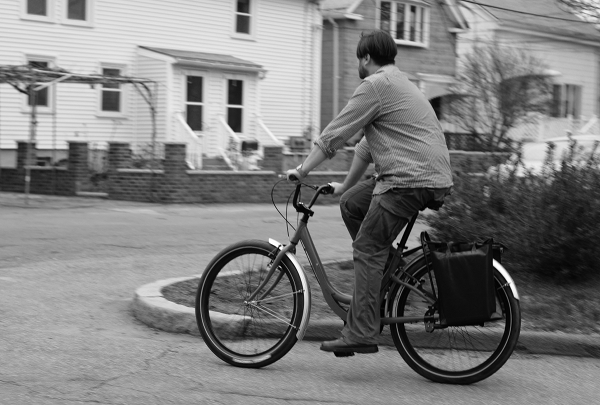
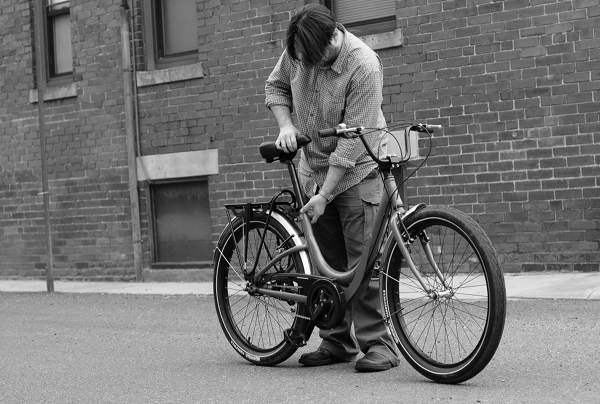
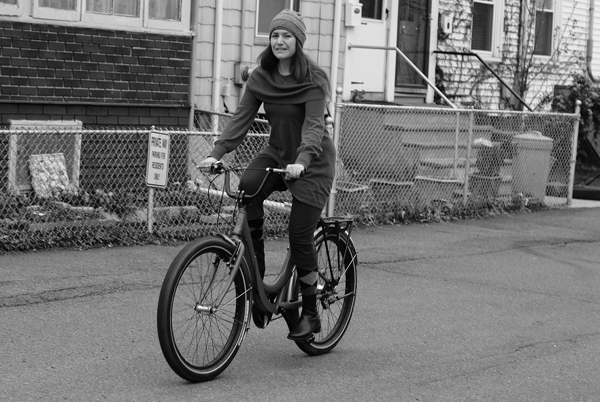
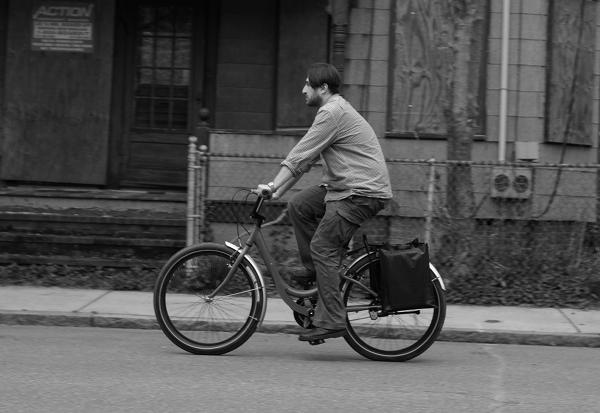
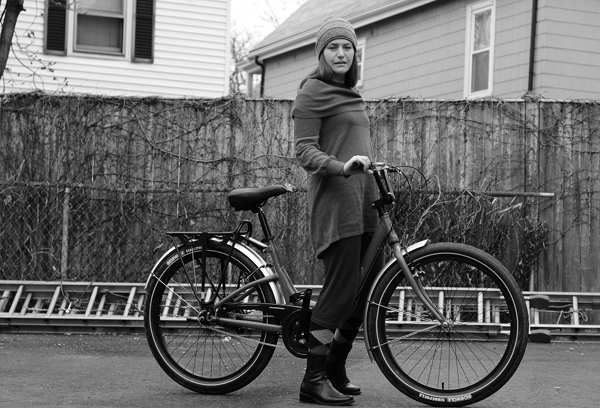
In an unexpected turn of events, the Co-Habitant has hijacked the Urbana bike that's temporarily in my possession. Well, not hijacked exactly. It's more like we now share it. I keep the bike locked up outside, which makes it considerably more convenient to use than my other bikes, and one day it just happened. "Listen," he said, "I don't feel like dragging my Pashley out. Can I take that bike on a quick errand?" Somewhat surprised that he was willing to be seen riding a U-frame, I replied "Sure, just use the quick relea..." But didn't get to finish, as it only took seconds for him to adjust the seatpost.

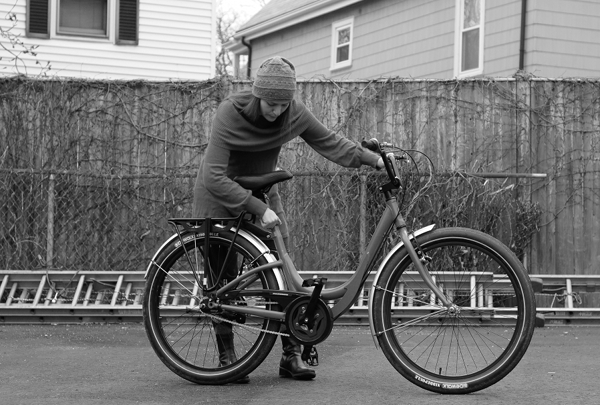
The Co-Habitant is just over 6' tall, whereas I am 5'7", but making the adjustment back and forth is easy.

I rode a bike with a quick release seatpost in Austria in early 2009, but found the lever to be stiff and difficult to use. My experience with the Brompton quick release was similar. In comparison, the lever on the Urbana bike is smooth and easy to operate.

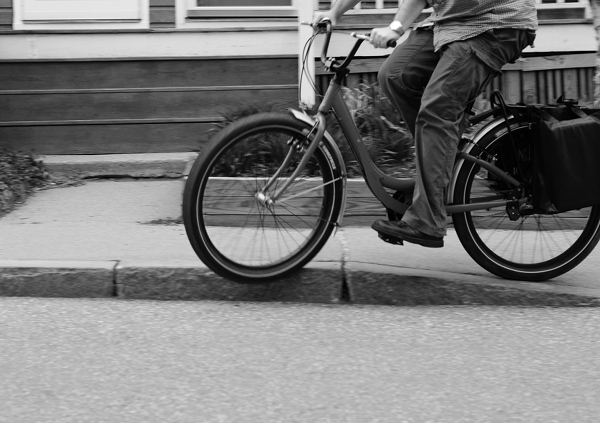
And so, this is now our shared errand bike - though he rides it a bit differently from the way I ride it. Why do I suspect that this whole "errand" business was just an excuse to practice curb hopping?

It's pretty weird to see pictures of us both riding the same bicycle. I am of course more upright, because the saddle is lower.

Despite the U-frame, I don't think the Urbana looks "feminine." The Co-Habitant says that he does not feel self-conscious riding it, and just sees it as a practical utility bike.

As a result of this experience, I've changed my mind about the usefulness of bicycles with adjustable unisex designs - such as the Workcycles FR8, the Urbana, and similar concepts (fill me in - what are the other popular bikes that allow for this?). I did not think we would have a need for a joint bike and I did not plan to share the Urbana, yet here we are both using it. For us, the aspects of the bike that make sharing it easy are the quick release seatpost, the low stepover U-frame, the ability to carry loads with minimum fuss, and the durability that allows it to be kept outdoors and within easy reach. A domestically shared errand-bike can be a worthwhile addition to any cycling household.

Tuesday, April 26, 2011

When Cyclists Complain About Cyclists

Copenhagen - Strandvejen 1955
[image via Copenhagenize]

Spring is here and the number of new cyclists is multiplying rapidly. It's fantastic to see so many people in Cambridge and Somerville going about their day on two wheels, as if this were entirely normal and natural - which of course it is. But with more bicycles on the roads, this is also the time of the year for complaints: motorists complaining about "scofflaw cyclists" and cyclists themselves complaining about "newbies."

While motorist hostility is nothing new or surprising, there is somewhat of a debate in the bicycle blog world as to whether it's right for cyclists themselves to criticise other cyclists' behaviour. On the one hand, when cyclists don't follow traffic laws and behave recklessly, they not only "make all of us look bad," but actually endanger us. The biggest example of this that I experience in Boston, is when I am intentionally riding toward the left of the bike lane in order to avoid the door zone, and a cyclist passes me on the right. I have also had cyclists nearly crash into me as a result of their running a red light: Ironically, those who do so tend to watch out for cars but not for other bicycles. Naturally, I find such actions disconcerting. I feel no common bond with those who jeopardise my safety - regardless of what mode of transportation they are using.

But when cyclists criticise other cyclists, I wonder about its overall effectiveness. Do the scofflaws feel shamed and curb their transgressive behaviour in response to the critical rants of law-abiding cyclists? Or is it more likely that they carry on just as before, and it's the timid, fledgling cyclists who are scared off from even trying to navigate such a treacherous landscape? This is what I was thinking while reading this post on BostonBiker this morning. While I actually agree with most of the points the author made, the tone just seemed so hostile. It also made me uneasy that the author criticised "new cyclists" - while themselves having only begun cycling this past winter. I have been cycling for over two years in Boston, including winters, and still consider myself to be fairly new at it. While I am safe, law-abiding and friendly, I am not perfect and sometimes make mistakes despite my best intentions. Is there a cyclist ranting about me on their blog because I neglected to signal a right turn last Thursday? A depressing thought.

I would not go so far as to suggest that cyclists must not criticise other cyclists, as part of some Velocipedean Brotherhood Code of Honor. But there has to be a way to discuss these issues in a more constructive manner. Do you complain about other cyclists when you think they are behaving recklessly, or do you opt for a united front? Is there an approach that accomplishes both?

Wednesday, April 20, 2011

Loaded

There comes a point in every bicycle blog's existence, when the author feels compelled to show off how much stuff they can carry on their bike as part of some errand for which one might normally use a car. If you think about it, it's impressive that I've held off for this long, so do give me some credit. But I am, after all, only human. And so, my time has come for the self-congratularoty "cargo hauling" post. Keep reading or close your browser in disgust, as you please - but yeah, it will be one of those.

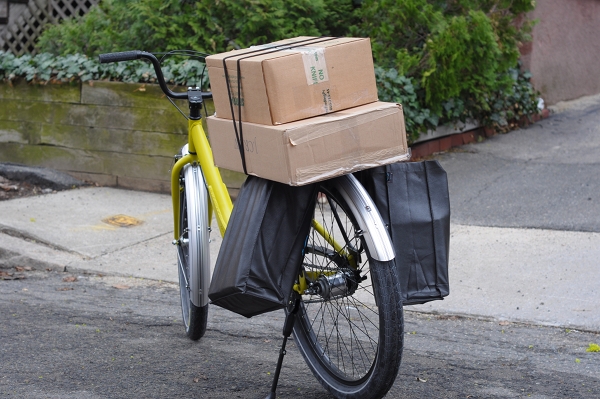
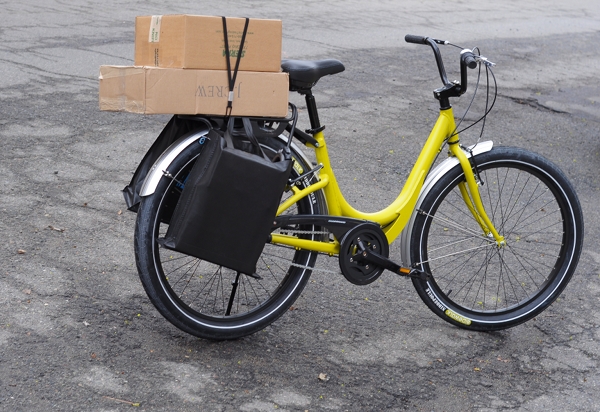
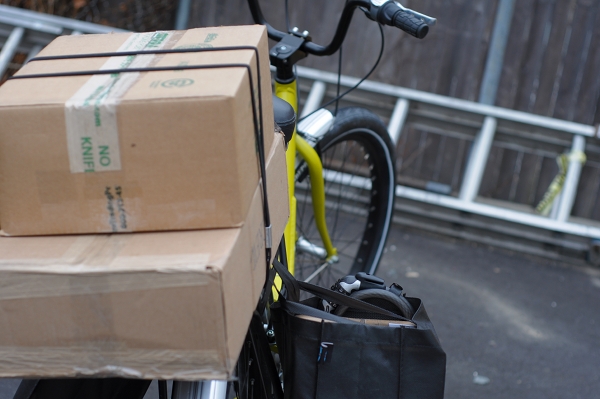
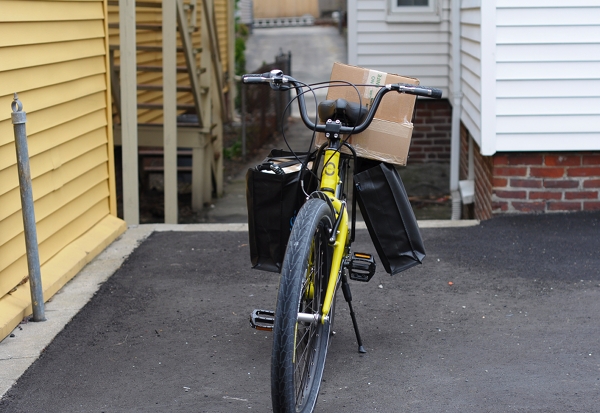
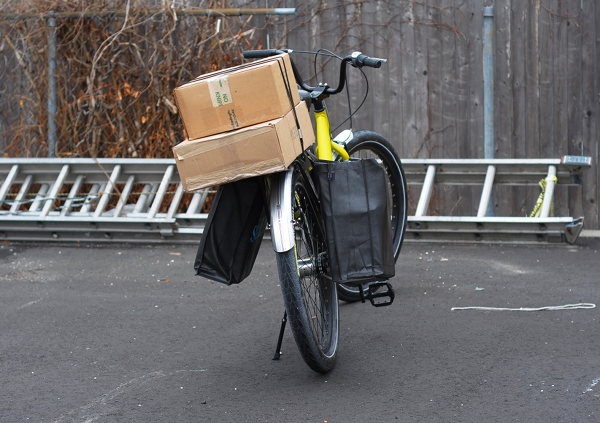
First, allow me to acknowledge that my so-called "cargo" pales in comparison to the likes of what some greater, more adventurous cyclists carry on their bikes every day without batting an eye. But I am neurotic and risk-averse, and I never really have all that much to carry. So for me, this was a great feat worthy of glee and merriment. To give you a sense of scale, the larger box with the J. Crew insignia (I re-use old boxes for shipping) originally contained a long winter overcoat and is almost twice the length of the rack supporting it. The box on top of it is shorter, but taller. And each of the bags on the sides contain two heavy, medium-sized boxes.

The trip was necessitated by my needing to mail a number of large packages simultaneously, which has not happened in a while. If confronted with this situation 5 months ago, I would have simply waited until the Co-Habitant was available and we would drive it all to the post office on a Saturday morning in the car. But now we no longer have a car (at least for the time being - it's not permanent, really!), so I could either make multiple trips to the post office or try to fit it all on my bike at the same time. The latter turned out to be surprisingly - almost disappointingly - easy. Within minutes of deciding to try it, the packages were secured to the sturdy backside of the Urbana bike.

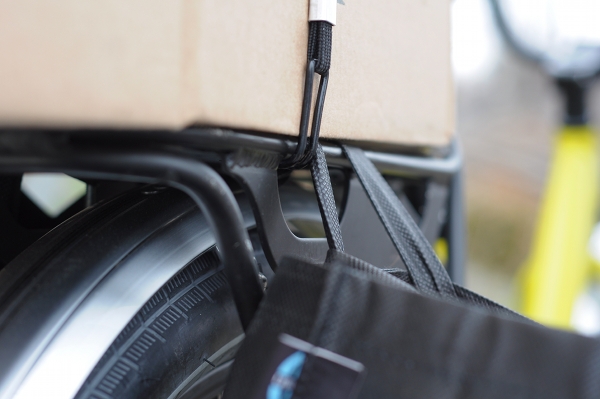
I wasn't sure whether my bungee cord would fit around both boxes, and whether it would be sufficient to keep the boxes sturdy. To my delight, it was a "yes" on both accounts. I secured the two bags on the sides using the rack's hook system (see here and here), which was convenient in that I did not need to use dedicated panniers or ropes. The whole set-up literally took 5 minutes, and then I was off: first gingerly, then at a moderate pace. The postoffice is fairly close to my house, so I cannot boast a grueling ride over hills or along dangerous highways. But for what it's worth, it was raining, and the roads in my neightbourhood are riddled with potholes the size of ditches.

The ride was an uneventful success. Still, I cannot say that I enjoyed cycling with six boxes attached to my bike. I was conscious of them the entire time, and kept worrying that something might fall off - not only getting damaged in the process, but also causing me to panic and do something unwise in the midst of traffic. So... while I can do it if necessary, I am just not one to derive pleasure from loading my bike up with a stack of boxes secured to the rear rack with bungee cords.

On the other hand, I do like the independence such hauling capacity offers, as well as the smooth handling of this particular bike despite the load. Richard Masoner of cyclelicio.us sent me a link to this picture of himself riding an Urbana with an enormous plastic tub bolted to the rear rack, in which he carried 80lb worth of camping gear. Okay, I like it. If this bike were mine, I can see turning it into a dedicated "cargo chariot," with a colour-matched tub permanently attached to the rack. Postoffice run? Toss the packages in the tub. Need to buy furniture or building supplies? Tub! This could seriously eliminate our need for using a car for local errands, without the need for an unwieldy longtail or Bakfiets.

The Co-Habitant cautions against the giant tub idea, pointing out that carrying a heavy load that high is bound to create handling problems. But I wonder whether that applies to all bikes, or whether the Urbana's design accommodates it - after all, the rack is rated for 150lb, and they do not specify that it needs to be carried as low as possible...

So, how about this question: Assuming that (1) one does not plan to transport children, and (2) the rear rack is rated for the weight, what, if anything, is wrong with attaching a Bakfiets-sized container to the rear rack of a hardy transport bike and turning it into a "cargo chariot"? I am not talking milk crate, but a truly enormous tub, as shown here. It seems to me that such a system could really work for a person who cannot deal with (or afford) a longtail or full-on cargobike. It could work for me, for sure.
Thursday, April 14, 2011

That Fateful Click

[image via GarySe7en]

So you're pedaling along a bike lane. Ever vigilant and keeping out of the door zone - or at least so you hope. And then, as you are cycling past a particular car - right at the very moment you are parallel to it - you hear that sound... that fateful click which accompanies the pulling of a car's door handle and precedes the flinging open of the door itself. You hear it, and your body reacts before you even have time to register a thought, let alone evaluate the situation and make a decision. Am I in the door zone? Will the swinging door hit me? If I swerve to the left, will I be in the path of car traffic? It hardly matters. The reaction to that click is a knee-jerk response. And what will it be?

Hurrying home at dusk with a pannier full of hot Indian take-out, I heard the blood-chilling click whilst passing a blue sedan. My knee-jerk response was to let out a pitiful yelp and hammer down on the pedals with all my might. I heard the door swing open a fraction of a second later. Would I have cleared it anyway? Very possibly. I really do my best to stay to the left in the bike lane. But our danger-evading instincts are strong and do not always work in our favour. I could have slammed the brakes. I could have swerved into traffic. We can't always control how we react when adrenaline floods our system.

It's times like these I wish that bike lanes weren't placed directly in the door-zone half the time. I know, what a tiresomely clichéd complaint.

Tuesday, March 22, 2011

The Stranger

A little while ago I locked up my bike in a neighbourhood I don't much like and left it there for a couple of hours. When I returned, there were objects arranged on my rear rack: an unfinished cup of coffee and a pair of broken sunglasses. I picked up the paper cup gingerly and threw it in the nearby trash. There was a stain and some crumbs stuck to the cup where someone's mouth had been. The cup was cold, but then the day was also cold; impossible to know how long ago the coffee drinker had left it there. I then looked at just the sunglasses alone on the rack. Reflective and cracked in several places, they reminded me of broken mirrors that could bring bad luck - I found myself not wanting to touch them, and just stood there looking at them for a bit. Finally I removed them from the rack and placed them carefully on the edge of a flower bed. 

So... some idiot left some stuff on my bike. What is the big deal? I don't know. I guess I am prone to seek meaning in things where none exists, and sometimes these random ambiguous types of acts bother me more than something more obviously hostile would. I tried to imagine the stranger who left the cup and sunglasses behind. Was it an absent-minded thing, where the person was on their way to the trash bin and suddenly their mobile phone rang? Or was it intentional, and a coin-toss between that and slashing my bike's tires? Was it a message, however unconscious, or did it mean nothing at all?

It's amazingly easy to leave our mark on somebody else's world, and bicycles - being personal objects that we just leave around, exposed - seem to attract that kind of mark-making. Be it a flower tucked into the handlebars, or garbage left in the basket, the gesture makes us aware of those countless strangers among whom we move and most of whom we will never know.

Thursday, March 3, 2011

You Take What You Can Get!

Today was the first time in two months that I went on what can even remotely be described as a "recreational" ride. Having finished my errands, I continued onto the Charles River trail for a half hour - then turned around and rode back. The wind was brutal and the temperature around 30°, but the trail was finally free of snow and I couldn't resist it despite my continually running nose. 

It felt weird to cycle "for no reason" after not having done it for so long! I kept thinking "wait, where am I going again?" before remembering that I wasn't headed anywhere in particular. But I'm sure I'll get used to it soon.

The Charles River trail now has less snow on it than the roads do - which is odd, because I didn't think they'd even plowed it all winter. Maybe it's warmer next to the river.  As for the roads, the snow has mostly melted - but hardened snowbanks still pop up when you least expect them, making transportation cycling like an obstacle course that requires constant merging in and out of traffic. I keep looking out the window and hoping that finally, today cycling will be normal again. But it isn't quite there yet. You take what you can get.

On the road, I had a conversation with a motorist at an intersection that I've had several times before (not with the same motorist, mind you). The light had just turned red and the driver began signaling a right turn. Since I was already on his right, I positioned myself slightly ahead of him and waited for the light to change.
Driver (good-naturedly): You trying to race me, hon? I'm pretty sure I'll win!
Me: What?... Oh. No, I'm trying to make sure that you see me and we don't collide when you turn right. If I'm further back you might not see me.
Driver: Huh?  (thinks about it for a moment) Oooooh. Huh! Okay, that makes sense. And I've been wondering why you guys do that.
For me, these kinds of interactions confirm what I intuitively suspect: Some of the safety maneuvers that cyclists take for granted as being logical and inherently understood by both parties involved, in fact often aren't. So here was this motorist, apparently wondering for God-knows-how-long why the heck all these cyclists need to make it a point of stopping slightly in front of him at intersections, and the reason simply never occurred to him until I explained it. And no, I don't think he was teasing me by pretending not to understand. Still, at least he was friendly and from now on he'll know. You take what you can get!

Wednesday, February 16, 2011

Is the Wheel Lock a Useful Feature?

Yesterday I mentioned not being a huge fan of bicycle wheel locks (or "cafe locks"), and so I wanted to elaborate. Most typically used on transportation bicycles, the wheel lock is a circular contraption that is installed over the rear wheel, with a metal latch sliding through the spokes when the key is turned. The wheel lock immobilises the bike, thus making it more difficult to steal - especially if the bike is heavy. I thought it was a neat idea before I owned one, but the Axa wheel lock on my Pashley annoyed me so much that I eventually removed it. The older model on my Gazelle works much better, but I am still considering getting rid of it.

Here are the pros and cons of the wheel lock as I see them (and your impressions, of course, might differ):

Pros:
. It's useful as an extra lock, for those who like elaborate lock-up jobs.
. It's useful if you're sitting in an outdoor cafe or a park bench, with your bike within sight.
. It's better than nothing if you forget your main lock.
. It's better than nothing if there is no structure to which you could lock your bike.
. If you live in an extremely safe area, you might be able to use it as your only lock - which would eliminate the need for a bulky U-lock or cable lock.

Cons:
. Its theft prevention effectiveness is limited.
. It is heavy (like having a U-lock permanently attached to your bike).
. If it jams in the "on" position, your bike will be immobilised.
. Some models are difficult to use and can hurt your fingers while you fiddle with the lever.
. Once installed, you must lock it every time you leave your bike. Otherwise someone else could lock it and walk off with the key. On most models, it is impossible to remove the key in the un-locked position.
. You can break a spoke if you forget that the lock is activated and try to forcibly roll your bike. Likewise, a passer-by can break a spoke if they try to give your locked wheel a spin with their hand.

Do you have a wheel lock on your bike? If yes, what make and model, and have you found it useful?

Tuesday, February 15, 2011

Misadventures in the Thaw

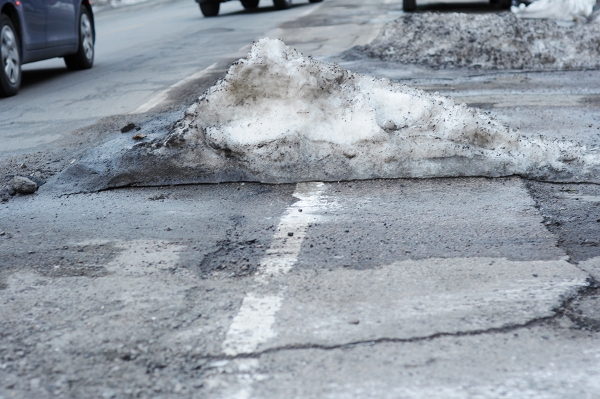
As you may have inferred from the dearth of personal posts and new pictures, there has not been a great deal of cycling lately. But suddenly, yesterday: a thaw. A cursory glance outside suggested that the streets had somewhat cleared of snow, and so I eagerly dragged out the bike. But what was meant to be a productive day, became instead a frazzled misadventure.
Liberated from the heaps of snow under which it's sat for over a month, my entire street now looks like it's being dug for trenches. I am amazed that this could happen over the course of a single winter, especially since they'd just recently repaved it. There is barely a foot of road where the asphalt is not broken, and it's nearly impossible to cycle through what is essentially one big ditch.

Soon I was on the main road, which has bike lanes in both directions. That is the bike lane in the picture above. When the blizzards were in full force, it was understandable that the bike lanes were not cleared. The whole town was covered in yards of snow, and I don't think bike lanes deserve special treatment compared to traffic lanes and sidewalks. But they do deserve equal treatment, and for the past couple of weeks they have not been getting it, as far as I can see. Everything except for the bike lanes is now cleared.

After a couple of swerves and dodges, I decided to get out of the bike lane altogether and cycle on the road. The drivers thought I was insane. Apparently, they are no longer sympathetic to cyclists being in the traffic lane, because the conditions aren't harsh enough to evoke the "winter weather mode of politeness." I got a couple of "what are you doing??" gestures through rolled down windows, and my feeble attempts to point at the slush and ice in the bike lane elicited only blank stares. The bike lane looked fine to them - at least fine enough to make it no longer acceptable for me to be out in the traffic lane. After this happened a couple of times, I gave in. I didn't want to be right. I just wanted to get where I needed to go without arguing with every third car that passed me. So I got back in the bike lane. And that's when it happened: My first near-accident.

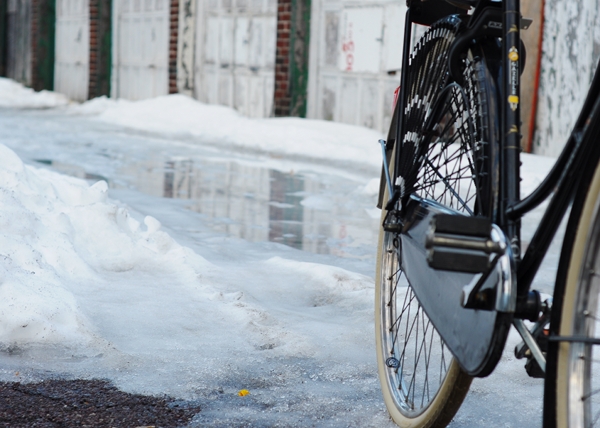
I don't have pictures of what the spot looked like, but it was similar to the watery area you see behind the bike here. I was cycling along a more or less clear portion of the bike lane, when suddenly I approached what looked like water with some slushy edging to it. It was getting dark at this point, and I considered that the water might in fact be covering a layer of ice. But by the time this thought entered my mind, I had a choice to either brake suddenly, swerve around it, or go through it. Looking over my shoulder, there was no room to swerve. And braking seemed like a bad idea in that particular spot. So I went through it. There was indeed ice underneath the water, and the bike's reaction surprised me. It did not slide out from underneath me or flip over upon hitting the ice, but remained upright while "skating" in a zig-zag, much like a car would on an icy road. Incredibly, I kept my balance and tried to contain the zig-zagging within the bike lane, as there was a steady flow of cars to my left. It seemed to me that this went on forever, but in all likelihood it was probably over in less than 10 seconds. I looked back afterward, and the ice-watery stretch was a quarter of a block long. I feel comfortable classifying that as a safety hazard.

I don't mind admitting that the experience left me a bit shaken, and I decided to turn back before reaching my intended destination. I switched on my lights and cycled on the road again, not caring whom I was inconveniencing and how they chose to express that. Then I stopped by a shop near my house to get some olives.

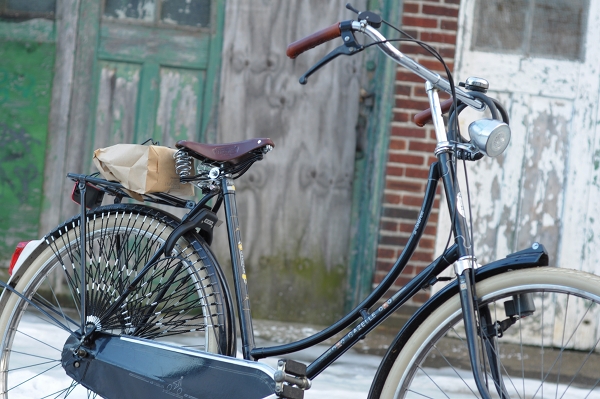
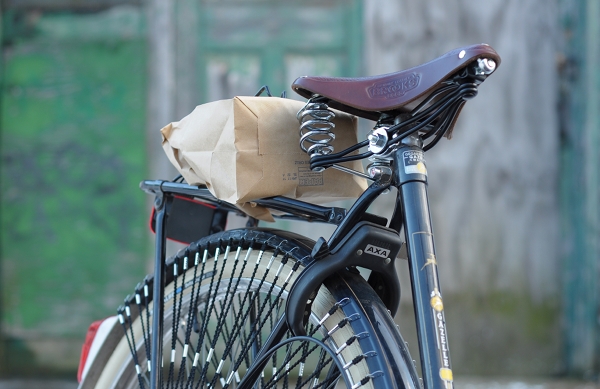
Not having taken my pannier along, I put the olives in a paper bag and secured the package via "rat-trap" - which made me think about rack design again. It is surprising to me that the Gazelle rack, which is rated for a huge amount of weight, has no provisions for bungee cord attachment. I don't really trust these rat trap thingies. I also have mixed feelings about "cafe locks." They are heavy, they are not always easy to use, and you can hurt your fingers if they get in the way of the lever popping back up when the lock is released - which is exactly what happened after my olive purchase.

I arrived home without further incident, albeit trailing olive brine from the rat trap having pressed into the container. A notification of a missed package greeted me with a malicious grin, as I removed the leaking packet from my bike rack and prepared to drag the Gazelle up the stairs. A productive afternoon it was not.

But surely there are lessons to be learned from this. The lure of the first thaw is not to be trusted? Water-covered ice is more treacherous than packed snow? Don't let drivers bully you into a bike lane that you feel is unsafe? Yes, all of those certainly seem to fit, but somehow I don't feel a whole lot wiser after the experience. What exactly am I supposed to do next time, cycle on the road and be shouted at the whole way? Or stay off the bike until the city finally decides to clear the sides of the roads? Neither is an appealing option.

Thursday, February 10, 2011

Step-Throughs: an Advantage in Traffic?

There was an interesting post on ecovelo yesterday, where the author compared how he uses his three transportation bikes: a Rivendell Sam Hillborne, a Surly Long Haul Trucker, and a Civia Loring. All three bicycles are set up with upright handlebars and decent load carrying capacity, but the Civia differs from the other two in that it has a fairly low stepover. And according to the author, the combination of its "upright riding position, step-through frame, and internal gear hub make[s] the Loring exceptionally confidence inspiring for riding slowly when in close proximity to pedestrians and automobile traffic." Initially, I read past that sentence with the kind of matter-of-fact acceptance that goes with processing what you already consider to be a given. But then later I mentally "rewound" and thought "Wait a minute, he is saying that he finds it more comfortable to ride a step-through in traffic than a diamond frame - Is this a generally accepted notion?" 

I used to think the reason I prefer step-throughs for transportation, is that I often wear skirts. But having read the ecovelo post, I realise that even when wearing trousers I feel better on a step-through in traffic. And, assuming that Alan of ecovelo mostly wears trousers, for him there must be other factors involved as well. Maybe for me it's the promise of the easy "hop off sideways" dismount should I need to bail, that makes me feel more secure. But to tell the truth, I am not sure what it is, and whether my preference is entirely logical.

All factors remaining equal (upright handlebars, ride quality, load capacity), what, if anything, would make a step-through bike an advantage in traffic?

Thursday, February 3, 2011

Cycling and Statistics

As someone with a background in the social and natural sciences, I was "raised" on statistics by the academic system. If we compare academia to religion, then making claims without statistical evidence is akin to taking the Lord's name in vain. But even beyond academia, we have an inherent faith in statistics as a culture. We respect numbers and charts, and we turn to them for comfort at times of uncertainty. Consider, for instance, this beautiful bar graph:

Now, some of us may have suspected that diamond frames tend to be ridden by men, whereas step-throughs and mixtes tend to be ridden by women, but only numbers and graphs have the power to lift us from the murky waters of speculation. We can now say that, in a recent poll conducted by Lovely Bicycle, of the 221 respondents who claimed to ride mainly diamond frame bikes for transportation, 76% were male. Of the 95 respondents who claimed to ride mainly step-through bikes for transportation, 80% were female. And of the 39 respondents who claimed to ride mainly mixte bikes for transportation, 66% were female. This numerical evidence we can wield like a mighty weapon the next time someone contradicts these tendencies.

Of course the one little problem with Statistics, is that it's mostly BS. In the words of comedian Vic Reeves, "88.2% of Statistics are made up on the spot" - which may very well be the case. But numbers need not be maliciously forged in order to misrepresent reality. There are multitudes of ways in which a study can be flawed or biased from the start, set up so as to elicit particular responses. Often this is done unintentionally, or at least unconsciously, by researchers eager to find evidence for their pet theories. Other scenarios can include how data is processed, or even how the final results are presented. Statistics are highly prone to human error and bias, which means that they are inherently subjective. This, combined with the fact that we respect them so much, makes our statistics-loving culture susceptible to misinformation.

[image via NHTSA]

The idea of statistics and misinformation brings me to what I really wanted to talk about here, and this is something I've been trying to make sense of for a while. I am puzzled by the use of safety statistics in bicycle advocacy, and I am hoping that someone could explain them to me. For example, many bicycle advocacy talks and internet presentations stress that it is safer to ride a bike than it is to travel in a car. In support of this, they use statistics such as this data from the National Highway Traffic Safety Administration (NHTSA), according to which there were about 30,000 motor vehicle traffic fatalities, and about 600 bicycle fatalities in the USA in 2009. These numbers are used by cycling advocates to point out how much safer it is to cycle than to drive. But unless I am missing something, the figures mean just the opposite.

Yes, the NHTSA numbers suggest that in 2009 there were 50 times more motor vehicle fatalities than there were bicycle fatalities in the US. But those numbers mean nothing until they are weighed against how many cars vs bicycles there are on the roads at large. If there were 50 times more cars on the road than bicycles, than the risks of fatal traffic accident would be equal for each mode of transportation. But I believe that in actuality, there are more like 1,000 more cars on the roads than bicycles... which means that the number of cycling fatalities is disproportionately high.

Obviously, I am not trying to prove that cycling is unsafe. But I do want to understand the reality of the situation. After all, if cycling advocates use statistics incorrectly, they open themselves up to some very harsh critique from unfriendly forces. Where could one go to obtain accurate statistics about the number of cars vs bicycles on the roads, and the number of traffic accidents for each?

Monday, January 10, 2011

The Mary Poppins Effect?

Lately, there has been some discussion in the comments about whether drivers display more courtesy when cyclists ride upright bicycles and dress in "regular" clothing. One reader wrote that "the uprightness [is] more visible and [the clothing] maybe less offensive to your average driver... The images generated revolve around Mary Poppins. Only a monster would do anything mean to Mary Poppins" (Christopher Fotos, December 10, 2010). Do you agree?

When Bike Snob NYC poked fun at the Tweed Ride last week in his typically colourful manner, I was laughing my head off about the associations with colonialism and Civil War re-enactments: I never found Tweed Rides appealing for precisely those reasons. But I disagree with his conclusion that nice clothes on a bike are generally "not traffic calming." It's one thing to be dressed in what appears to be period costume, joined by dozens of others who have done the same while taking a joyride through the city. It's another thing entirely to be cycling to work in a suit and a wool overcoat, because that is what you normally wear to work.

Speaking solely from my own experience, I'd noticed as soon as I started cycling for transportation that drivers are nicer to me when I dress "normally." And since having begun to ride a roadbike recreationally, the difference between how I am treated on the roads when on a bike with drop bars, wearing "sporty clothing" and my hair tucked away, in comparison to how I am treated when on an upright bike in "city clothing," with my work bag in the basket and my hair visible, is notable. The majority of the time, when a driver is rude to me or impatient with me, I am on my roadbike - which is odd, since I am faster on a roadbike than I am on an upright bike, and thus should be less "in the way."  To me, this just confirms that drivers' perceptions of how annoying a cyclist is, are entirely subjective. You can be going 10mph and somehow this might be okay, or you can be going 25mph and they might still be annoyed.

In part, I think the idea of not wanting to harm Mary Poppins is valid - in the sense that a cyclist dressed "normally" looks more human to the driver. The way people process each other visually and emotionally is governed by a complicated system of simulation and self-recognition (this is actually my research specialty, so I've spent a lot of time thinking about it!). And from that point of view, it makes sense to speculate that the more "I am human! I am you!" signals we give off when cycling, the more empathy a driver will feel towards us. Dehumanisation, on the other hand, makes it easier to cause harm to another human being - because we fail to simulate their emotional state and relate to their suffering. And dehumanisation is facilitated by things like uniforms (one reason it is easier to kill soldiers and war prisoners, than civilians), or anything else that obscures individuality and hides signs of "humanness".

But in addition to the Mary Poppins effect, I think that there are also implicit "right of way" rules that are present in the driver's mentality, from which "normally" dressed cyclists benefit. I am not suggesting that this is right or justified in any way, but I get the impression that drivers are enraged by the associations with leisure and recreation that a road cyclist's attire evokes. The cyclist is on the road because they are "going for a ride." The driver, however, is on the road because they "need to be somewhere." So the reasoning follows, that the person who needs to be somewhere clearly has more valid reasons to use the limited road space than the person who is going for a ride, which is why the presence of the road cyclist causes annoyance. On the other hand, when the cyclist's appearance suggests that they are also engaging in transportation and "need to be somewhere" just like the driver, their presence on the roads seems more justified. This is just a theory, but the fact that drivers will shout things like "Get a job!" to roadies, but will ask me "How long does it take you to get to work?" at red lights when I am dressed up, gives it some plausibility. They associate the "normal clothes" look with going to work, and they associate the sporty look with recreation.

All of this is, of course, entirely speculative and none of it is to say that cyclists should strive to dress in any particular way in order to secure the driver's compassion. Only the certainty of criminal prosecution can reliably deter a driver from causing harm to a cyclist, and I hope to see that become the norm in the US in the near future. Until then, let's hope that drivers can find a way to see Mary Poppins in all of us, whether we are dressed in lycra, tweed, or something in between.