Showing posts with label diamond frame. Show all posts

Saturday, June 18, 2011

The Surly Cross Check Review: a Colourful Build and a Fender Massage

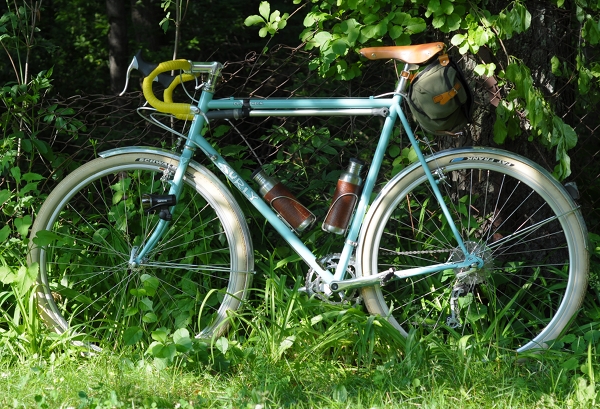
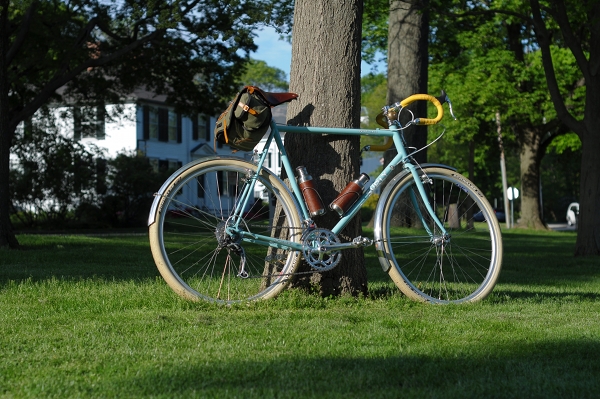
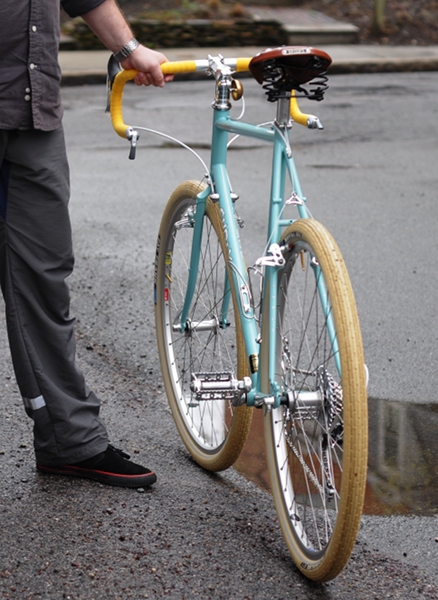
Two months ago, the Co-Habitant got a Surly Cross Check frame that he wanted to build up as a fun on/off road bike around a touring wheelset with fat tires that we already had in our possession. He is getting a nice roadbike later this summer (waiting for the frame to be finished!), and the Surly was meant to be "the other bike" - a playful, go-anywhere bike built around an inexpensive frame, mostly using components we already had. He swiftly put the bike together and has now cycled about 500 miles on it. The Cross Check is technically a cyclocross frame, but it is versatile and can also be used for touring and commuting. Given its unusual build, we've had many questions about this bike and so I offer a review on the Co-Habitant's behalf.

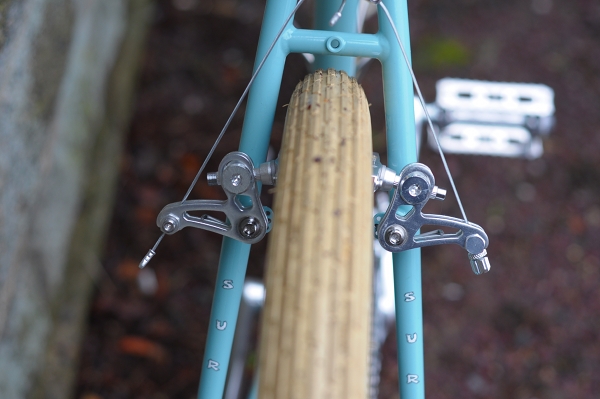
The most noteworthy aspect of the build, is that we were able to fit the frame with Schwalbe Fat Frank tires and metal fenders. This looks great, and the tires feel awesome, but to tell the truth the whole thing was a pain. The Cross Check is described as being able to fit tires up to 45mm with fenders, but the Fat Franks are 50mm. It was a tight fit that required some DIY. Initially we wanted to use Berthoud steel fenders, which are available in 700Cx60mm, but the Co-Habitant was not impressed with their quality upon seeing them in person. He also dislikes plastic fenders and did not want to use SKS. In the end he decided to get the Velo Orange Zeppelin 700c x 52mm fenders (which are rated for 42mm tire), and "massage" them to fit.

Out of the box, the fenders were too tight: The edges touched the sides of the tires and there was not enough space under the brake bridge and behind the seat tube to mount them high. So, the fenders had to be opened up. But when you open up a fender that's 52mm, it no longer follows the line of a 700C tire, instead making the opening much smaller. So while opening the fender, it had to also be stretched out -  taking care not to crimp the edges. To do this, he used a flat low table holding the fender upside down against its surface and pressing down gently, rolling it end to end - opening and pressing down. Pressing down would close the fender and opening it would alter the curvature, so the back and forth balanced out the opposing forces.

For the front fender there was sufficient clearance underneath the fork crown, but in the rear there was less clearance - the brake bridge is quite low and the chainstays are short. He had to dent the top of the rear fender (which isn't visible) in order to get it closer to the brake bridge, then fabricate a custom circular-L-bracket to hold the fender in place, screwed into the eyelet of the brake bridge. To dent the fender, he placed it on some clothing on the top edge of the back of a chair, then hit it with a rubberized end of a pedal wrench, creating a grooved dimple. He also had to dent the ends so that they wouldn't pinch near the bottom bracket. It was a bit of an ordeal, and if you are going to attempt this beware that it is easy to ruin the fender - it may not be a risk worth taking.

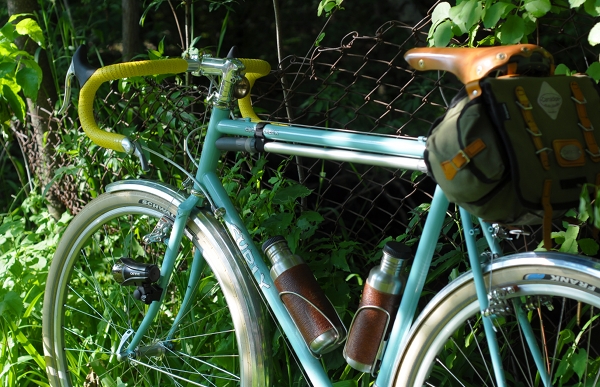
Happily, the "massaging" was a success and the Cross-Check looks great with the fat cream tires and the VO Zeppelin fenders. The ride is fast and cushy, and the Co-Habitant is discovering just how addictive wide tires are. On the downside, the clearances between the tires and fenders are so tight, that the set-up is not really practical for serious off-road cycling: stuff can get caught in there and cause problems. But for fire trails and gravel paths it is fine, and if he decides to do anything more serious (like the D2R2!), he will remove the fenders.

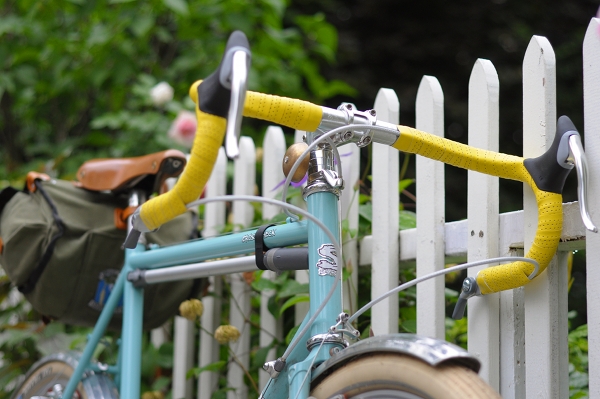
The rest of the build for this bicycle has mostly already been described here, but a few changes have been made since then. The original shortish stem has been replaced with a 9cm stem, flipped upside down. The original yellow cloth tape got filthy and tattered fairly quickly, so we replaced it with Fizik tape. Initially, the cloth tape was supposed to be shellacked to a warm caramel - but the bright yellow looked so "right" on this bike, that it began to seem like an inherent part of its personality and he decided to keep it that way. He also added a frame pump, lamenting the lack of pump peg and using a strap to hold it in place.

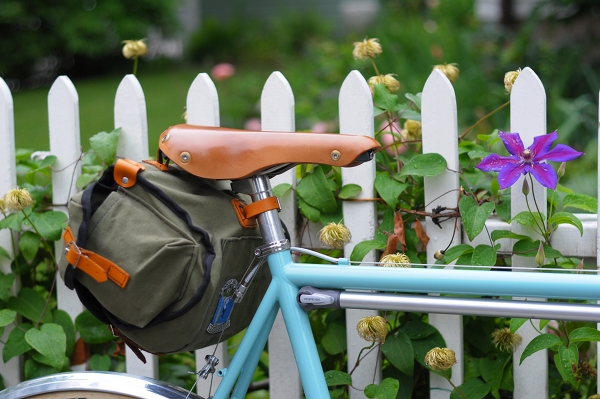
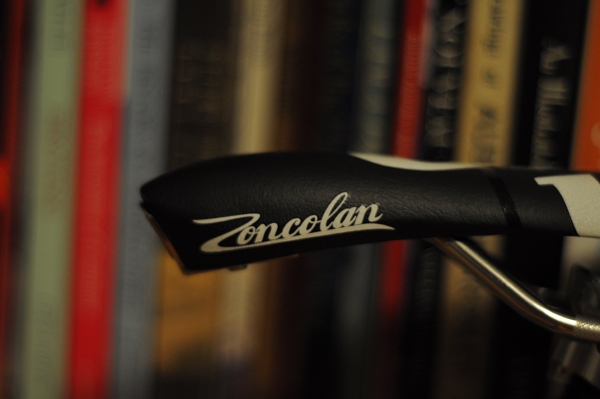
After two years in a lukewarm relationship with his Brooks Flyer saddle, he decided to sell it and replace it with a Berthoud touring saddle - the male version of the one I now have on my Rivendell. So far he loves it.

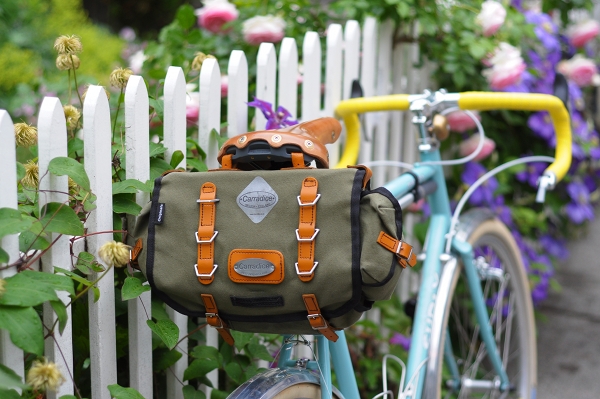
He fitted the bike with the Carradice bag that used to be on his old bike.

It now has a patch on it, to cover the tear that happened as a result of the bag rubbing over the brake cable on his old bike.

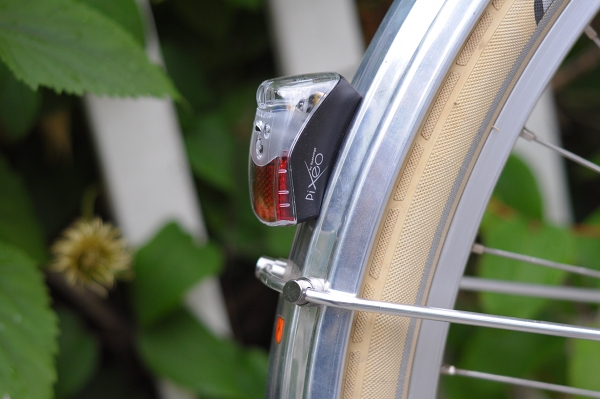
He affixed a CatEye headlight to a braze-on on the front fork, and a Spanninga Pixeo tail light to the rear fender.

He tried to liberate himself from clipless pedals and rode the bike with touring pedals for a few weeks, but ultimately could not take it anymore and put his old clipless pedals back on. Fair enough, but this does limit the versatility he originally had in mind for the bike.

After riding the Surly Cross Check for two months, his main feedback is that the bike is faster than he expected - even with the wide tires and a bunch of weight in the saddlebag. While initially he intended to use the Cross Check in conjunction with his old Motobecane until he got his new roadbike, the Motobecane was retired as soon as he started riding the Surly - no need for it, since the Cross Check did everything it could do and more. He does not find the bike sluggish, and it seems that the tubing is just right for someone of his stature (6ft/ 200lb+). Overall, he is pretty happy. Though he likes lugs, he also likes a nicely done TIG-welded frame and the Surly suits him just fine.

My take on his Cross Check... I think it is a well-made, attractive frame for the price and I am glad that he finds it comfortable and fast. To be honest, I think that at least to some extent this build was not so much about practicality, as about doing a fun and challenging project using a bunch of components that we had acquired but had no use for. If the original purpose of the bike was off-road, then the tire+fender combo with such tight clearances does not really make sense. I have a feeling that he will end up using it mainly on the road, because I can't imagine him bothering to remove and reinstall the fenders every time he wants to take it on serious trails. And this means that when he gets his long-awaited road frame later this summer, the functionalities of the two bikes will overlap considerably. Not that there's anything wrong with that. But given how much he likes the Surly I am almost worried that he might be disappointed with the special bike he's waiting for. Well, hopefully not.

On a more general note, while the Cross Check is clearly versatile enough for commuting and touring, I wonder whether many cyclists actually use it for cyclocross racing. I have a hard time imagining that, given how relatively heavy it is - even the floor models with narrower tires and sportier components. But maybe I'm just biased from having handled too many lightweight bikes recently.

The Surly Cross Check is a fun bike with a cult following, and it is particularly impressive how customisable the frame is. With its happy colours, fat cream tires, elegant fenders and classic touring accessories, the Co-habitant's Cross Check is distinctly his own.

Thursday, June 16, 2011

Our Beautiful Experiment

When Bryan Hollingsworth phoned to tell me that "our" frame was back from the painter's, I dropped what I was doing, grabbed my camera and was there within minutes. For weeks I had been nervously anticipating the results of my emphatic description of what I wanted this frame to look like - a description presented in an illustrated 3-page document, then further clarified in a tête-à-tête with the painter. He must have thought I was insane to wax lyrical about the precise shade of "stormy seas" I had in mind. But no matter, because it's done and it looks just as I had imagined!

So what exactly is this frame? I have mentioned before in passing that I am collaborating with Bryan of Royal H. Cycles on a classic randonneuring bicycle. I provided the geometry and tubing specs (don't worry, I had a lot of help), came up with the colour scheme, and specced the components. Bryan built the frame with his signature touches, and will be putting the bike together - including internally routed lighting. In other words, he did the real work while I talked, gesticulated, sent emails, and took pictures. It takes all kinds.

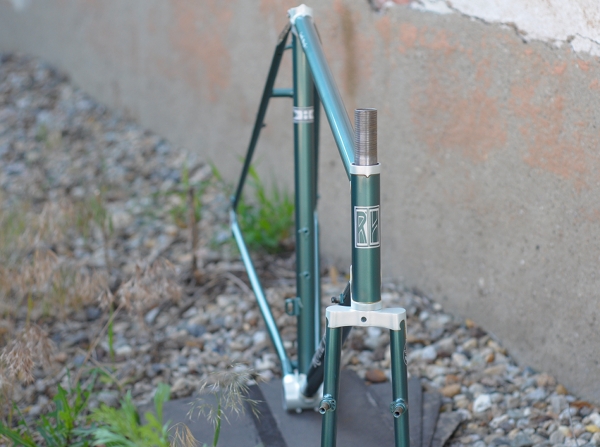
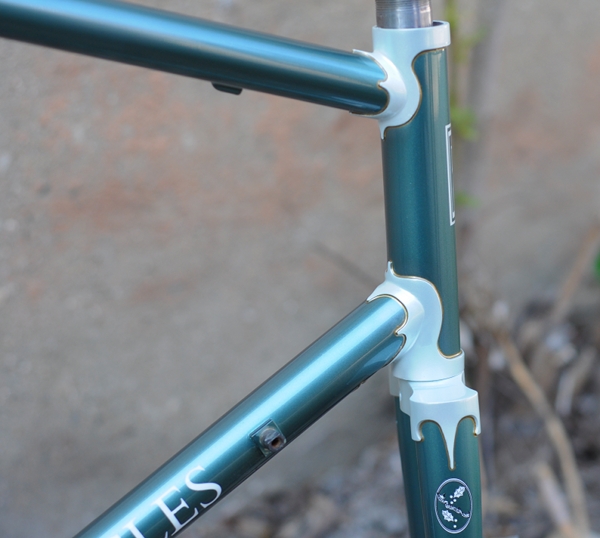
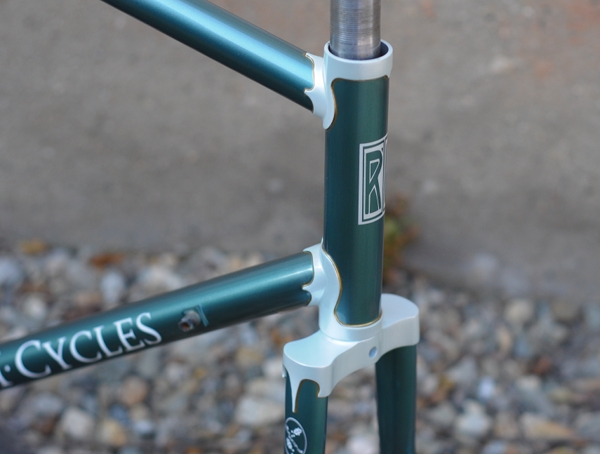
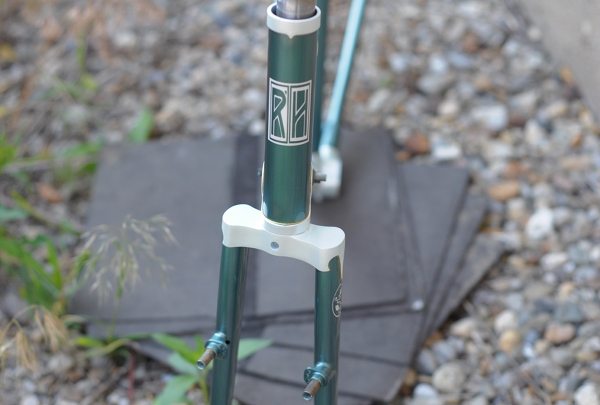
It's difficult to tell at the drawing board how a frame will really look once it is finished, but this is pretty much what we hoped it would look like. The Everest lugset and Grand Bois fork crown are just perfect together. The tubing is True Temper OX Platinum, with Kaisei Toei Special fork blades.

This is a classic randonneuring frame in the sense that it has low trail geometry and is built for 650B wheels with wide tires. Specifically, we will be using the Grand Bois Hetres, and you can see them fitted onto the "naked" frame here. The build will be fairly classic and high quality, but nothing too flashy. We are going to try to keep the weight down as well. The frame and fork themselves feel very light.

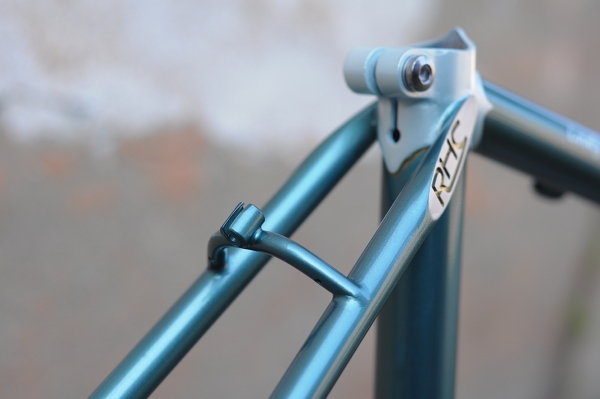
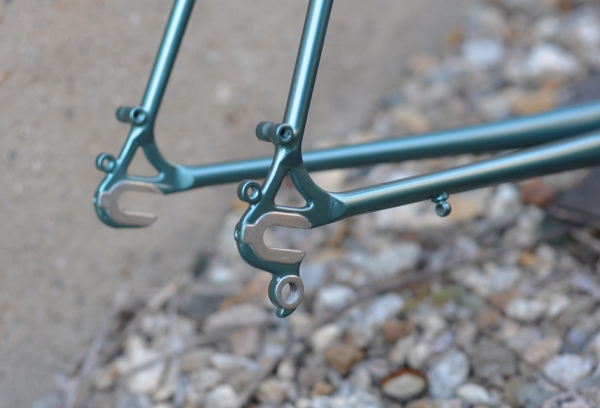
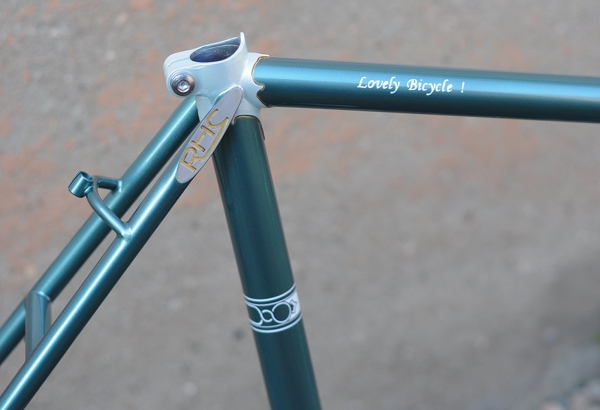
Bryan had just ordered these custom RHC (Royal H Cycles) end caps for seat stays, and this is the first frame that will have them. He also made the cantilever cable hanger.

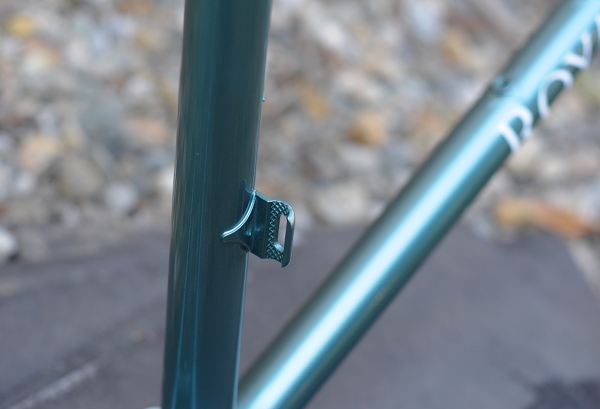
Front derailleur hanger.

Zink-plated dropouts, eyelets for fenders and rear rack.

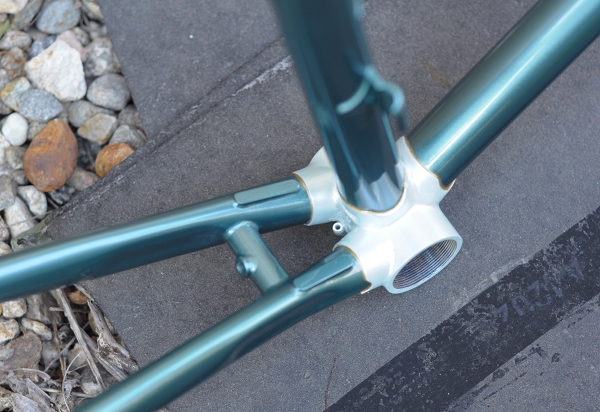
Bottom bracket, cable routing, stainless kickstand plate. There is much more to this frame, but I will save it for when the bicycle is finished!

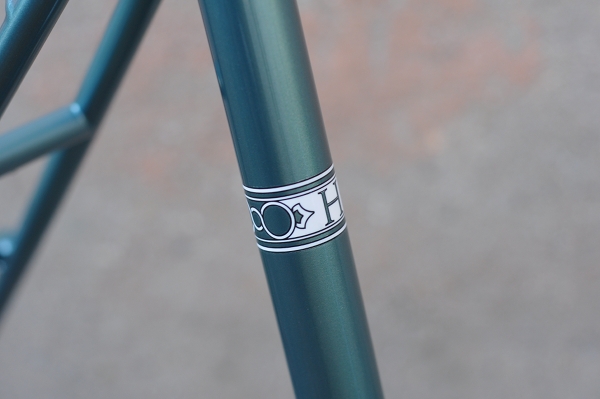
Bryan has several options for decal designs that he uses, and I wanted the frame to have aspects from different ones. So the head tube insignia design is from one set, while the downtube insignia is from another, and I love the way it all came together here. I also really wanted this band around the seat-tube, which reminds me of a vintage candy wrapper.

The main frame colour is a slate-blue-green metallic paint with very fine pearlescent particles. I suspect that this is the same or a similar paint as what Mercian uses for their polychromatic colour family, which they describe as resembling "the underside of tin foil." While it's not for everyone, I am crazy about this finish, and the colour really does resemble a stormy sea. The lugwork is off-white with a similar metallic shimmer as the main frame colour, resulting in a sort of mirror finish effect. In person this creates an interesting illusion, where the lugs sometimes look white, and at other times resemble the main frame colour. The lugwork is subtly outlined in gold.

Before this bicycle is sent off to the customer, I will be test riding it for a few weeks and inviting a couple of more experienced cyclists to test ride it as well. Neither the framebuilder, nor the customer, nor myself have any idea what to expect from this bike and that is part of the excitement. We all wanted to try a classic randonneuring bicycle, and creating one ourselves was an interesting way to make that happen. I will post more about this bike once it is built up, and will most likely be writing about it for Bicycle Quarterly sometime later this year, so stay tuned. A big thank you to everyone who helped make this happen. It is a beautiful experiment, and I can't wait to find out how it rides!
Tuesday, May 24, 2011

I am Curious, Yellow

Obscure film references aside, the past week for me has been dominated by equal parts anticipation and anxiety. I've ridden my loaner roadbike for 120 miles in preparation for the next paceline ride... which, ironically, was cancelled for the second time in a row due to rain. The more time passes, the more my anticipation builds and the more exaggerated my anxieties become.

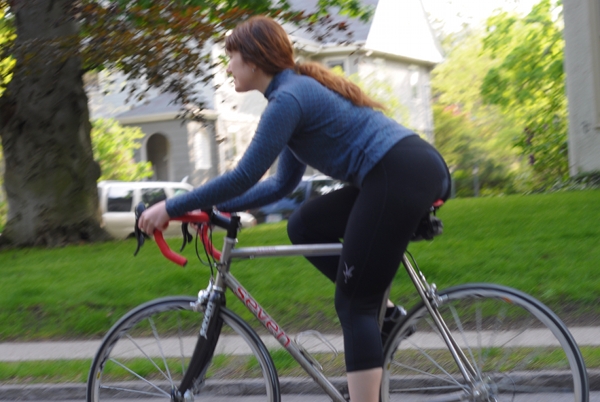
The Co-Habitant and I did two fast-paced, hilly rides over the weekend - he on his Surly Cross Check and I on the borrowed Seven. We went over the same hills where he has previously passed me nonchalantly regardless of which bikes we were both riding... only this time our positions were reversed dramatically. I shot past him while exerting little effort, continued to merrily cycle uphill, and then waited for him to catch up as I sipped water and sniffed flowers.

Of course we expected that a racy roadbike would be faster than a heavier and more relaxed cyclocross bike with wide tires and a saddlebag. But since he is a stronger cyclist than I am to begin with, I thought that the discrepancy would level the playing field between us. Neither of us thought that it would make me this much faster uphill.

The interesting thing is that on downhills and flats there was not much difference between us; it was uphill that the bike really began to matter. This parallels my experience of the paceline ride on my Rivendell, where it was specifically on the uphill portions that I felt a disadvantage to the others.

But while I am now confident in the bike's climbing ability, this is tempered by a fear not only of its speed on descents, but also of my relative unfamiliarity with its handling. After putting nearly 2,000 miles on my Rivendell I pretty much know how it behaves across a wide range of situations. The 120 miles on the Seven are just not sufficient for that kind of comfort to develop. I don't mind admitting that I'm plain scared when riding it at 25mph+ downhill - scared of the narrow tires, scared of the carbon fork, and scared of its precise but aggressive cornering. The fear saps away my confidence, making me squeeze the brakes and cycle more conservatively than I am capable of.

Being 100% comfortable with a bicycle is not something I can force; it takes time. My curiosity is a strong motivator to keep riding and practicing, specifically seeking out those situations that still make me nervous.

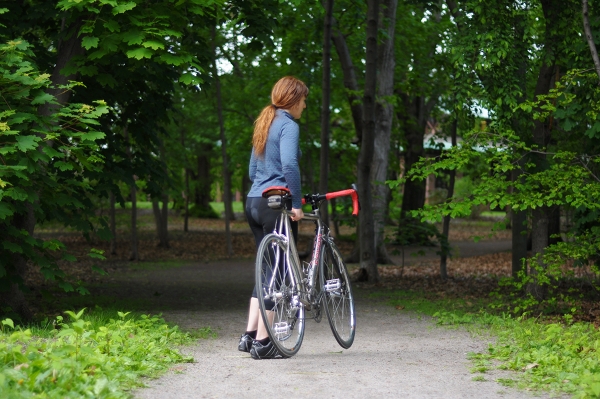
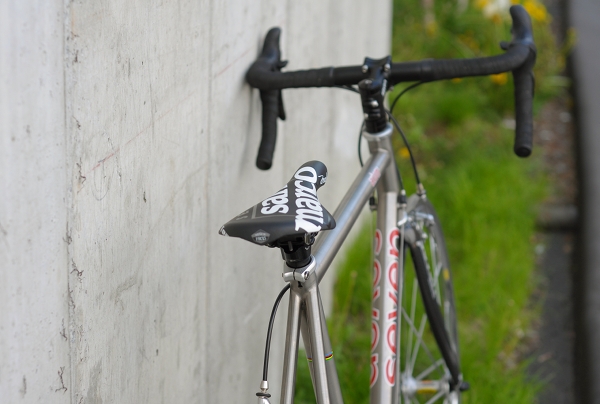
While the bike is in my possession I've fitted it with my own saddle, which has made it more comfortable to ride long distances. I've also installed my pedals (the narrow MKS Streams) and PowerGrips. This looks silly on a bike that is typically ridden clipless, but I don't care: I need to ride it in a way that makes me comfortable. I've also now raised the saddle another 5mm from how it's shown in this picture, which almost makes it look like the standover is not too high. Almost. The length of the toptube and the handlebar set-up work well for me (the Ride Studio Cafe matched the configuration to one of my own bikes) and it's only the seat tube height that's off. The result is that the bike fits me extremely well when I am riding it, but looks too big when I am not. Ideally, the frame would have the same virtual top tube length, with the actual top tube just a little bit sloped in order to reduce standover. Given the available demo models I prefer this set-up over a smaller frame, because I don't like toe overlap. All in all I feel good on this bike, which is what matters.

I really hope they don't cancel the paceline ride next week; the anticipation is getting ridiculous. In the meantime, all I can do is keep riding.

Friday, May 20, 2011

Tentatively Titanium

As many have figured out by now, I am being loaned a Seven roadbike as part of a sponsorship deal with the Ride Studio Cafe in Lexington, MA. I will have it for a few weeks, and it is the bike on which I will attempt future paceline training rides - if it ever stops raining long enough for them to resume!

My acquaintance with this bicycle goes back to last Autumn, when I first discovered the Ride Studio Cafe and the Seven demo models that dwelt within its space.

I half-joked with the owner then, that I would like to test ride one: Some of my friends in Europe are big fans and they were excited to learn that I lived in such close proximity to Seven Cycles. He was on board with the idea, and eventually the test ride took place. That was two weeks ago, and I intended to post a test ride report earlier. But now that I have the bike for longer, I will wait to write a proper review until after I return it - in the meantime offering some initial thoughts. 

Seven Cycles are built in Watertown, MA - which is 5 miles from where I live. And it seems like every local bicycle mechanic and framebuilder I know has either worked for them or has some sort of connection with them, and almost certainly owns at least one of their bikes. This creates a weird discrepancy: Knowing so many people who own them, I cannot help but think of Seven bikes as commonplace. But then I also keep hearing oohs and aahs from non-locals about how expensive and precious they are. 

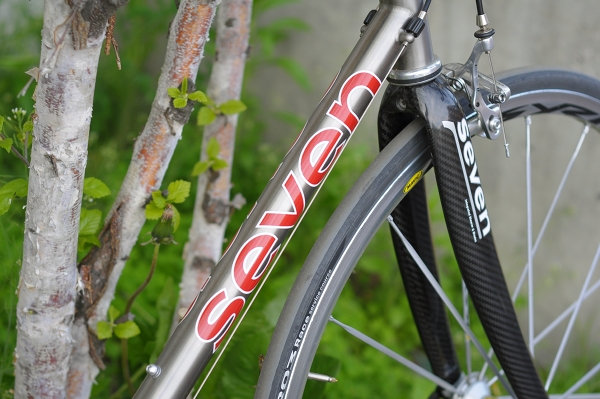
The model I rode is the Axiom S: titanium frame with carbon fiber fork, fitted with the Campagnolo Chorus component group, Mavic racing wheels and 23mm tires. More than a little intimidated by the set-up, I expected the bicycle to ride like my idea of a racing bike: stiff, harsh, aggressive. In fact, I half expected not to be able to ride it at all, not to feel comfortable with the handling. But the handling was easy, and the ride quality was not what I expected.

I don't know how to describe the Seven without a reference point. Ideally, I would like to have something to compare it to other than lugged steel and a couple of very brief aluminum and carbon fiber experiences. But speaking from my current, limited viewpoint, I can only describe the sensation as "extreme road dampening" - to the point of not being able to feel the ground. This is a different feeling from the way fat tires roll over potholes, or a flexible steel frame dampens shock. This is something else, and it feels weird. It's like the ground isn't there. I see the bump. I see my 23mm front tire start going over the bump. But I don't feel it. Throughout this, the frame and fork are very stiff - there is hardy any flex at all. Having thought that flexible frames dampened shock and stiff frames translate into harsh rides, I am a little confused.

Furthermore - and this is even harder to put into words - it is as if I can't feel the bike while I am riding it. I feel the cranks being turned by my legs, I feel the handlebars at the points where I am holding them, and I feel my butt on the saddle... but the frame feels almost absent. 

The combination of these sensations leaves me with a disembodied feeling - as if I am floating above the road instead of making contact with it. Is that a good thing? 
  
With its sleek titanium surface, curved stays and ethereal ride quality, the Seven to me is like some alien machine rather than a bike. I've gone on four rides on it so far, and I feel comfortable with its precise, stable and distinctly non-twitchy handling. But the "floaty" feeling puzzles me.

It's been raining here non stop for over a week, yet I've been stubbornly cycling. Covered in a layer of crud after such rides, the Seven seems more down to earth and I find myself welcoming that. When clean, the titanium has an almost clinical quality that intimidates me, but the dirt makes it warmer and less machine-like. Maybe it is a bike after all.

Hopefully the rain will soon stop, so that I can practice some hills and see how the Seven really compares to my other bikes. I am sure it will be faster, but will it feel safe? The fact that I am comfortable riding it in the rain is a good sign, but I'd like to learn more about its handling, especially on descents. And I would love to know how a bicycle this stiff and aggressive can produce such an extreme road dampening effect. 

What are your thoughts on titanium frames? 

Saturday, April 30, 2011

Surly Progress and a Couple of Glitches

We are nearly done building up the Co-Habitant's Surly Cross Check, and here is an update on the progress:

As mentioned previously, we got this frame to build up as a fun off-road bike. We already had the wheelset, Fat Frank tires, handlebars, saddle, pedals, and some other components, making the remaining build fairly easy and financially feasible.

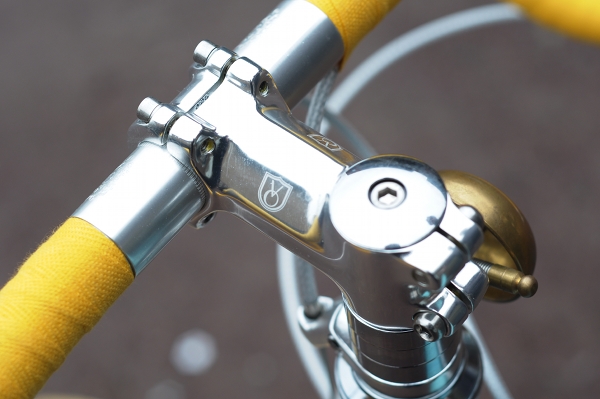
Among the new components we bought were the Velo Orange threadless headset and stem. Though we do not plan to transition to threadless stems, they do make life easier in some respects - such as making it possible to remove the handlebars without redoing the bar tape and lever placement. And as far as threadless stems go, the VO is rather nice looking.

The brass bell is mounted on one of the spacers, which mechanic Jim tapped for us when we were picking up the frame from Harris Cyclery.

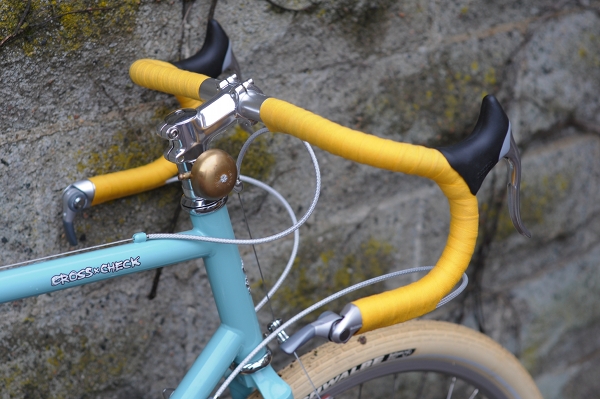
The handlebars are only temporarily yellow - Once we shellac them, they will turn caramel to match the saddle. But the bicycle does look kind of cute with them as they are, like an enormous children's toy. The "maiden voyage" was on Easter Sunday, and the colour scheme was certainly appropriate.

We also bought these Velo Orange Grand Cru MK2 cantilever brakes, which I think are just beautiful. Unfortunately, after riding with them for 27 miles the Co-Habitant is not sure whether he is happy with their functionality. In his opinion they do not perform as well as the Tektro cantilever brakes I have on my Rivendell - so he is not sure what to do. It is not a safety issue, since the VO cantis still outperform the old centerpulls he has been using on his Motobecane for the past two years. But he doesn't want to feel as if he is sacrificing performance for looks or "vintageyness," and he thinks that this may be the case here. Has anybody else tried these?

Similarly, he has mixed feelings about the VO metallic braided housing. While beautiful, the brake housing is very stiff and has considerably more friction than the Jagwire we are accustomed to using. I asked about this on bikeforums, and apparently stiffness is a known trait of this particular housing - which is why some avoid it, and others use it only with vintage non-aero brake levers. I wish we had known that before buying and installing the stuff. But now that it's already done, we are trying to determine whether it will perhaps become less stiff over time. Is that a possibility, or just wishful thinking?

The final disappointment is with the fenders, or lack thereof. We had initially ordered the 700Cx60mm Berthoud fenders, which, by all accounts and calculations should have been a perfect fit. The first problem was that the fenders arrived damaged: a crushed box, courtesy of UPS. We filed a damage report and will be returning them, with the hope that the seller will be fully reimbursed. But when examining the fenders, it also seemed quite apparent to us that even had they been intact, they would not fit. In fact, we are genuinely wondering whether the set we received was mislabeled, because they simply don't look like they can clear the 50mm tire.  Now we are confused as to whether to ask for an exchange, or simply return them and try the SKS. The Co-Habitant does not like SKS fenders - but then he was not too happy with the quality of the Berthouds either (what we could see of it based on the undamaged parts) - so we are sort of at an impasse on this one.

These glitches aside, we are extremely pleased with the new Surly Cross Check. It took us only one night to put it together, and in that sense a new frame is much easier to work with than an old one. By contrast, we constantly run into unexpected problems when building up vintage frames, which delays those builds by weeks and sometimes months (this is the case with my give-away touring bike, but more on that later). With the Surly, everything came together as expected, with no installation problems.

On its first ride, the Cross Check performed better than the Co-Habitant expected. He anticipated that it would be more comfortable, but slower than his vintage Motobecane roadbike. Instead, it is more comfortable and faster. He does not feel that the frame is too stiff, as some report, which can of course be due to his size and weight. And he definitely does not feel that the bike is in any way sluggish. As his riding partner, I have to agree: He is faster on the Surly than on the Motobecane. Hmm. We are eager to get the brakes and fenders issue resolved, so that he can ride it more - but so far he is impressed.