Showing posts with label bicycle reviews. Show all posts

Saturday, June 18, 2011

The Surly Cross Check Review: a Colourful Build and a Fender Massage

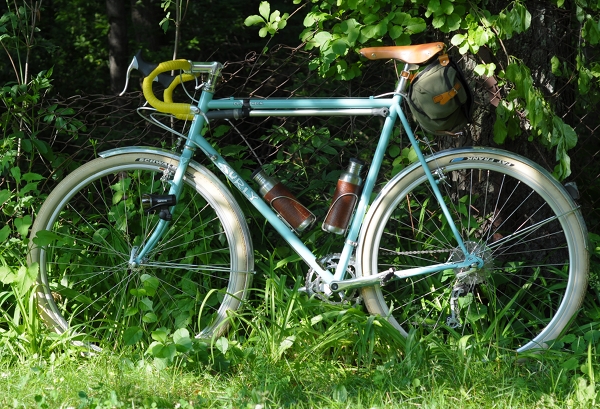
Two months ago, the Co-Habitant got a Surly Cross Check frame that he wanted to build up as a fun on/off road bike around a touring wheelset with fat tires that we already had in our possession. He is getting a nice roadbike later this summer (waiting for the frame to be finished!), and the Surly was meant to be "the other bike" - a playful, go-anywhere bike built around an inexpensive frame, mostly using components we already had. He swiftly put the bike together and has now cycled about 500 miles on it. The Cross Check is technically a cyclocross frame, but it is versatile and can also be used for touring and commuting. Given its unusual build, we've had many questions about this bike and so I offer a review on the Co-Habitant's behalf.

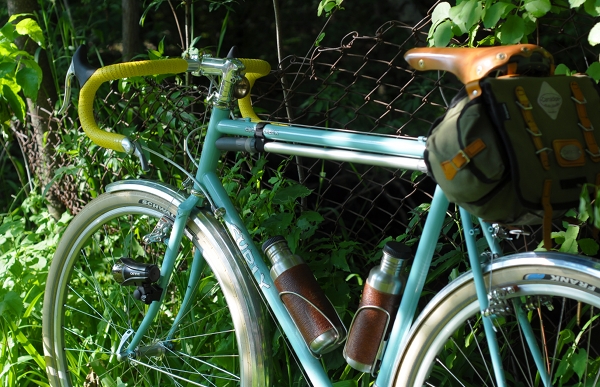
The most noteworthy aspect of the build, is that we were able to fit the frame with Schwalbe Fat Frank tires and metal fenders. This looks great, and the tires feel awesome, but to tell the truth the whole thing was a pain. The Cross Check is described as being able to fit tires up to 45mm with fenders, but the Fat Franks are 50mm. It was a tight fit that required some DIY. Initially we wanted to use Berthoud steel fenders, which are available in 700Cx60mm, but the Co-Habitant was not impressed with their quality upon seeing them in person. He also dislikes plastic fenders and did not want to use SKS. In the end he decided to get the Velo Orange Zeppelin 700c x 52mm fenders (which are rated for 42mm tire), and "massage" them to fit.

Out of the box, the fenders were too tight: The edges touched the sides of the tires and there was not enough space under the brake bridge and behind the seat tube to mount them high. So, the fenders had to be opened up. But when you open up a fender that's 52mm, it no longer follows the line of a 700C tire, instead making the opening much smaller. So while opening the fender, it had to also be stretched out -  taking care not to crimp the edges. To do this, he used a flat low table holding the fender upside down against its surface and pressing down gently, rolling it end to end - opening and pressing down. Pressing down would close the fender and opening it would alter the curvature, so the back and forth balanced out the opposing forces.

For the front fender there was sufficient clearance underneath the fork crown, but in the rear there was less clearance - the brake bridge is quite low and the chainstays are short. He had to dent the top of the rear fender (which isn't visible) in order to get it closer to the brake bridge, then fabricate a custom circular-L-bracket to hold the fender in place, screwed into the eyelet of the brake bridge. To dent the fender, he placed it on some clothing on the top edge of the back of a chair, then hit it with a rubberized end of a pedal wrench, creating a grooved dimple. He also had to dent the ends so that they wouldn't pinch near the bottom bracket. It was a bit of an ordeal, and if you are going to attempt this beware that it is easy to ruin the fender - it may not be a risk worth taking.

Happily, the "massaging" was a success and the Cross-Check looks great with the fat cream tires and the VO Zeppelin fenders. The ride is fast and cushy, and the Co-Habitant is discovering just how addictive wide tires are. On the downside, the clearances between the tires and fenders are so tight, that the set-up is not really practical for serious off-road cycling: stuff can get caught in there and cause problems. But for fire trails and gravel paths it is fine, and if he decides to do anything more serious (like the D2R2!), he will remove the fenders.

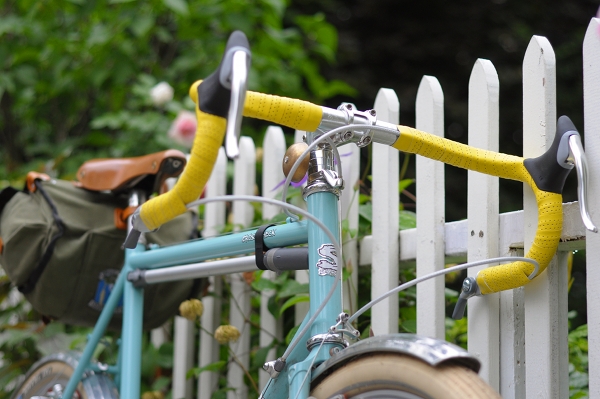
The rest of the build for this bicycle has mostly already been described here, but a few changes have been made since then. The original shortish stem has been replaced with a 9cm stem, flipped upside down. The original yellow cloth tape got filthy and tattered fairly quickly, so we replaced it with Fizik tape. Initially, the cloth tape was supposed to be shellacked to a warm caramel - but the bright yellow looked so "right" on this bike, that it began to seem like an inherent part of its personality and he decided to keep it that way. He also added a frame pump, lamenting the lack of pump peg and using a strap to hold it in place.

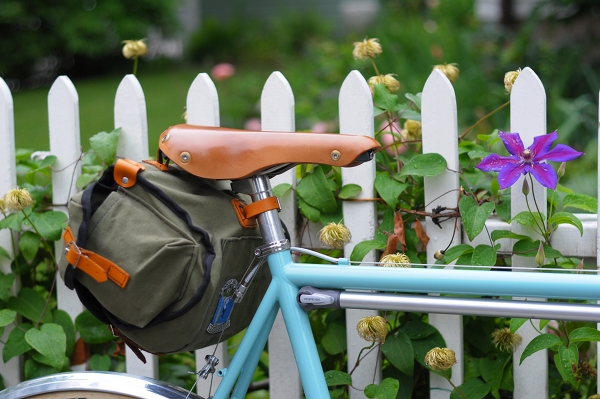
After two years in a lukewarm relationship with his Brooks Flyer saddle, he decided to sell it and replace it with a Berthoud touring saddle - the male version of the one I now have on my Rivendell. So far he loves it.

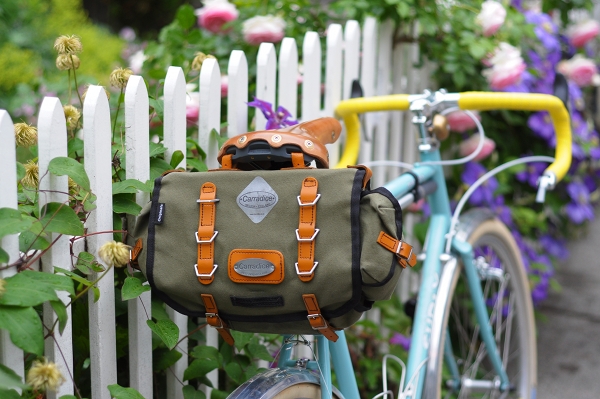
He fitted the bike with the Carradice bag that used to be on his old bike.

It now has a patch on it, to cover the tear that happened as a result of the bag rubbing over the brake cable on his old bike.

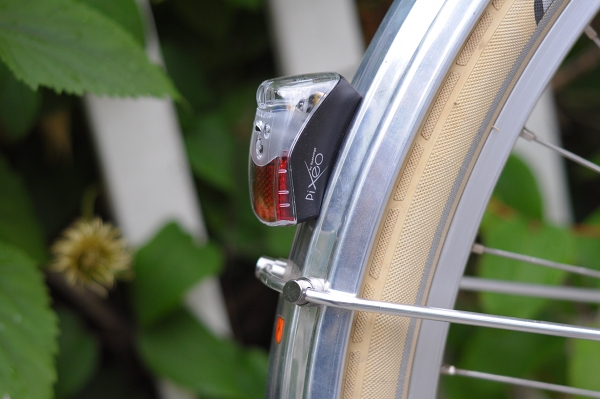
He affixed a CatEye headlight to a braze-on on the front fork, and a Spanninga Pixeo tail light to the rear fender.

He tried to liberate himself from clipless pedals and rode the bike with touring pedals for a few weeks, but ultimately could not take it anymore and put his old clipless pedals back on. Fair enough, but this does limit the versatility he originally had in mind for the bike.

After riding the Surly Cross Check for two months, his main feedback is that the bike is faster than he expected - even with the wide tires and a bunch of weight in the saddlebag. While initially he intended to use the Cross Check in conjunction with his old Motobecane until he got his new roadbike, the Motobecane was retired as soon as he started riding the Surly - no need for it, since the Cross Check did everything it could do and more. He does not find the bike sluggish, and it seems that the tubing is just right for someone of his stature (6ft/ 200lb+). Overall, he is pretty happy. Though he likes lugs, he also likes a nicely done TIG-welded frame and the Surly suits him just fine.

My take on his Cross Check... I think it is a well-made, attractive frame for the price and I am glad that he finds it comfortable and fast. To be honest, I think that at least to some extent this build was not so much about practicality, as about doing a fun and challenging project using a bunch of components that we had acquired but had no use for. If the original purpose of the bike was off-road, then the tire+fender combo with such tight clearances does not really make sense. I have a feeling that he will end up using it mainly on the road, because I can't imagine him bothering to remove and reinstall the fenders every time he wants to take it on serious trails. And this means that when he gets his long-awaited road frame later this summer, the functionalities of the two bikes will overlap considerably. Not that there's anything wrong with that. But given how much he likes the Surly I am almost worried that he might be disappointed with the special bike he's waiting for. Well, hopefully not.

On a more general note, while the Cross Check is clearly versatile enough for commuting and touring, I wonder whether many cyclists actually use it for cyclocross racing. I have a hard time imagining that, given how relatively heavy it is - even the floor models with narrower tires and sportier components. But maybe I'm just biased from having handled too many lightweight bikes recently.

The Surly Cross Check is a fun bike with a cult following, and it is particularly impressive how customisable the frame is. With its happy colours, fat cream tires, elegant fenders and classic touring accessories, the Co-habitant's Cross Check is distinctly his own.

Saturday, June 4, 2011

Red and Blue, Old and New: Fun with Bike Comparisons

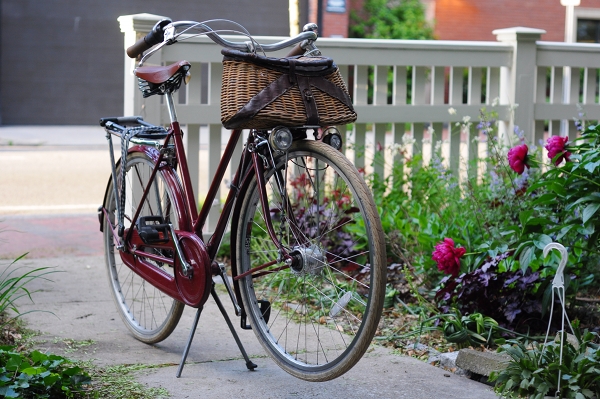
A couple of days ago I visited "Cycler" from Biking in Heels, asking her to test ride the Pilen I am reviewing and tell me what she thinks. While we were at it, we also compared the geometry of the Pilen to that of her modified vintage Raleigh Lady's Sports - the charming bicycle described here.

Unlike the traditional English roadster (which is similar to a Dutch bike), the Sports model is a zippier bicycle with somewhat more aggressive angles and a more leaned-forward posture. It made sense to compare it to the Pilen, which is also somewhat more aggressive than Dutch bikes.

Placing the two bicycles side by side, we did notice some similarities. The seat tube angles, front end geometry and bottom bracket heights were fairly close - at least in comparison to those of Dutch bikes and English Roadsters. The Pilen has a slightly more relaxed seat tube and a higher bottom bracket - but the extent of this is minor when compared to the more relaxed Dutch bikes and Roadsters with their high bottom brackets. The Pilen however, has a longer wheelbase than the Raleigh Sports - not to mention that it is dramatically larger.

When looking at this picture, consider that the saddles of the two bicycles are set to roughly the same height. Now notice the amount of seatpost showing on the 21" (53cm) Raleigh Sports compared to the 22" (56cm) Pilen Lyx (see here for a close-up of the Pilen's seatpost). Despite the 3cm difference in their frames, the actual size difference between the two bicycles is considerably greater. This is because the Raleigh has 26" wheels with 35mm tires, whereas the Pilen has 700C wheels with 50mm tires - raising the Pilen's frame higher off the ground. Wheel and tire size are definitely something to be aware of when determining the actual size of a complete bicycle. The frame size alone is fairly limited information.

Cycler and I are similar in height (she perhaps 1/2" shorter), and we prefer similar bicycles for transportation - both of us especially in love with the ride quality of the classic Raleigh DL-1. It was therefore informative to learn that she had a similar reaction to the Pilen as I did. On the other hand, two other (taller) persons who also tried the bike had very different reactions. I will write about that in more detail at a later stage, but suffice to say that there is a bike out there for everyone. It is amazing to me how many variations exist of the traditional upright step-through design; I never tire of learning about the similarities and differences between them.

Sunday, May 22, 2011

An Igleheart and a 'Sex Hub'

At the New England Bicycle Expo a couple of weekends ago, I had the pleasure of meeting legendary New England framebuilder Christopher Igleheart and briefly test riding one of his bicycles - an upright commuter model called the Yoyodyne. One cool thing about this bike - aside from it being an Igleheart - was the 3-speed Sturmey Archer S3X hub - aka "the sex hub." Several people I know have set up their bikes with this hub and their feedback has been intriguing, so I wanted to try for myself. And what better way than on an Igleheart bike?

Located just North of Boston, Mr. Igleheart - like many local builders - traces his professional beginnings to the legacy of Fat City Cycles, where he started as an apprentice welder in the 1980s. By 1994 he had established Igleheart Custom Frames as an independent operation, spcialising in TIG-welded steel. In the chaotic environment of the Bicycle Expo, a sense of calm presided over the crowded Igleheart booth. The man is very comfortable with his work and discusses it in a way that communicates his experience and versatility. Road bikes, mountain bikes, transportation bikes and even randonneuring bikes - he knows them all, executing them in his distinct aesthetic.

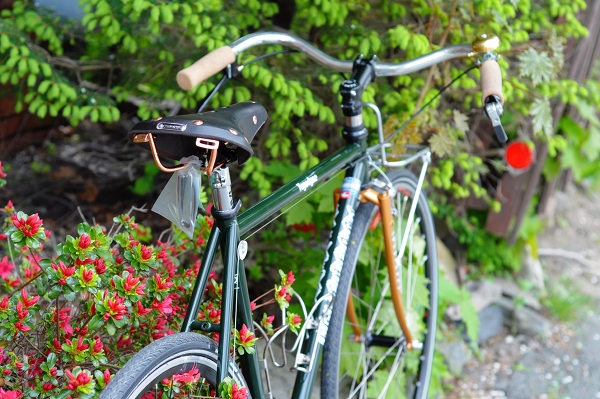
Unfortunately, I somewhat dropped the ball on photographing this beautiful bicycle. The high noon light was unflattering from every angle, the background I chose was too busy, and people kept coming up to ask about the bike and distracting me. The results are washed out and entirely unworthy of the Yoyodyne, so I did what I usually do with ruined pictures: upped the contrast and at least tried to make them atmospherically interesting.

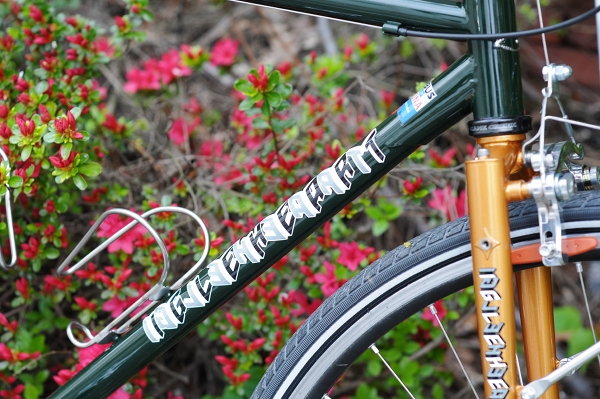
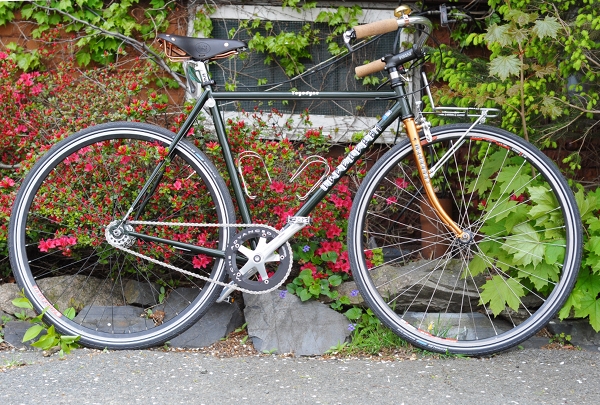
The Yoyodyne is designed as a fun and comfortable city bike. This particular one has a green frame and an orange fork, which is an unexpectedly pleasing colour combination. 

Columbus Zona is a comfortable all-around tubing that contributes to a plush ride quality. The welds are very cleanly done. The segmented fork is one of my favourite fork designs and I never tire of its various iterations from different New England framebuilders.

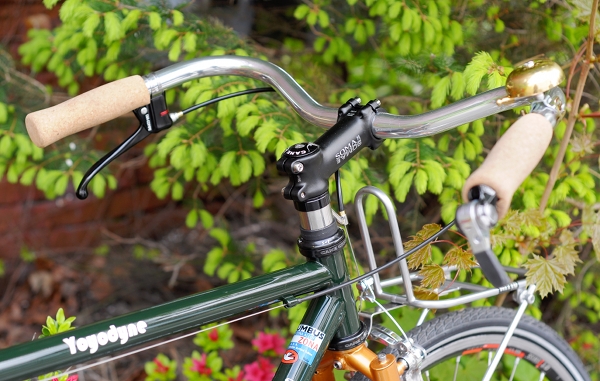
Components cater to urban commuting, combining good quality and budget considerations: single crankset, Soma stem and Oxford swept-back handlebars, cork grips, simple city brake lever, brass bell, and a front rack. [edited to add: I just learned that the price for this complete bicycle is $1900 - good deal!]
Cardiff leather saddle with copper rivets. You can't see this very well here, but the seat post has a special feature that allows the top of it to be easily detached and reattached, without having to re-adjust saddle position.

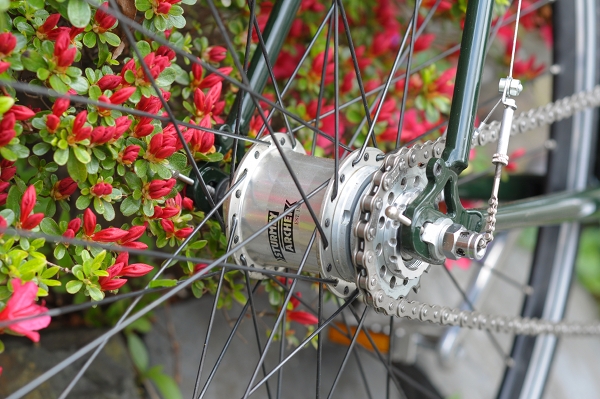
And of course, the exciting 3-speed fixed gear hub. A testament to just how distracted I was, I even failed to capture the "S3X" label. It's on the other side. 

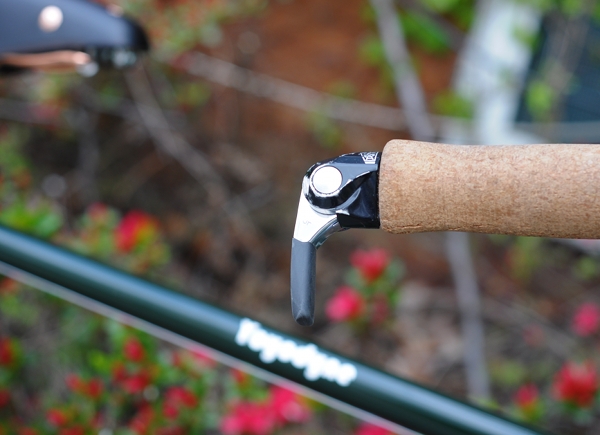
Sturmey Archer has a new gear shifter for 3 and 5-speed hubs that is versatile in that it can be used both on upright and drop handlebars. I found it a little difficult to budge in comparison to the traditional trigger shifter, but perhaps that can be adjusted. 

It's difficult to properly test ride a bicycle at a crowded Bike Expo, but I made a half dozen laps on it around the large parking lot in the back of the building, as well as cycled up and down the long driveway a few times. With a constant stream of cars coming and going it was like a slower version of actual urban cycling.

The ride quality of the bicycle felt familiar as soon as I began pedaling. Cushy and easy to handle, it was not unlike a vintage Raleigh Sports - only more responsive, 1/3 of the weight, and made of far nicer tubing. I would feel comfortable riding it in city traffic. However, I would need a longer test ride to determine how it handles potholes at speed. 

All of this struck me before I remembered about the bike being fixed gear. What I mean is that usually the fixed-gearness of a bicycle tends to dominate my impression of it, but here this was not the case. It felt more like a comfortable 3-speed, on which it just so happened that I didn't coast. This could be due to the bicycle's handling, or it could be due to the hub.

The ride with the S3X hub felt interesting, but I would say not entirely like a fixed gear bike. When I ride a single speed fixed gear, there is more to the sensation than merely not coasting. I feel like I have a direct connection to the drivetrain, and for me that is part of what makes riding fixed gear bikes enjoyable. This aspect is gone with the S3X: It basically feels like a nice 3-speed hub that does not allow you to coast. Shifting is easy and the gear spacing is just about perfect, but no matter what gear it is in, the feeling is not quite the same as single speed fixed gear.

One thing you have to watch out for with the S3X is that if not adjusted properly, the hub can "space out" and go into coasting mode for a millisecond's time at the end of each pedal revolution. Several people I know who've installed the S3X hub report this, and I experienced it as well - which makes me think that the adjustment has to be extremely precise in order for it not to happen. 

While I like 3-speed hubs and I like fixed gear, I am not sure that the combination is for me, as it introduces a degree of complexity into both categories. But I still think it's a neat idea, and I am glad I tried it. In future, I hope to have the opportunity to learn more about Igleheart bicycles and to take one on a longer test ride. Many thanks to Mr. Igleheart for allowing me to ride the Yoyodyne!

Friday, May 6, 2011

Urbana: Review of a True Transport Bike

A month ago, I received a bicycle from the Canadian manufacturer Urbana, to test ride and review.  When the offer was initially made, I visited Uebana's website and was both confused and intrigued. Did they not see that I liked classic bicycles and not modern monstrosities? Did they realise the risk they were taking asking me to review this thing? Still, even then I was aware that this wasn't some generic comfort bike, but a unique design with a distinct look and unusual geometry. The manufacturer insisted that I'd like it once I tried it, and my curiosity was piqued.

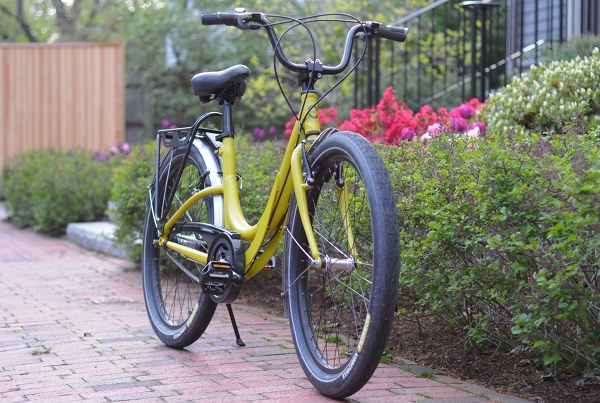
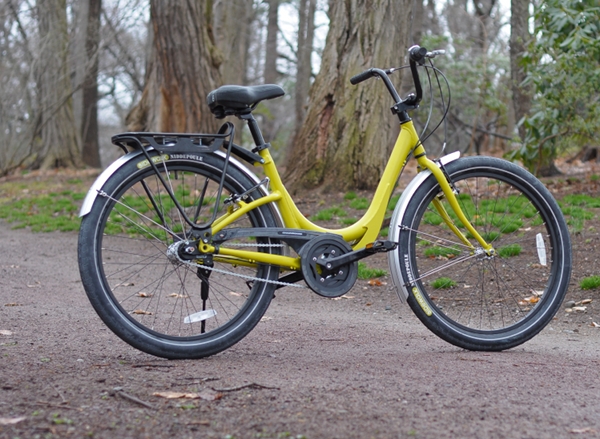
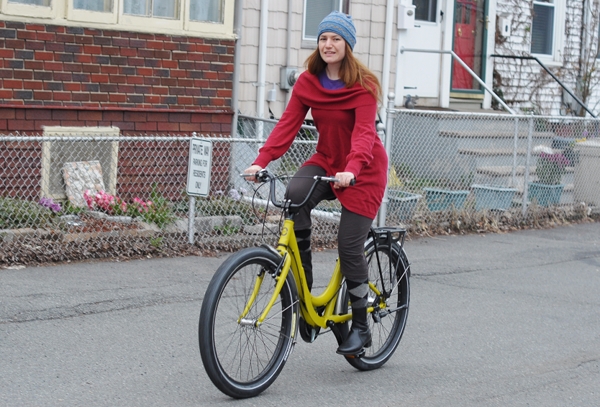
If you've been reading this blog for the past month, you know the result: I ended up riding the Urbana far more than I had intended... to the annoyance of some readers who found it not sufficiently "lovely" to grace this website. But to those readers I say: Come on, open your mind. Though not "pretty" in the classic sense, the Urbana is aesthetically harmonious, well-designed and comfortable - which in my book is lovely indeed. The neon yellow was an accidental choice on my part: It was described as "olive" and looked army green on the website. But everything else about this bike I like. In fact, had I gotten it in black I would have had a problem parting with it - so perhaps the neon colour is a blessing in disguise.

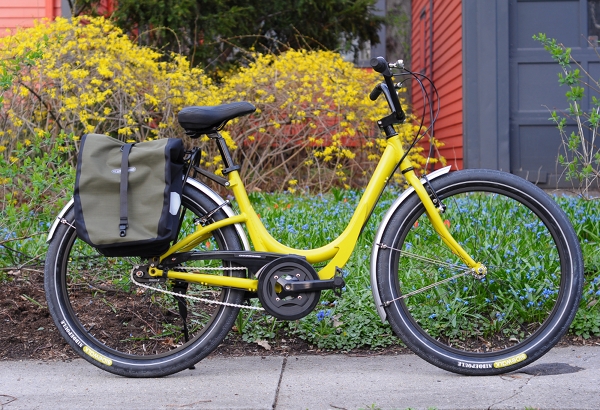
So, what kind of bike is the Urbana? Technically speaking, it is a hybrid between a mountain bike, a BMX bike, and a Dutch transport bike. The mountain bike legacy comes from the downhill MTB designer Jerome Roy, in the form of reinforced frame and fork construction with wide 26" tires. The BMX attribute is in the handlebar setup and in the squat stature.

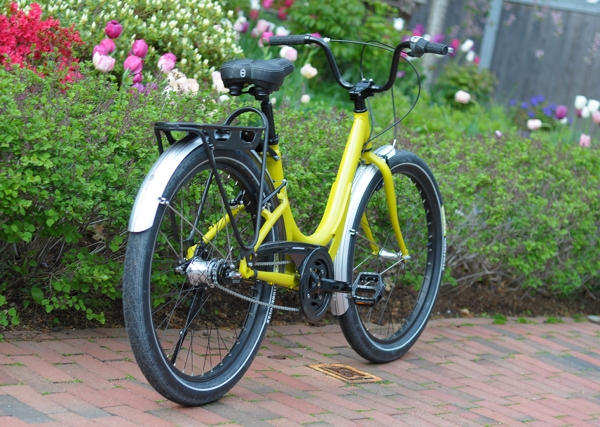
The Dutch aspect is in the relaxed angles, deep U-frame, fenders, and heavy-duty rear rack. It may seem like a mish-mash of incompatible styles, but it all comes together harmoniously - and, to my eye, adorably in a "friendly little forest troll" kind of way.
The sitting position itself feels Dutch, in the sense that the seat tube is relaxed (I would guess 70° or less), and I could attain nearly full leg extension while still being able to touch the ground with a toe.

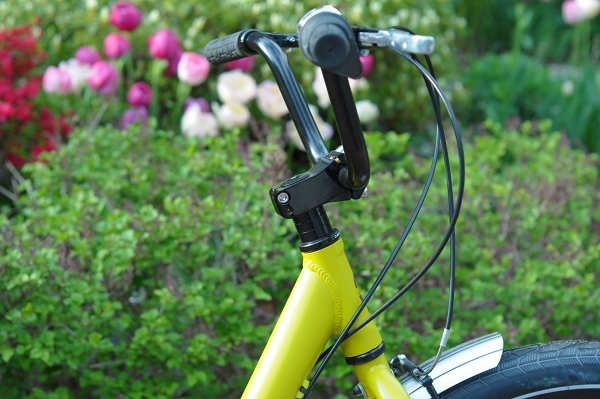
At the same time, the low BMX handlebars place the rider in a considerably more forward-leaning position, than would a Dutch bike. The threadless stem allows to easily alter the positioning of the handlebars - leaning them toward or away from the rider, depending on preferences and the person's height. I had my bars set pretty much straight and found them comfortable.

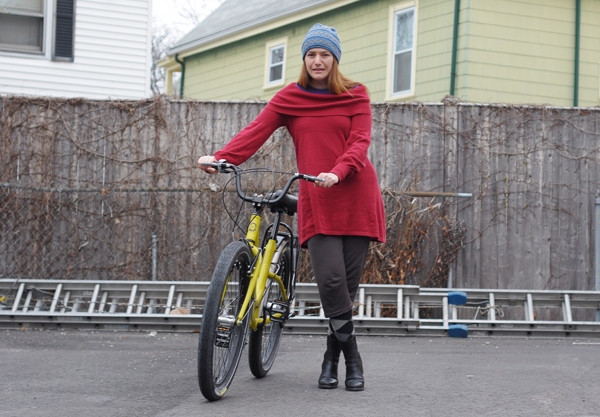
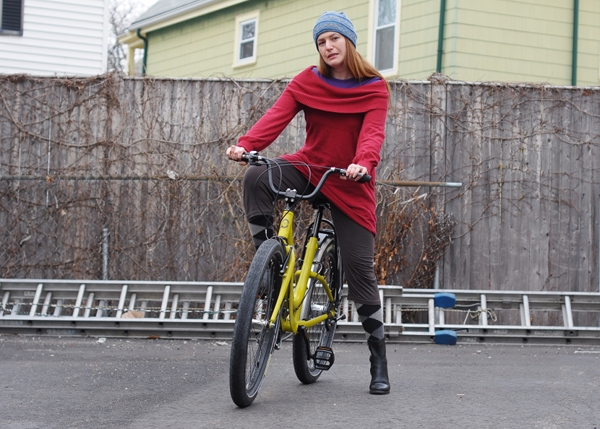
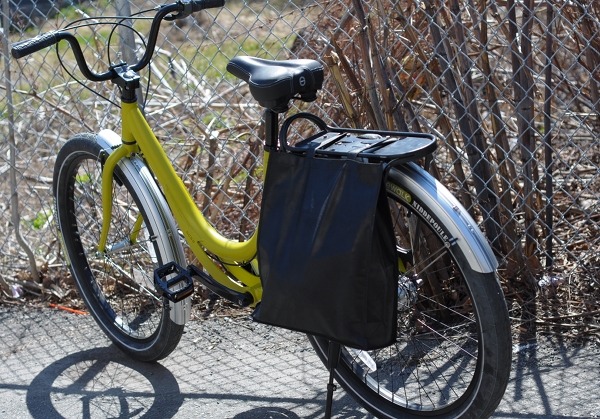
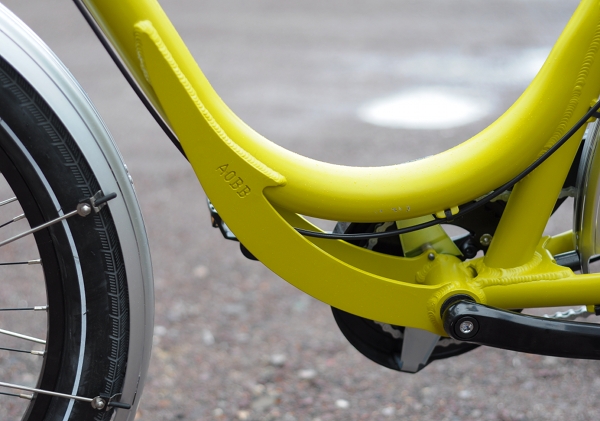
This picture shows the relaxed geometry and long wheelbase of the bike fairly accurately, as well as the saddle-handlebars positioning. The frame of the Urbana is welded aluminum, executed in a manner that I would describe as industrial. Some readers have mentioned that the bike reminds them of "bikeshare" bicycles, but any visual similarity is superficial. The Urbana is constructed differently and handles differently. It is a bike meant to haul serious weight and to withstand the roughest terrain, which bike-share machines are not.

The letters carved into the frame are part of a security code for registering the bicycle (the second part of the code is located elsewhere). Urbana has an interesting system for registering and securing these bicycles that makes stealing them an unwise move.

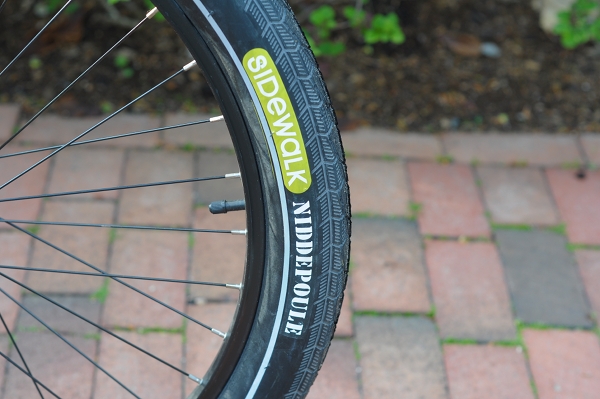
Of course, one of the main defining features of the Urbana are its 26" x 2.6" Niddepoule "Sidewalk" balloon tires with reflective sidewalls. They are extremely wide, extremely cushy, and roll fairly fast. I have tried most good modern fat tires at this point, and in terms of handling these feel similar to the 26" Schwalbe Fat Franks - only wider. Potholes are not an issue.

Reviewers of the Urbana tend to delight in how easy and fun it is to hop curbs with the tires, and of course there is that. But I feel like stressing this aspect almost trivialises them. The tires are genuinely useful on bad roads. There is no road shock, none at all - which is a big deal for those who find going over potholes painful. I have rolled over what I would otherwise have considered obstacles on the road and swerved to avoid. And yes, I have gone up on curbs - just not on camera.

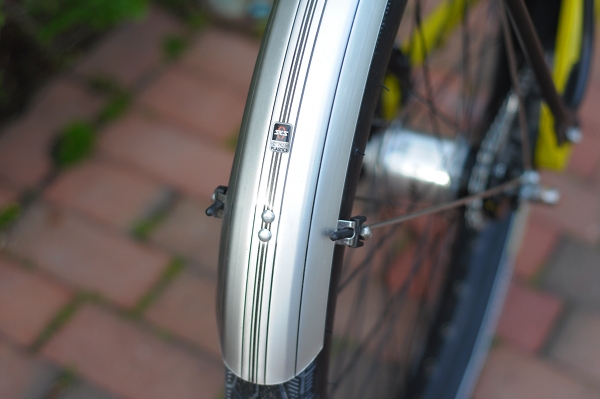
Urbana bicycles are semi-customisable, and I requested fenders. They use SKS fenders, which provide good coverage.

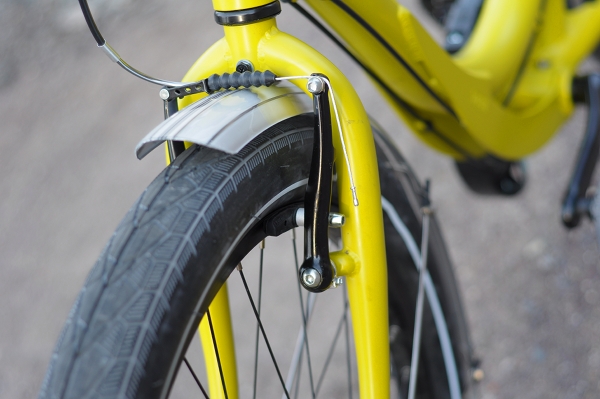
Some have complained that the front fender is too short - but while visually that is true, I did not find that I was sprayed with water from the front tire when cycling in the rain. We did find it difficult to set up the V-brakes in a way that did not interfere with the front fender. If you opt for the fenders, consider choosing disk brakes instead of the V-brakes. 

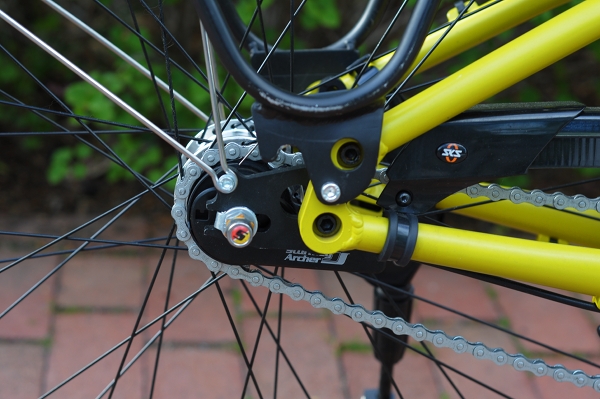
For gearing, I asked for the 3-speed option - which came with a Sturmey Archer hub. The hub worked flawlessly and was more than sufficient for me. The gearing felt similar to that on my Gazelle - I stayed mostly in second gear. Notice how the hub is connected to the (lack of?) rear dropouts. This frame construction is so different from what I am used to, that I do not even know how to describe this.

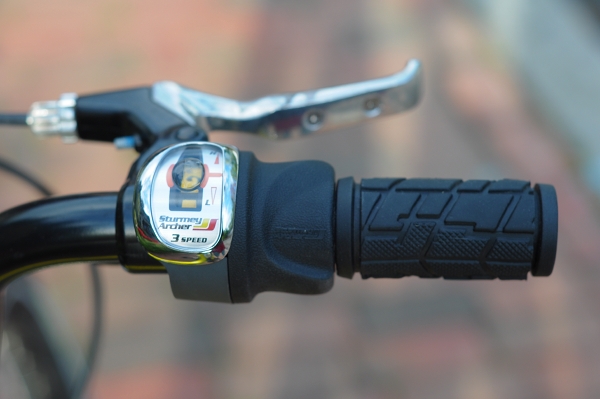
The SA twist shifter has a rainbow-esque look to it that I think suits the bike well. Not a whole lot of grip space next to the shifter, but more than on some other bikes I have tried. Interestingly, my hands did not hurt in the straight-in-front position these bars put me in, whereas usually I find this position unbearable as a result of nerve damage in my hands. It must be not just the hand position that bothers me, but the combination of it plus road shock. Since I experienced absolutely no road shock on this bike, the position alone did not cause discomfort. At least that is my theory as to how I was able to ride this bike, but not any other bike with the same style of handlebars.

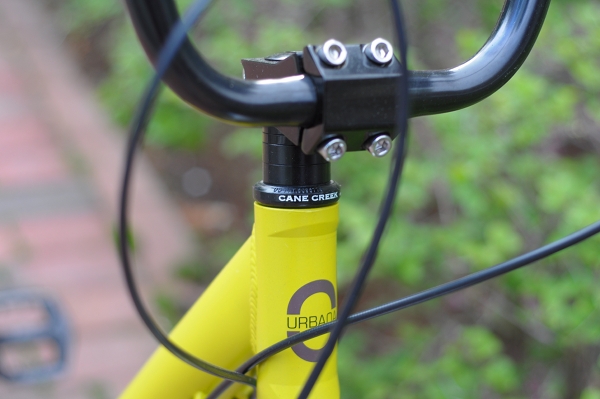
Overall, the components used on the Urbana are pretty good - from the Cane Creek headset to the SKS  fenders and chainguard. There are no flimsy, generic parts; all is solid. The Co-Habitant doesn't love the V-brakes they used, but otherwise he agrees. I thought the V-brakes were fine, though they are generally not my favourite brake type simply because they are too strong and don't modulate well. The Urbana stopped too well, and I had to be careful with that.

Notably, the Urbana is not equipped with a lighting system, which I see as its one major flaw. A dynamo lighting option would make it a fully equipped urban utility bike.

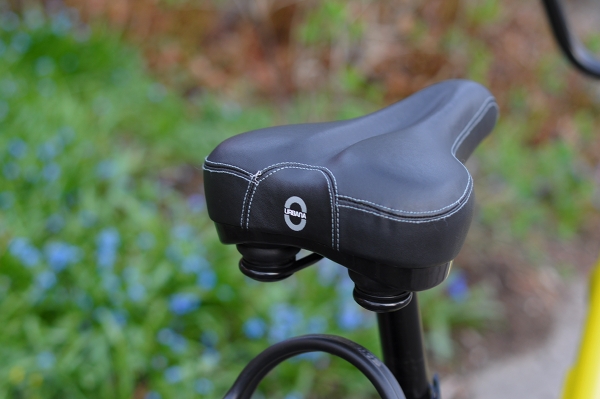
The proprietary saddle is tightly sprung and mildly padded vinyl. I found it quite comfortable for rides under 5 miles and felt no desire to change it. The Co-Habitant didn't like it, but I think that's because he is quite a bit heavier than I am and his weight made the springs over-active.

Last, but not least, there is what Urbana calls the Reinforced Rack (RNR). It looks fairly inconspicuous and normal as far as racks go, but is designed to withstand 160lb of dynamic weight. This includes anything from furniture, to squirming children, to - well, me.

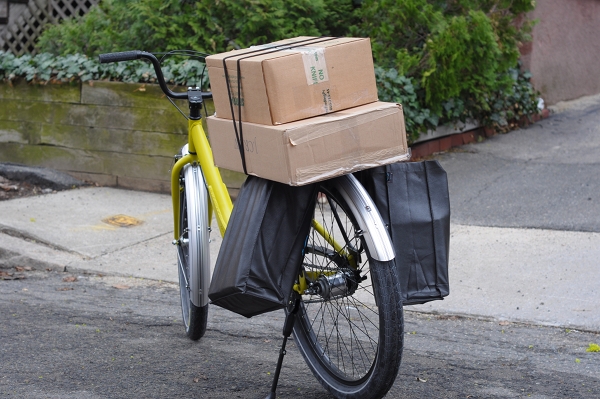
The above was a fairly easy and normal arrangement for me to set up on the Urbana, and I wrote about it in detail here. I did not feel the weight shifting around or slowing me down while I was cycling. My Gazelle is pretty good at carrying loads as well, but not this good.

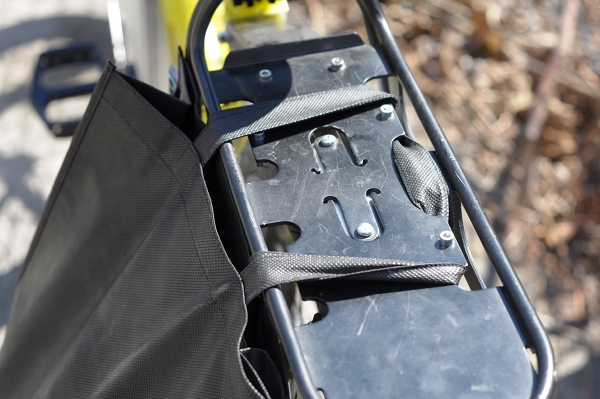
Aside from the generous weight rating, it also helps that attaching stuff to the RNR rack is easier than to any other rack I've owned.  It's a ridiculously simple design that anyone could have thought of... but didn't. Each side of the rack's platform has a carved-out section with bolts poking out undearneath, making it possible to attach virtually any bag to the rack by wrapping the handles around the bolts.

The utility and freedom afforded by this ridiculously simple design is just amazing: No need for dedicated panniers.

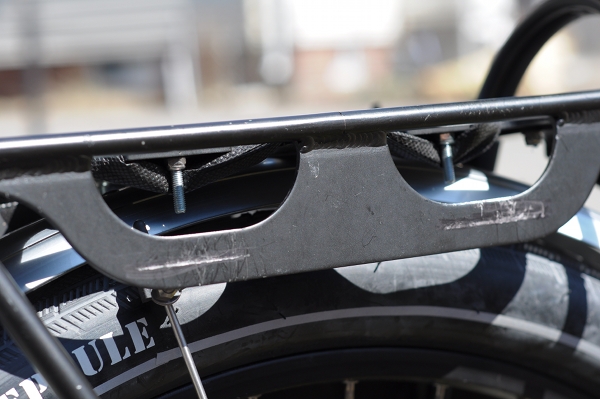
Of course, if you do with to carry panniers, it's not a problem: The rack's tubing will accommodate almost any attachment system (with the exception of fixed 3-hook systems - which I believe only Fastrider uses). So the cyclist is really given functional freedom here. Panniers? Fine. No panniers? Also fine. The rack also has a handy built-in notch for bungee cord attachment at the bottom, which you can see here.

With its easy-to-load rack, and the durability that allowed me to keep it locked up outdoors 24/7, I was soon using the Urbana all the time for transportation - instead of my own bikes. Before I knew it, the Co-Habitant was using it too and you can read about us sharing the bike here. All this was in no way part of my agreement with Urbana, but entirely a product of how convenient the darn bike was to use.  In the end, we end up using what's most convenient - simple as that.

The weight of the Urbana as I had it set up was roughly 42lb. There is one particular section on the seat tube by which it is very easy to pick the bike up, making the weight totally manageable. To pick it up any other way is uncomfortable. But best of all, is to park it outdoors. I kept it locked up in the back of the house for the entire month it was in my possession, and it weathered this just fine.

The ride quality feels more than anything like that of a good mountain bike... fitted with unusually fat, fast tires. Maybe because I rode a mountain bike in high school, the experience of riding the Urbana made me feel young and "bad-ass" again, which I enjoyed. Gosh, if someone gave me this bike when I was 16 years old and riding this, I would have been in heaven! Aside from the fun ride, this is probably the most stable bike I have tried thus far, all things considered. The responsiveness is decent, but obviously not roadish. Maybe half way between a mountain bike and Dutch bike. Acceleration is surprisingly good, and going uphill was similar to my Gazelle (i.e. good enough for my terrain). If you have ever tried a Retrovelo, its ride quality comes the closest to the Urbana than anything else I've tried - save for the posture and hand positioning.

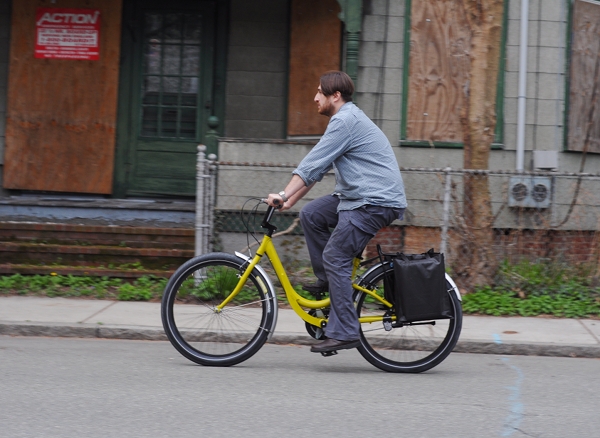
Co-Habitant on the Urbana, with grocery bags.

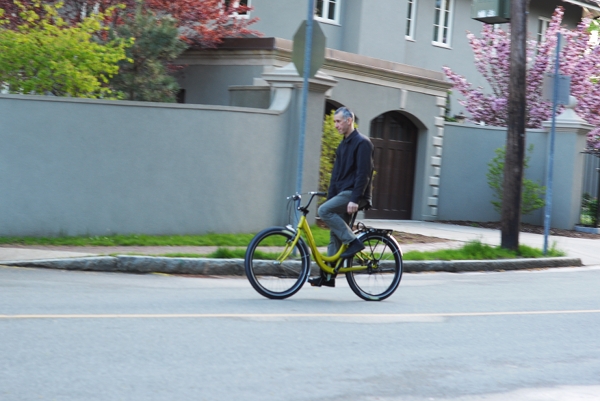
Our neighbour Somervillain on the Urbana, riding no hands.

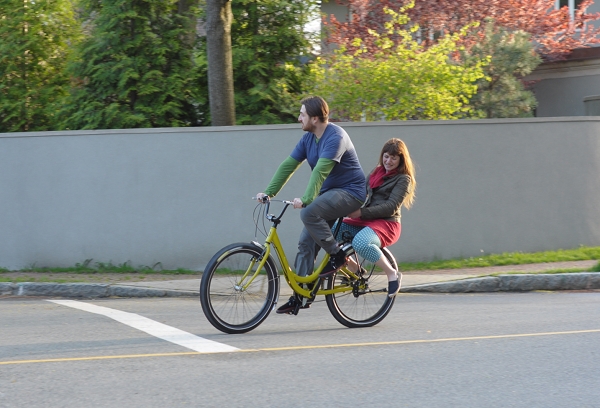
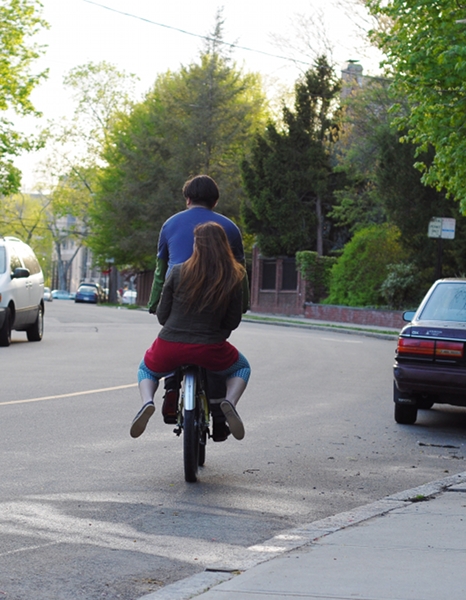
And the two of us together again. Can't say that I particularly enjoy riding on the rear rack (I like to pedal, not to be carted around), but it is definitely doable and the bike remains stable. We went to the grocery store this way once when we didn't feel like taking separate bikes, and it was fine. I screamed when he tried to hop a curb with me on the bike, but you can hardly blame me for that.

Overall, I do prefer the ride quality of traditional, upright loop-frame bicycles to the Urbana, simply because of the more comfortable hand positioning and the upright posture. Over long distances, I begin to find the MTB posture tiring - whereas on my traditional upright bicycles I can keep going for 30 miles. However, the utility and convenience of the Urbana made me prefer it for short-distance trips - especially when carrying anything of significance on the bike. Had the bike been equipped with lighting, its utility would have been truly remarkable, but the lack of lights made it only usable during daylight hours.

The US retail price of the Urbana will be around $1,000-1,370 - depending on how it is equipped. I suspect that the market will find that price range too expensive for this particular bike, but I could be wrong. Would I buy it for myself? Possibly - especially as a winter bike and dedicated "cargo chariot" that I would share with the Co-Habitant. I would get it in black, and I would want them to knock several hundred off the price. That is my honest feedback.

More than anything, the Urbana challenged my priorities - an experience that will have a long-lasting effect on my design sensibilities. I appreciate the opportunity to review this product and wish Urbana the best of luck.