Showing posts with label Pashley. Show all posts

Wednesday, March 30, 2011

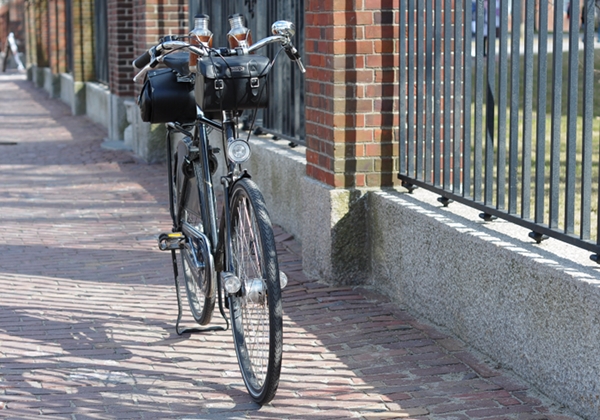
The Pashley Roadster Sovereign: Review After Two New England Winters

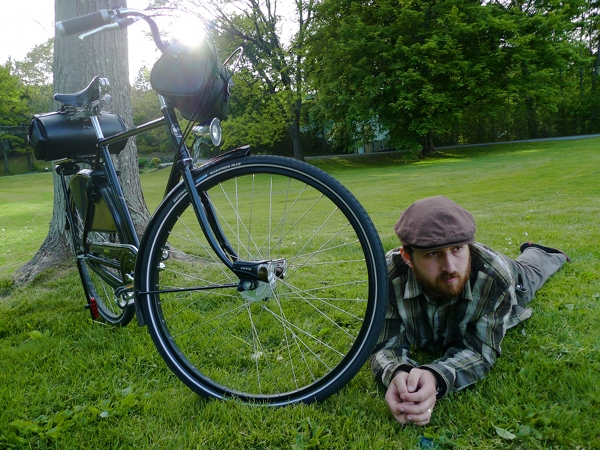
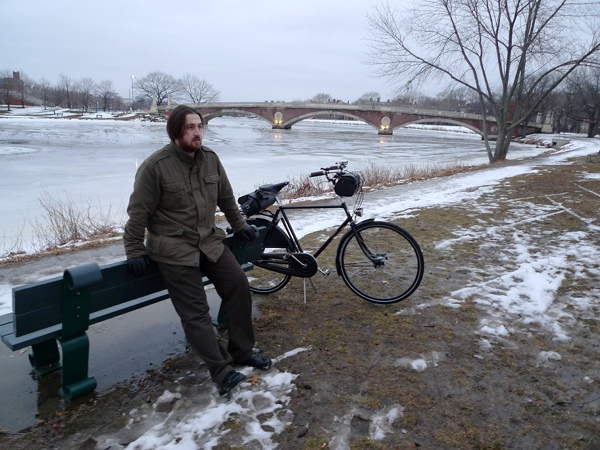
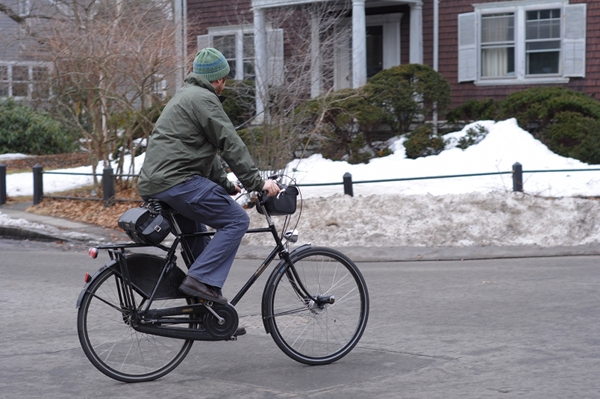
If you are a regular reader, you probably know that the Co-Habitant owns a Pashley Roadster Sovereign. We bought a pair of Pashleys when I first started this blog, and while I've since sold my Princess, he has kept his Roadster. He loves this bicycle. It is his main transportation bike, taking him to and from work every day for nearly two years now - in sunshine, rain and snow. This review is based on both his and my impressions of the bike.

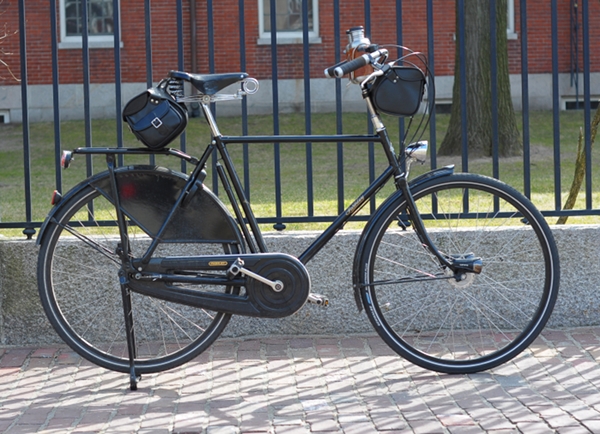
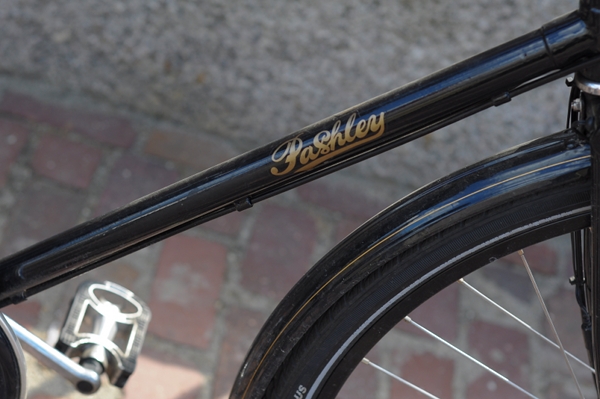
Pashley bicycles have been made in Stratford-upon-Avon, England since 1926. The Roadster is a traditional lugged steel English roadster frame with relaxed geometry and 28" wheels. It is powdercoated black and fitted with a 5-speed Sturmey Archer hub, dynamo lighting, and drum brakes. See here for the full specs and here for the complete set of images. This bicycle was purchased in May 2009 from Harris Cyclery in West Newon, MA (not a sponsor at the time).

One interesting thing to note about this bike is the sizing. The Co-Habitant is 6' tall and his preferred frame size is normally 60-64cm, depending on geometry. However, his Pashley's frame is only 22.5" (57cm), and yet it is his size. That is because the Pashley Roadster has an unusually high bottom bracket (330mm), which makes the standover considerably higher than it would be on a typical bike. For comparison, the bottom bracket height on his vintage Raleigh DL-1 Roadster is 310mm, which in itself is considered high. This explains why the Raleigh and Pashley are both his size, despite the former being a 24" frame and the latter a 22.5" frame. When in doubt, go down a size with the Pashley Roadster.

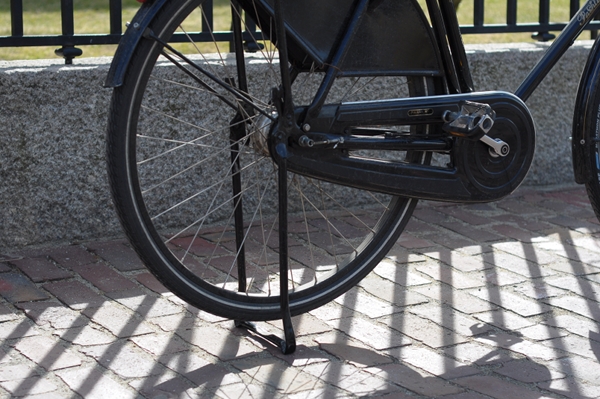
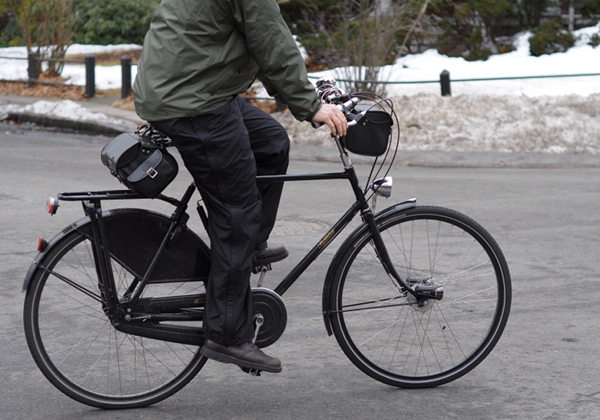
The Pashley Roadster Sovereign is a bicycle fully equipped for commuting: generous fenders, full chaincase, vinyl dress guards, large rear rack, drop-down kickstand and an integrated wheel lock. The Co-Habitant finds the dressguards and chaincase convenient, because they enable him to wear pretty much anything he wants on the bike - including dressy clothing and overcoats. He does not like tucking his trousers into socks or wearing ankle straps when riding to work, so these features are important to him. The chaincase has kept his chain immaculately clean through two winters and does not stand in the way of rear wheel removal. For those who dislike the drop-down kickstand, the frame does come with a kickstand plate, so it's possible to install an alternative. Initially, we installed a Pletcher double-legged kickstand and used it instead of the drop-down, until it broke, so now it's back to the original.

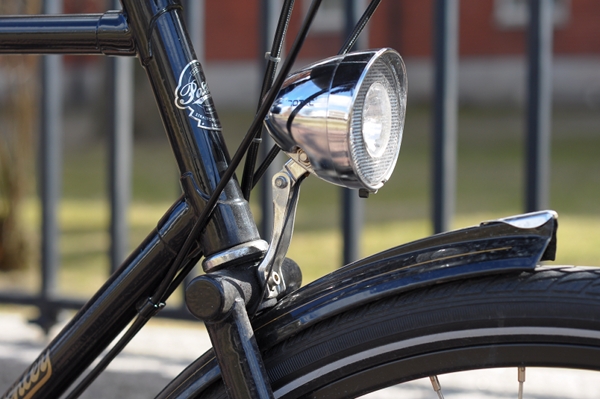
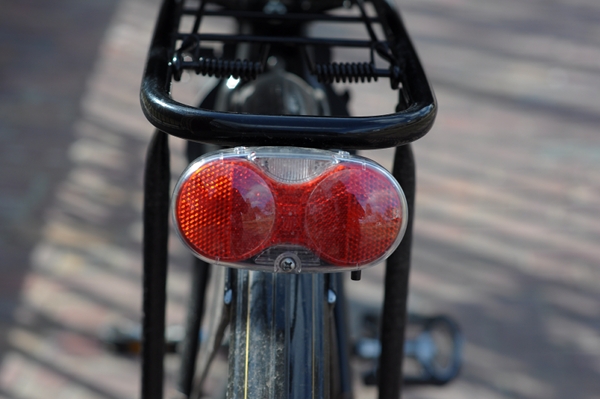
Though the headlight on the Roadster is dynamo-powered, the tail light is battery-operated. The 2.4W dynamo hub makes it difficult to modify this lighting set-up, and we are really not sure why Pashley chose to do this instead of using a 3W hub and bulb. We are considering eventually replacing the lighting on his bike with a front and rear LED system with standlights. Trouble is, there aren't any classic LED headlights in a style that would suit the Pashley.

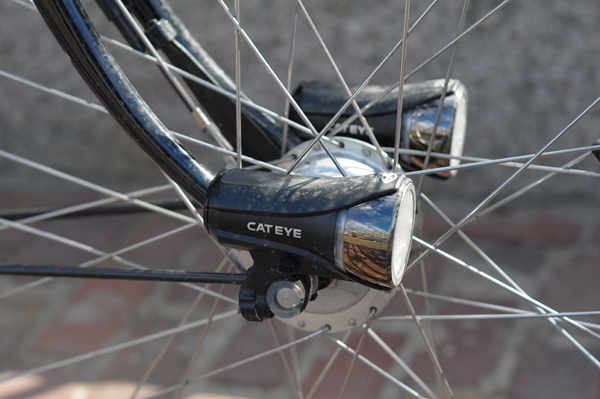
Supplementary Cateye battery lights attached for situations when visibility is especially poor. The bolts on the Pashley's front axel make it easy to mount these.

The rear rack is spacious, but made of such thick tubing that most pannier mounting systems will not fit it. The Ortlieb QL2 and the R&K Klick-fix systems sort of fit, but just barely.

Tires are Schwalbe Marathon Plus. They are not my favourite tires, but the puncture protection is unbeatable.

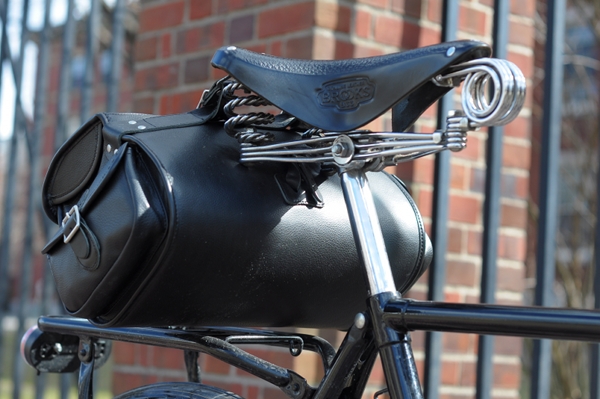
The saddle is the super-sprung Brooks B33 - especially suitable for the larger gentlemen on upright bikes.

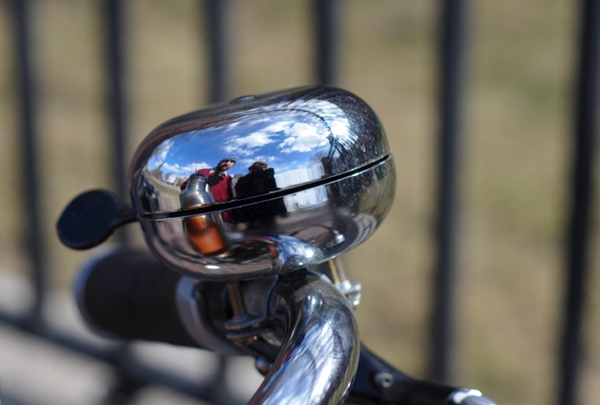
And of course, the shiny "ding dong" bell. That's us, reflected in it.

Though we are both lovers of customisations, there wasn't much that the Co-Habitant modified on this bicycle. All the components have remained stock thus far. As far as positioning, he lowered the handlebars to make them level with the saddle and angled them down a bit, for a more aggressive position. He also shoved the saddle forward by means of reversing the seat clamp. He added a Brooks Glenbrook saddlebag and Millbrook handlebar bag, which are permanently affixed to the bike. The saddlebag contains his lock, bungee cords and saddle cover in the side pockets, with the main compartment kept empty for quick grocery trips and other errands.

The handlebar bag contains his rain gear, gloves, bad-weather cycling glasses, flashlight, and epic toolkit. The toolkit he carries only on longer trips.

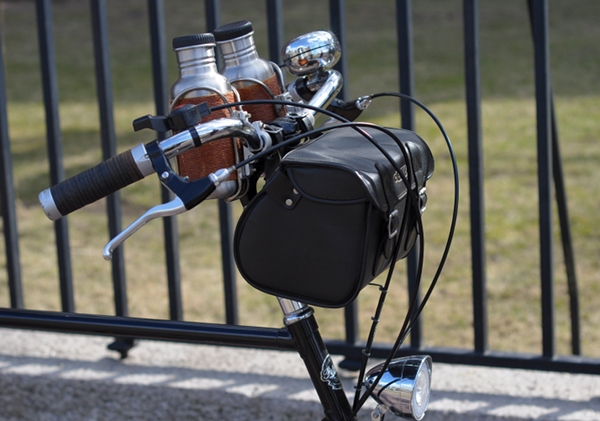
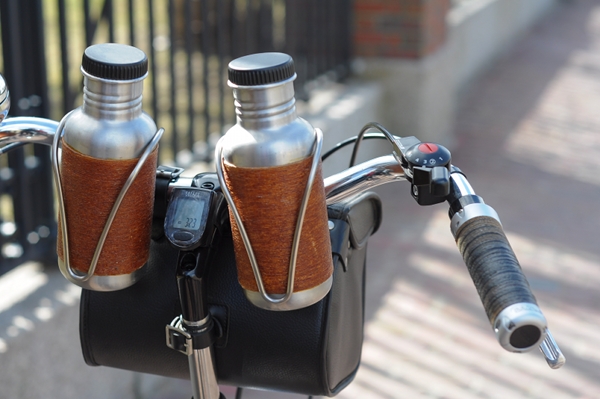
The original plastic handlebar grips were replaced with the Brooks leather washer grips. Front and rear drum brakes are hand-operated, and he has them routed right-front. And just in case you haven't noticed, the handlebar set-up includes a cycling computer and twined water bottles in their DIY handlebar mounts. The computer is fairly unobtrusive, blending in with the black part of the riser stem.

And a close-up of he bottle cage mounts. The set-up with the twin bottles sticking out like miniature cannons over the handlebars is over-the-top eccentric for me - but over time I've grown used to seeing them on his bike and even find them endearing. He has also carried paper cups full of coffee in those bottle cages - successfully.

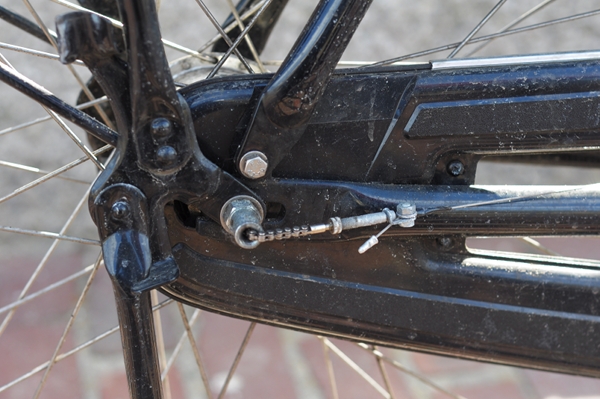
We considered washing the bicycle before taking pictures for the review, but ultimately decided against it. These pictures realistically portray what the bike looks like after a winter of commuting - and a harsh winter at that. The only time this frame has ever been wiped down was after the previous winter. With everything either fully enclosed or stainless, the Pashley Roadster is as low-maintenance as they get. The powdercoating has held up excellently, with just a few scuffs here and there. Over the time he's owned this bicycle, the Co-Habitant has broken two spokes on the rear wheel (one per year) and had them replaced. The wheels also had to be re-trued a couple of times, no doubt due to the horrible pothole-ridden roads on which he commutes. Otherwise, significant adjustments have not been necessary.

As far as ride quality and subjective feedback go, there is a distinct feeling of the bicycle being stable, reliable and enormous.

It can comfortably travel at high speeds, with the cyclist feeling relaxed, perched high above city traffic. And this isn't merely an illusion - with the high bottom bracket and the upright sitting position, the height at which the rider is placed really is out of the ordinary.

The bicycle handles well on the road and off, in dry and wet conditions. In the winter, it has proven to be a trusty companion.

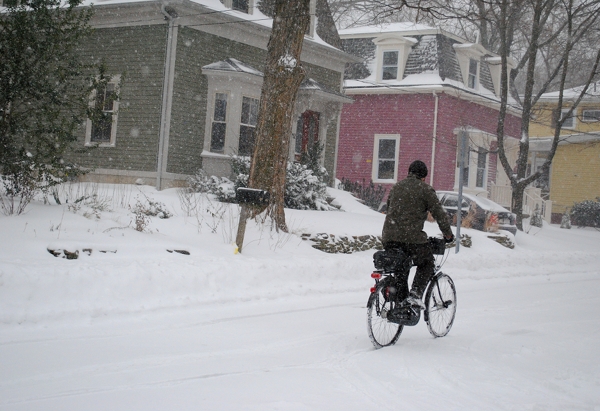
Even during blizzards, the Co-Habitant continued to commute on this bicycle, and felt comfortable doing it.

When describing the Pashley Roadster's ride quality, it is worth noting that it is not the male equivalent of the Princess model: The geometry and handling of the two bikes are different. Performace-wise, the Roadster accelerates faster and climbs hills easier than the Princess, which can be problematic for those who buy the two bikes as a "his and hers" pair. Though this discrepancy between the men's and women's models is unfortunate, the Roadster's performance in itself is terrific.

As for my own impressions of the Co-Habitant's Pashley, I've come to see the bike as his permanent companion or even an extension of his personality. He loves the bike, never complains about it, and uses it daily for transportation, which is fantastic. But sometimes I do wonder whether the bike is overbuilt for his purposes: To me it seems excessively heavy, and I don't get the point of having that monstrous rear rack if it is seldom used for anything other than saddlebag support. Also, it takes great effort to convince him to leave the bike locked up in the city, which is frustrating. At work he has secure locking facilities, but when we go out he worries about the bike too much - which in my view somewhat undermines its usefulness. However, the most important thing is that he enjoys the bike and rides it, which I feel has been accomplished here pretty well.

Though the Pashley Roadster Sovereign is not inexpensive by any means, it is a good value once you consider what is included and add it all up: a traditional lugged frame made in England and a fully integrated "commuting package" consisting of fenders, drum brakes, full chaincase, dressguards, puncture-proof tires, lighting, and a high quality sprung leather saddle. After close to two years of daily use, including two New England winters, the bicycle looks hardly worse for wear - a testament to its durability. As with everything, your impressions may differ, but the Co-Habitant is a happy owner. He is not looking for another transportation bicycle for the foreseeable future.
Sunday, March 13, 2011

Beautiful Stranger... Yet So Familiar

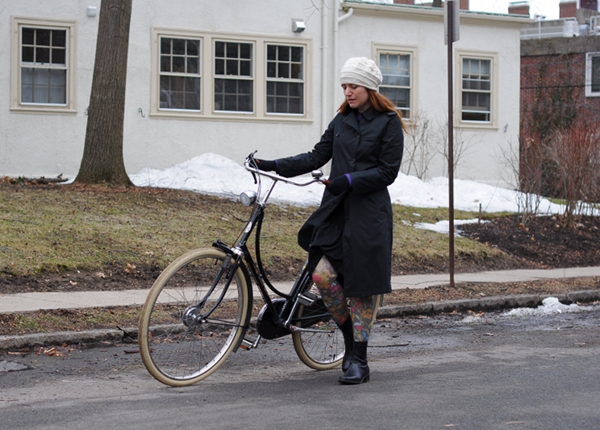
You know how it goes: Just when you thought you were over your Ex, she turns up wearing a sexy outfit. That's how I felt when I saw this creature in the neighbourhood! Though it wasn't my old bike, the beautiful stranger was not only of the same nationality, but had similar tastes in adornments.

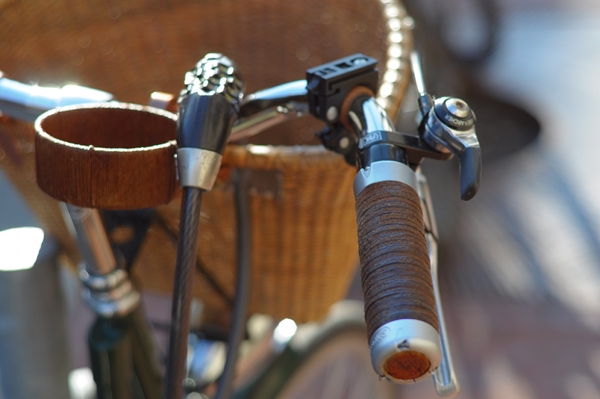
Leather washer grips and a twined coffee cup holder. Not sure what that additional black bracket is on the handlebar - maybe for an extra battery-powered headlight. The Co-Habitant and I were debating whether this is a newer Pashley or one from a few years ago. He thinks it's older, because the frame is muddy and the saddle is well broken in. I think it's newer, because of that Sturmey Archer shifter (didn't these just come out in 2010?). Also, the tires were not the usual Schwalbe Marathon Plus, but something by Continental.

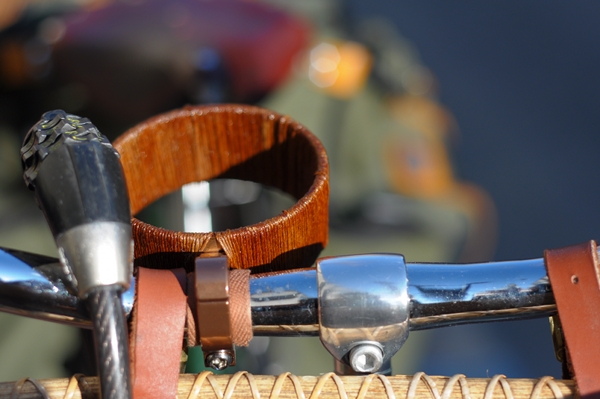
Close-up of the twined coffee cup holder. I've never seen one that integrates with the overall look of the bicycle more harmoniously! And I think the twine may also solve the loose fit/ rattling problem some of these cup holders are known to have.

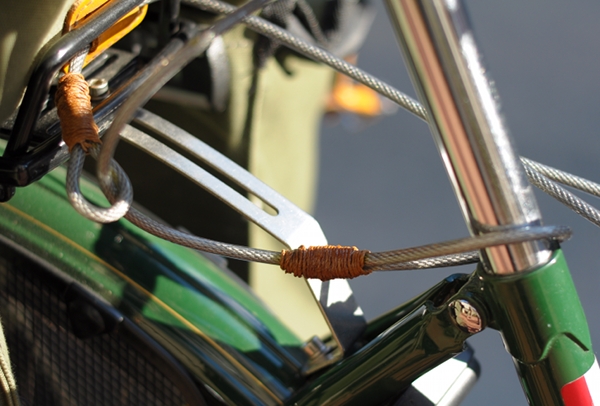
Twined cable lock - just one of many locks that were keeping this Princess safe. I am ashamed to say that I never provided mine with this much security!

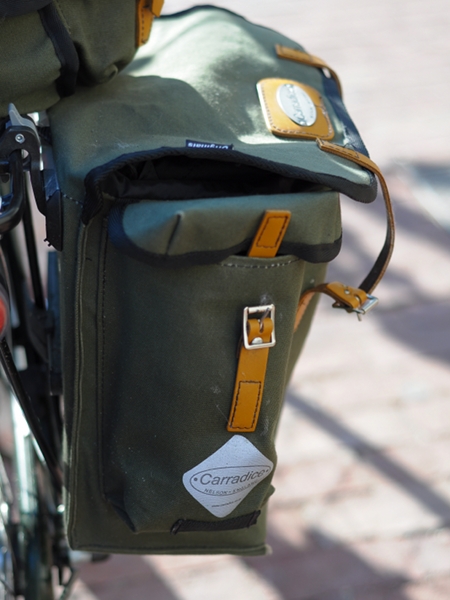
And the piece de resistance: a Carradician triumvirate, its olive magnificence catching the golden afternoon sunlight just so. The saddlebag is a Barley model, but I have never seen these Carradice panniers before.

The panniers are absolutely gorgeous and use what could be an Arkel mounting system. I wonder whether they are custom made (I know that Carradice will sometimes make bespoke items), or a new model I did not know about. Oh Beautiful Stranger, if only you could speak!

Wednesday, March 9, 2011

His Rain Gear

Now that it's stopped snowing, it's been raining - and happily, the Co-Habitant has some new rain gear that keeps him from getting soaking wet on the way to work. As far as finding what worked for him, his case was a tricky one. In his hatred of shopping and owning too much clutter, he wanted something suitable for both roadcycling and commuting to work. So a nice waxed cotton trench coat was out, as those are uncomfortable on a roadbike. A waterproof cycling jacket was out, as those are too tight to be worn over office clothing. And most waterproof windbreakers are too short in the back to be worn on a bike, plus they are seldom available in the classic colours he likes. Also, two years ago he bought a couple of rain capes and hated them: They billowed in the wind, didn't cover his knees as much as he wanted, and started to fall apart after just a couple of storms. I was at a loss as to what else to suggest.

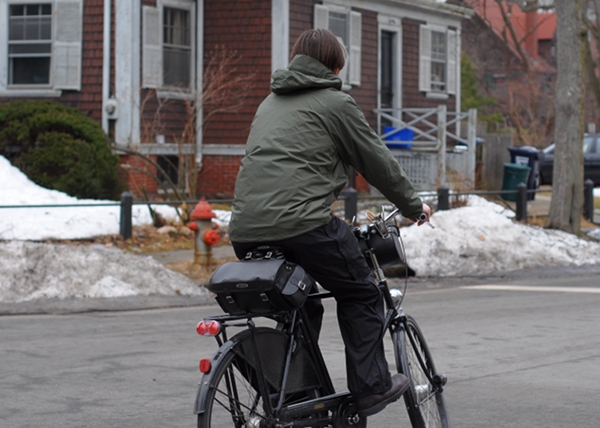
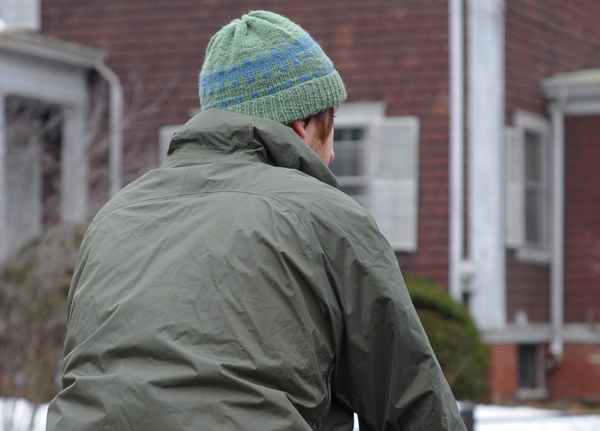
But what I feared would be an endless search for The Garment That Does Not Exist, ended after a visit to our local Eastern Mountain Sports: The EMS Thunderhead rain jacket and rain pants turned out to be just what he'd been looking for. The colour he chose is a very classic shade of loden/olive green, which was exactly what he wanted. Although the jacket is not cycling-specific, it works great on a bike.

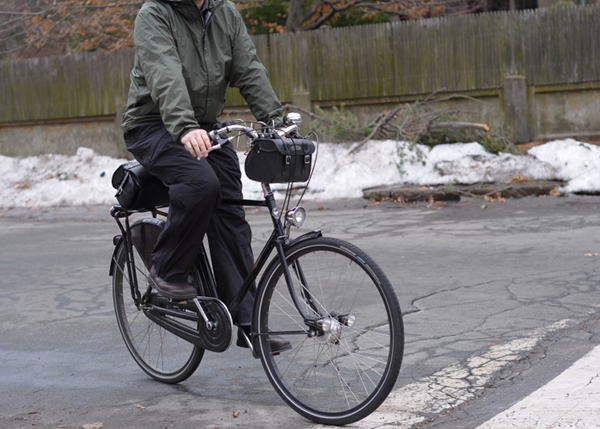
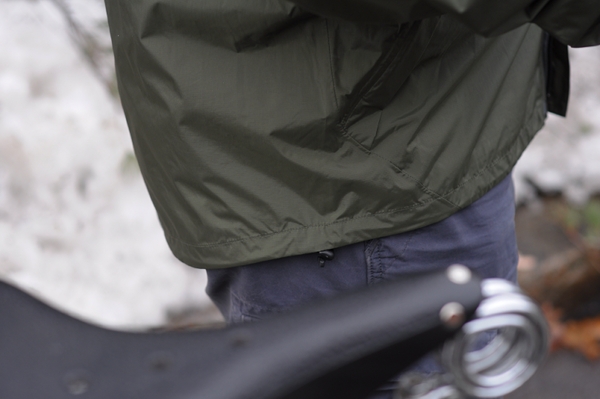
It is cut more slender than a typical windbreaker, which reduces billowing. And it is considerably longer in the back than in the front, just like a cycling jacket.

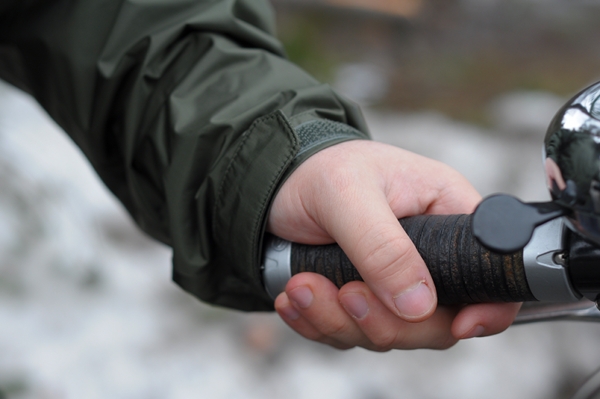
The wrists are mildly elasticised and can be tapered further via velcro closure - or loosened up for a less sporty look.

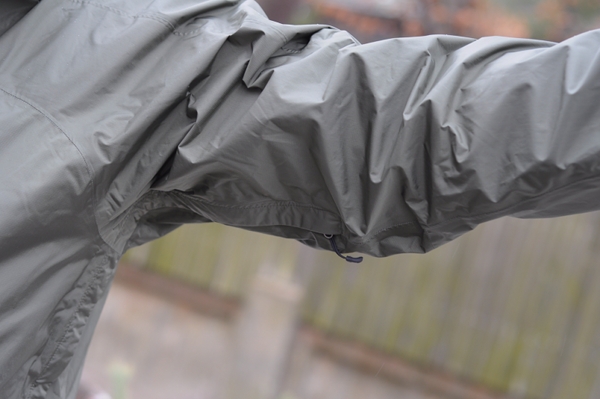
Air vents under the arms.

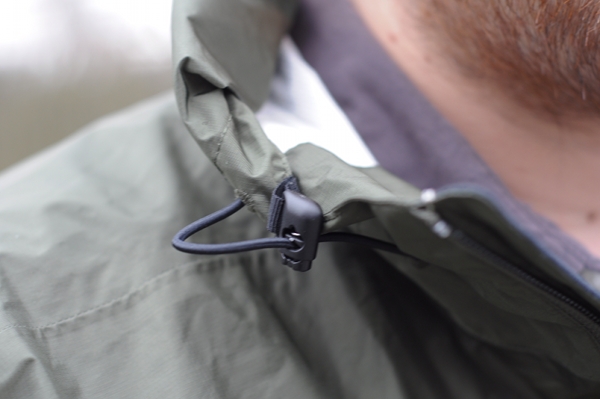
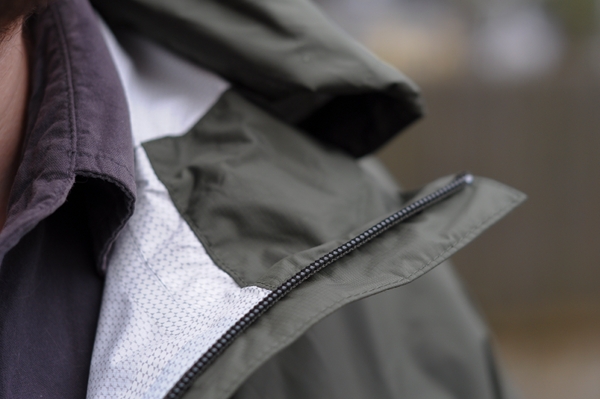
Elastic for adjusting collar and hood.

The zipper is bi-directional (Is that the right term? It opens at the collar and at the hem). The hood rolls up an stows away under the collar.

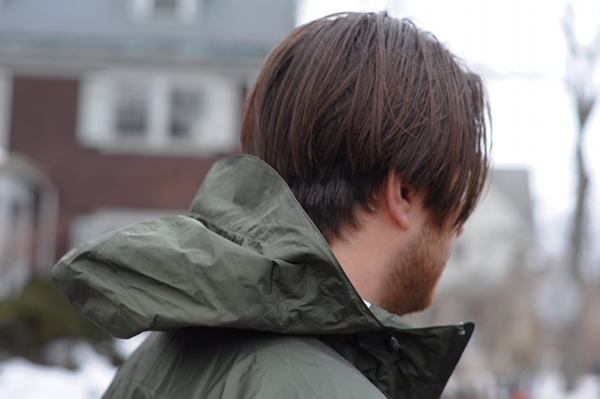
The hood is a pretty nice one - classic and even a bit old-fashioned, with an elegant front extension instead of a visor.

The jacket is not restrictive while cycling. While the EMS product description states that the material is breathable, the Co-Habitant says not so much. Still, at least it is a thin shell, and ventilation can be improved by opening the vents.

The rain pants are from the same Thunderhead line as the jacket. He liked them because they look presentable for cycling to work and not too sporty.

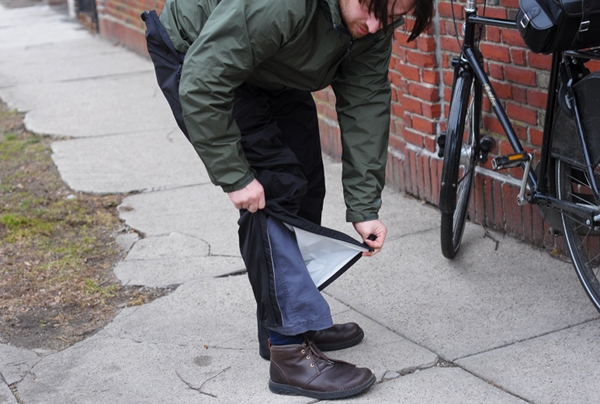
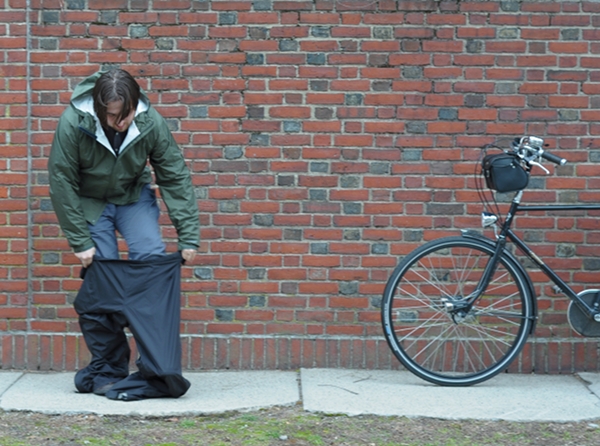
Made of the same material as the jacket, these are meant to be pulled on over regular pants when it starts raining. They are roomy, so this is easy to do.

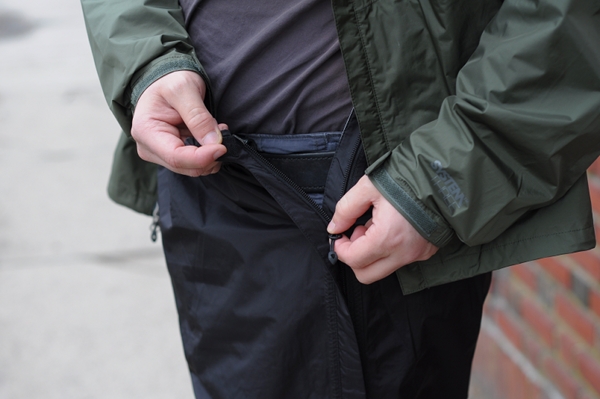
Alternatively, they can be put on or removed via the side zippers.

Side zipper again.

Both the rainpants and jacket fold up to take up very little space, and can be stowed away easily in a handlebar or saddle bag.

I don't know much about the EMS Thunderhead line, other than what's here. The product page includes customer reviews, some of which state that the jacket loses waterproofing over time - which has been my experience with pretty much any waterproof jacket. Still, for those looking for rain gear that is versatile enough both for cycling to work and on a roadbike, I think this set-up works pretty well. It stows away easily, works in all seasons, and is neither too roadie nor too dandified - just some easy to wear, easy on the eyes, all around rain gear in a classic colour scheme and at a reasonable price.

Monday, March 7, 2011

Getting My Groove Back!

Finally, oh finally! Today I felt like myself on my bike again. Not watching my speed. Not watching for black ice. Not getting off every couple of blocks to drag the poor bike across a snowbank or to cross a tricky intersection in order to make a left turn. While Spring has not fully sprung yet, winter is definitely gone and the roads are clear. So what if it's raining and there isn't a green leaf or flower in sight (other than on my tights)? I got my cycling groove back!

Taking it nice and slow on the Gazelle since the snow began to fall in December, I'd almost forgotten how awesome this bicycle feels to ride when I really push it. Though heavy, it accelerates wonderfully and moves fluidly with my body. It is tremendous fun to cycle 17mph on this gorgeous beast - steering with my hips and leaning into turns with abandon - sometimes to the amazed looks of passers-by and fellow cyclists. Oh my 50lb flying machine, how I've missed these good times!

And if you're wondering how I know that I can go 17mph on the Gazelle, it's thanks to the Co-Habitant's computer on his Pashley. Yes, he has computers both on his roadbike and on his transport bike, and when we ride together he likes to inform me of my speed. Although secretly pleased, I dutifully pretend to be annoyed. I mean, come on - a computer on a Pashley Roadster! What's next, bottle cages? Oh wait...

Well, as you can tell, I am in a fine mood. I had not fully realised until now how much cycling this winter had been stressing me out. While I am always vigilant when riding in traffic, the sort of hyper-vigilance the road conditions commanded over the past two months really did a number on my nerves. I guess for me, cycling is both stressful and tedious if I expect to have to execute emergency maneuvers at any moment. I wouldn't make a good bike messenger for sure.

Of course, one downside to the winter ending is that all the thick wool hats I've been making (that our apartment is now littered with) will soon have to be retired until the next cold season - but that is a small price to pay for getting my cycling groove back. It has been weird to keep up Lovely Bicycle for the past couple of months while doing only a minimal amount of cycling, and I felt almost fraudulent to be waxing lyrical about bicycle design and cycling-related issues while riding hardly 10 miles per week. Hopefully that is all in the past (that is, until next winter) and I will soon once again have the pleasure of boring you with descriptions of 40 mile rides on my roadbikes, trips to distant grocery stores, and discoveries of new-to-me lands.

Friday, February 18, 2011

The Pashley Princess: a Retrospective from a Former Owner

While we are still in hibernation season, I wanted to write a retrospective review of the Pashley Princess I used to own. My existing review of this bike was written after only a month of ownership and leaves a great deal out. I hope to make this review more representative of my overall experience, while providing the sort of information that might be helpful to those shopping for a new bike.
I owned a Pashley Princess Sovereign from June 2009 until August 2010. A lugged steel bicycle made in England, the Princess is a thing of incredible beauty and high quality. It was my first "nice" adult bicycle, and the first bicycle I've ever ridden for transportation. As such, it saw me through a period of almost continuous transformation as a cyclist - defined by changes in skill level, confidence, knowledgeability, and preferences. For that reason, I will arrange this review chronologically - from the start of ownership to the end.
The Decision to Purchase
My Pashley was not an impulse buy. I did a lot of research, test rode a number of bikes, and took my time deciding. Among the other bicycles I test rode at the time were Gazelle, Batavus and Velorbis. During those test rides, I remember that I did not feel comfortable with my ability to control the Dutch bikes (Gazelle and Batavus) in comparison to the Pashley. I did not understand why at the time, but now I think I do: Dutch bikes have a light front end, which can take some getting used to. The Pashley's handling felt natural from the start. As for Velorbis, I remember thinking that it was similar to the Pashley, but not quite as nice, and so it was out of the running. I also admit that my deep attachment to England - where I spent a good part of my twenties - influenced me as well. I liked the idea of having an English bicycle.

First Impressions
I purchased the Pashley Princess Sovereign in June 2009 from Harris Cyclery (not a sponsor at that time), together with the Co-Habitant's Pashley Roadster Sovereign. I chose the 20" (medium) bike in "regency green," and immediately made a number of modifications to it, including the installation of a 7-speed coaster brake hub, netted dress guards and Brooks leather washer grips, as well as extra lights to supplement Pashley's lighting system. All lady's Pashleys have 26" wheels. Detailed specs can be found in my earlier review.

While initially my choice of frame size seemed "perfect," I now consider that size borderline too small for me and prefer larger frames. When I first began cycling as an adult, I was extremely nervous about it and felt that I needed to be able to have my feet almost flat on the ground while remaining in the saddle - which accounts for the discrepancy in size preferences between then and now. Two years later, I prefer a 22" step-through frame for transportation.

As far as ride quality, initially I was quite happy with it. What I liked the most about the Pashley Princess was its stability and feeling of "solidness." It made me feel very, very safe - which in turn "empowered" me to try vehicular cycling. What I didn't like, was how much I struggled to pick up speed and go up hills on this bike. But at the time I thought that this was normal for traditional transportation bicycles, and did not see it as a problem.

One thing that caused some frustration in the beginning, but was entirely my fault and not the bike's, was  the question of how to transport my laptop. I did not trust the idea of clip-on panniers, and the front basket did not feel entirely stable with a huge bag in it. So, for the first few months of owning this bike, I carried a messenger bag. But eventually I stabilised the front basket by securing it with a myriad of zip ties and began to transport my laptop bag inside it - which was fine. However, had I just bought a clip-on pannier, such as the Fastrider I now own, it would have been even better.

Discovery of Limitations
The first inkling that my Pashley may not be the right bike for me, came after I acquired and refurbished a vintage Raleigh Roadster. Despite being larger and clunkier, the old Raleigh DL-1 was considerably faster to accelerate and easier to ride up hill than the new Pashley. I was stunned by the discovery of these differences, and my interest in frame geometry and ride quality was launched largely as a result.

With the arrival of Winter 2009-2010, my qualms about the Pashley's handling were temporarily forgotten, because as a winter bike it was truly fantastic. Since I ride slower in the winter anyhow and stick to shorter distances, acceleration and climbing long hills no longer played an important role in day to day transportation cycling, and I was once again happy with the bike. But as soon as the snow began to subside, the frustration began anew.

The more skilled and confident I became as a cyclist, the farther I started to travel, and the more torn I began to feel about the Pashley Princess. It was such a sweet, well-made, picturesque and iconic bicycle - How could I even think of giving it up? But beyond gentle trails and neighborhood streets, I felt limited on it.

Experimentation and Modifications
In Spring 2010, I began to experiment with the Pashley's positioning and components in order to address my complaints: I lowered the handlebars, raised the saddle, replaced the sluggish Marathon Plus tires with the faster Delta Cruisers, and even removed the front wicker basket in hopes of reducing wind resistance. Each of these changes indeed made a difference, and to my delight the bike now handled similarly to the vintage Raleigh.

I also installed a set of Wald rear folding baskets, which improved my quality of life immensely.

The Decision to Sell
At this point, I was once again happy with the Pashley Princess and had decided to keep it after all. I rode it for most of the summer without complaints. But then, something unexpected happened. By some bizarre stroke of luck I came across a 1990s Gazelle, which I was able to acquire for less than the cost of a Brooks saddle. The second-hand Gazelle handled similarly to my vintage Raleigh, but it was newer and I felt more comfortable using it for transportation. Once I had the Gazelle and found myself riding it all the time, I could not financially justify keeping the Pashley. I decided to sell it and did so swiftly to avoid further agonising over the decision. It was a beautiful bicycle, and I basically learned transportation cycling while riding it. But I do not regret my choice.

In Conclusion
I would describe the Pashley Princess as an elegant and well-made bicycle that is perhaps best suited for those who prefer to cycle slowly and do not live in a hilly area. But ride quality is highly subjective, and so I would recommend reading as many reviews of this bicycle as you can to get a sense of how others feel about it. After all, Katie Doncaster toured across Europe on hers and found it to be well suited for the trip. It is also worth noting, that the Princess model should not be compared to the men's Roadster model, as the latter has 28" wheels and possibly different frame geometry (it looked like it, but we didn't measure when we had both bicycles). While I decided to sell my Princess, the Co-Habitant continues to ride his Pashley Roadster happily on a daily basis and will hopefully soon grace us with a review.