

.....
view posts about the Pashley Princess
view posts abut the Mercier mixte
Thank you for looking!
As mentioned previously, my beautiful Mercier mixte (now named Suzanne) was acquired and spruced up for the important role of Studio Bike. She lives full-time in our photography studio outside of Boston, and is there for me when I need her for local errands. These involve mostly coffee runs and scoping out photo-shoot locations, neither of which are too far from the studio. And thank goodness for that, because my initial impression of the area as "No Bike Town" has only been confirmed over the past two months.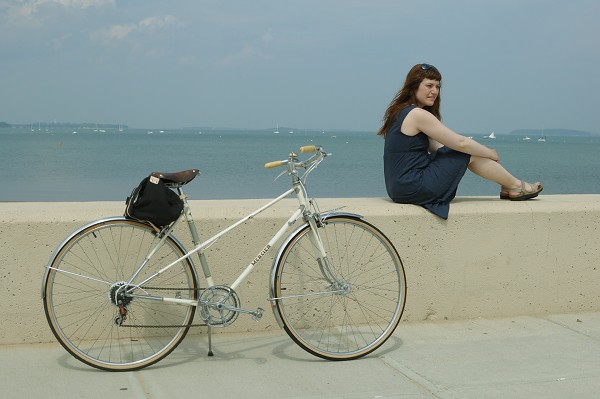 I know it looks like a day at the beach, but honest - we've been working all through the weekend! Plus, this bit of sunshine was but a brief interlude between hurricane-like rains.
 See? Hard at work. Mlle. Suzanne fits nicely in the narrow space between my desk area (a.k.a. negative-scanning station) and the wall. To the right is the Co-Habitant's desk (a.k.a. paper-cutting station), behind us is the darkroom, and in front of us is our studio-mate's work area - including a formal portrait studio that he has been operating for decades.
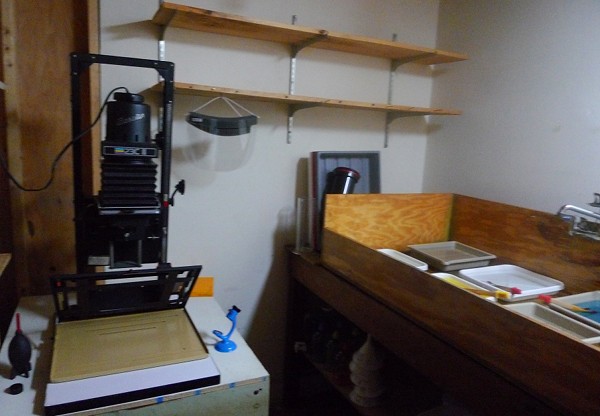 A portion of the dark room.
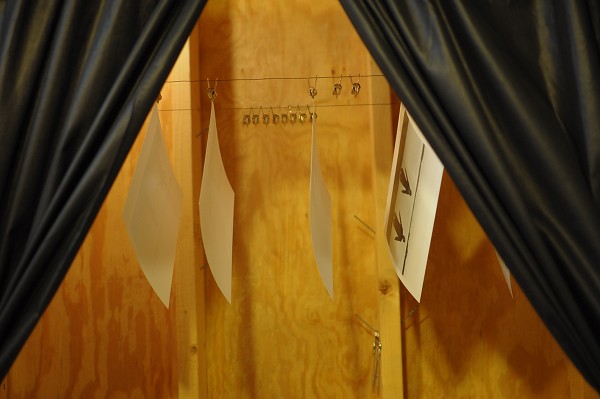 Drying area for negatives and prints. Suzanne is overjoyed to have access to this cool space and to work as an artist's assistant. And I suspect being close to the beach does not hurt either.
 What is a 5-Speed Conversion?
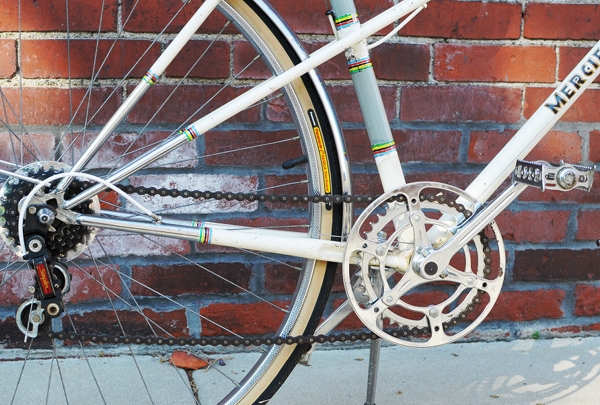 Why do this? Doesn't it mean you have fewer speeds now?
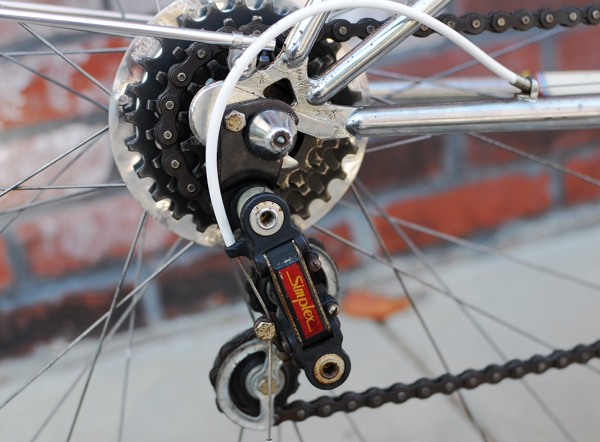 If you're going to make it a 5-speed, why not use a 5-speed hub and ditch the derailleur system all together?
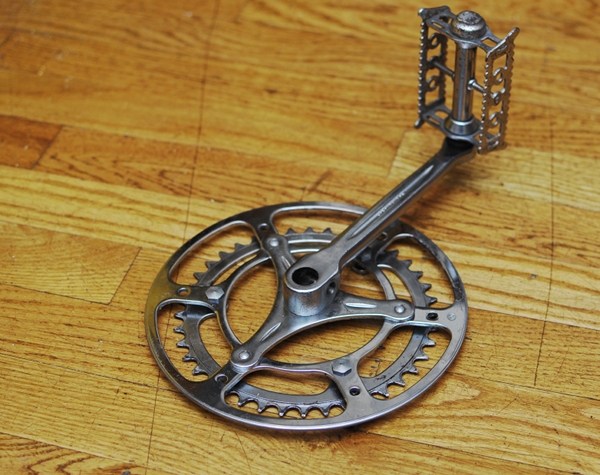 1. Front chainring removal
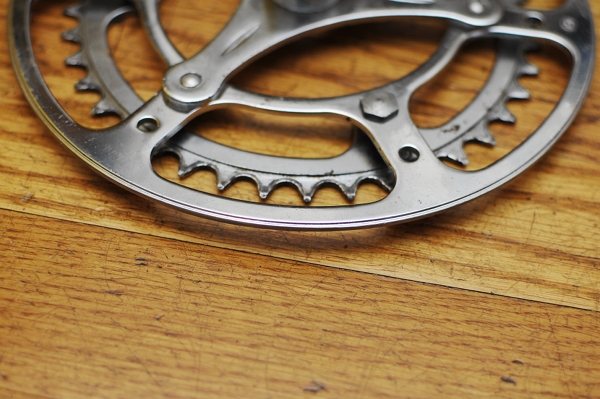 Here is a close-up of what was formerly the larger chainring. Notice how beautifully the edge is done - giving it a professionally finished look.
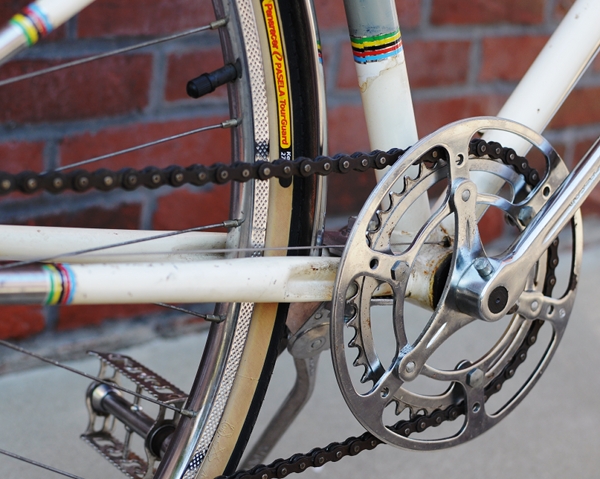 2. Front derailleur removal
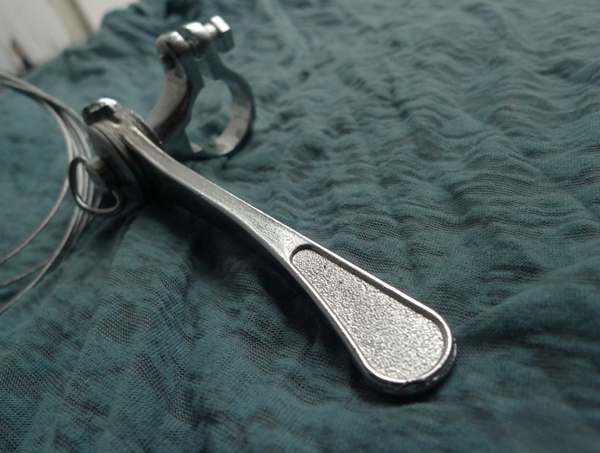 3. Changing the shifters
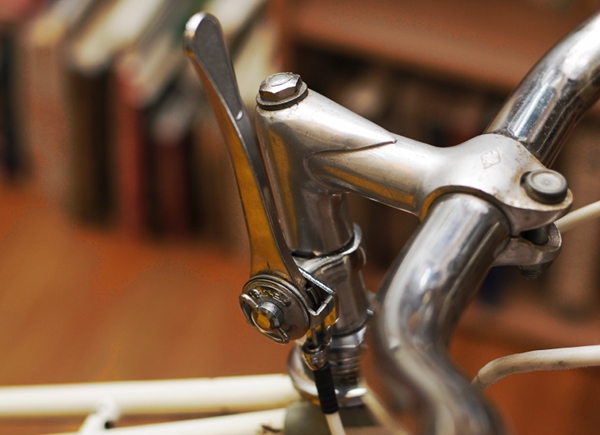 Here is the Huret shifter installed on the stem. I am not 100% sure though that this is the ultimate solution. Originally, the Mercier had downtube shifters, and this is where the single braze-on is located. However, I do not understand how one is supposed to use downtube shifters on a near-upright bicycle. At least for me, and in traffic, they were too much to handle - especially given that the shifting has to be done with the right hand.
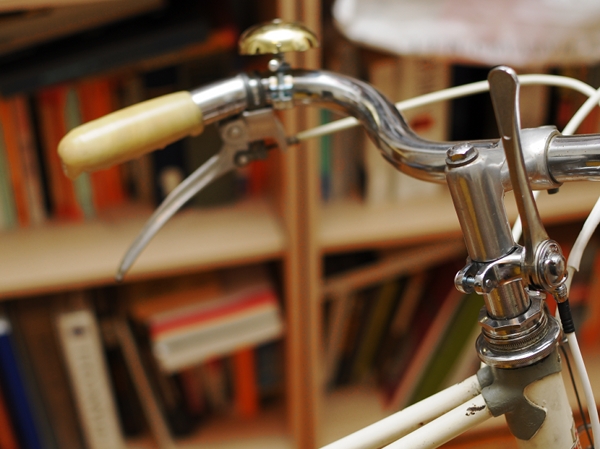 So now there is a cable stopper where the downtube braze-on is, and the cable then extends further to the stem. Though the Huret shifter is beautiful on its own, I am not sure how fitting it is here. For instance, the reason it is not all the way at the bottom of the stem, is that placing it here makes it hit the handlebar when it is moved all the way forward. Hmm, right? Your thoughts on this welcome.
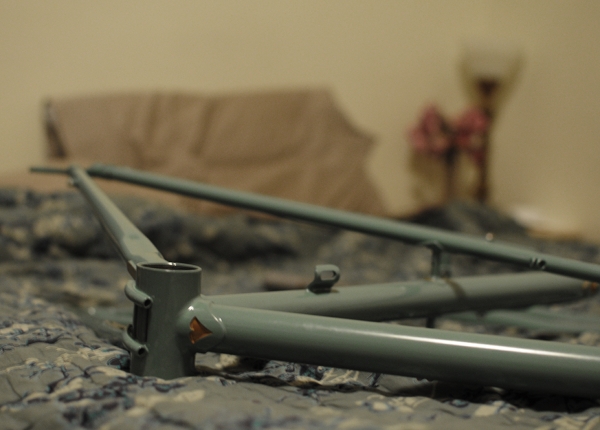 My beautiful Royal H. mixte frame came home today, and it looks like I will be building it up much later than I thought - possibly in the end of the summer, or whenever I manage to save the money. And my attempt to tackle the Sam Hillborne frame on my own over the winter did not end well. In the end I brought the frame back to Harris with the metaphorical tail between my legs, and it is only now being built up - in the very midst of the spring customer rush. Naturally, having a bicycle built at a shop is more expensive than doing it oneself, and so my plans for the Royal H. mixte are on hold until some serious financial recovery time after the Hillborne. In the meantime, I better wrap it in bubble-wrap and put it away. I don't think it's healthy to sit on the bed next to a bicycle frame and stare at it for this long.
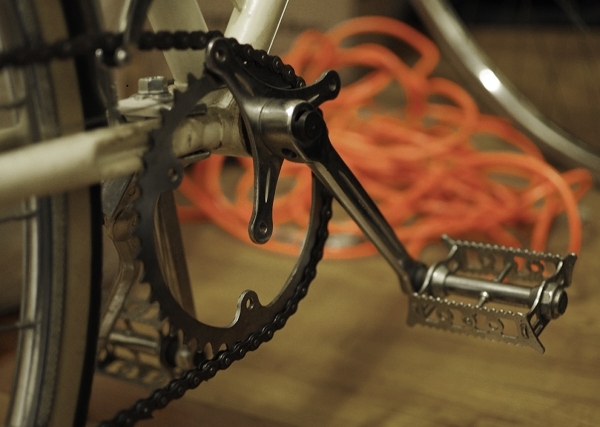 My Mercier mixte is now also a "purgatory bike", albeit very temporarily. The large chainring is off getting "de-toothed" by a fine gentleman who is a reader of this blog, as part of my scheme to convert this bicycle to a 5-speed. The chainring will be back soon, and till then I respond to the Mercier's questioning glances by gently stroking its handlebars and assuring it that it is not being disassembled for parts but is being improved.
 Pictured here are my latest additions: fenders, front rack, bell, and stem shifters.
 For fenders, I chose the inexpensive stainless steel fenders from Velo Orange. The idea (aside from saving money) was that the plain polished fenders would go nicely with all the chrome parts on this bicycle. I think it worked out well.
 And this is the tiny, adorable vintage TA front rack, designed to attach to the Mafac brakes on the Mercier. These come up for sale occasionally online and from fellow collectors at reasonable prices.
 The rack, while very cute, is so small that I am not sure what I will put on it. A classic touring handlebar bag does not really fit the look of this bike, but I will keep thinking. What did the French put on bicycles with these handlebars?
 Finally, we replaced the original Simplex downtube shifters with Suntour stem shifters (this part was done at Harris Cyclery, while the fender and rack installation we did at home). Downtube shifters just did not seem appropriate for this bicycle and reaching all the way down there in traffic did not feel safe. The little stem shifters are perfectly placed and very easy to operate.
 All of this does sound like a lot of fuss about an old bike. But in a way, it is the Mercier's decrepitude that liberates me: Had the original paint been in better condition, I would not have dared re-paint the lugs by hand to this nice green-gray from the original black. Had the components been higher-end, I would not have been willing to experiment with a 5-speed conversion. There is a lot of fun to be had with an old bicycle. The main thing, is that you like the ride quality and care enough to gradually improve the rest.
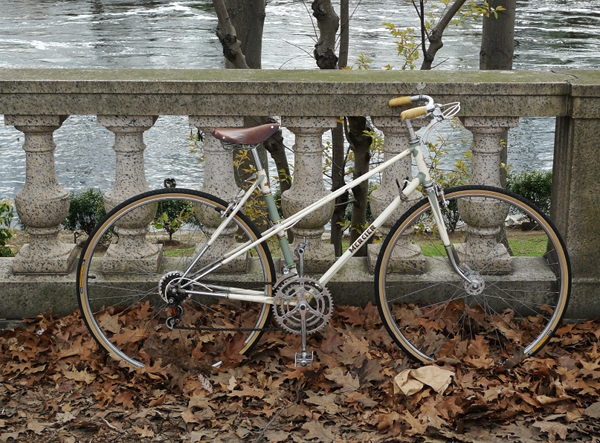 Can you spot the differences between this picture and the Mercier in its initial state?
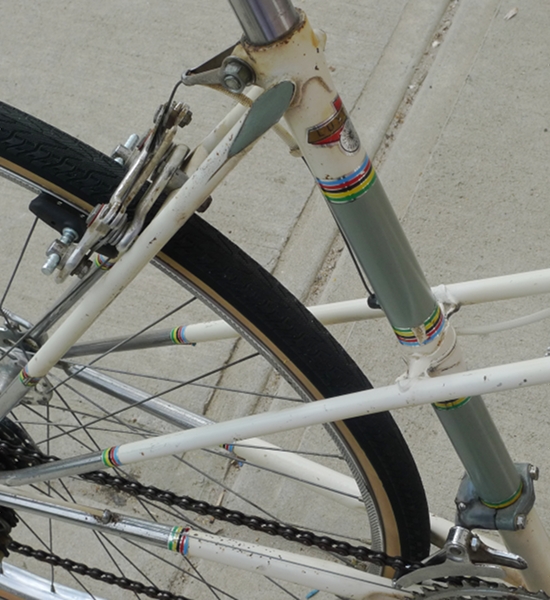 If you are thinking that the colour scheme looks a bit different, you are right. Originally, the Mercier had black lugwork and paneling - but to my eye, this created too harsh of a contrast with the cream frame. It also had the effect of stopping the eye at the frame's joints and making the bicycle look "choppy", whereas I like mixtes to have an elongated, fluid look to them. So after considering my options, I bought some enamel paint and hand-painted over the black lugwork and panels. The new colour is a light green-gray; very French and Spring-like. I have yet to redo the gold pinstriping around the edges, but from a distance it looks passable as is.
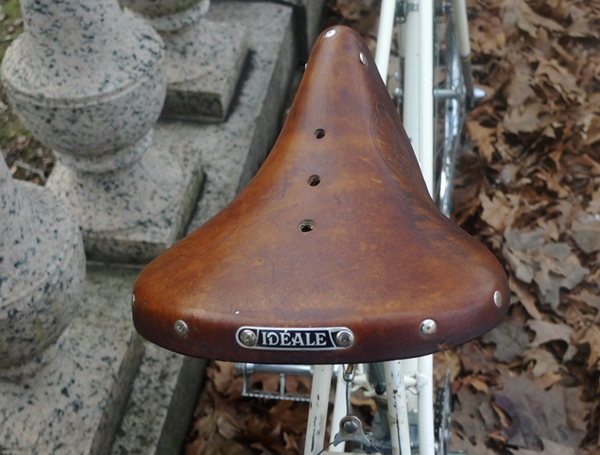 Another visible update to the Mercier is this fantastic Ideale saddle - acquired in a trade with a Lovely Bicycle reader (thank you!).
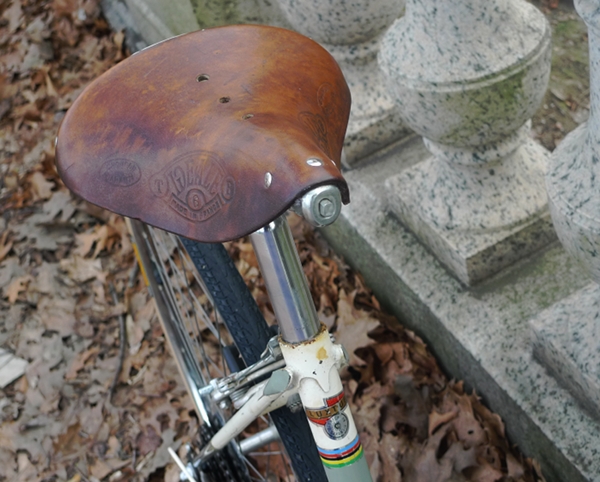 Ideale saddles are French, and described in this interesting article as "celebrated and enigmatic". This one is a Model 6, which is a short-nosed women's model from the 1970's.
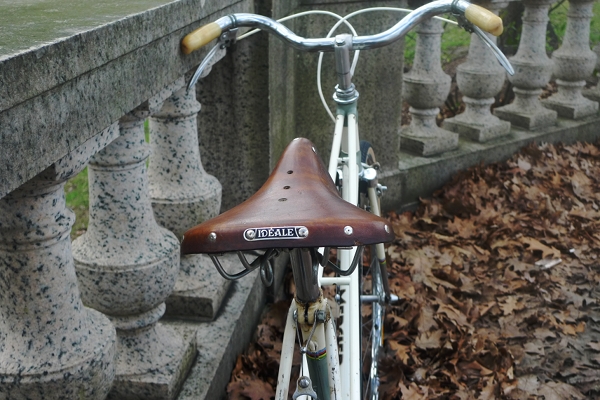 It is comparable to a Brook's B72S and has two rear loop springs.
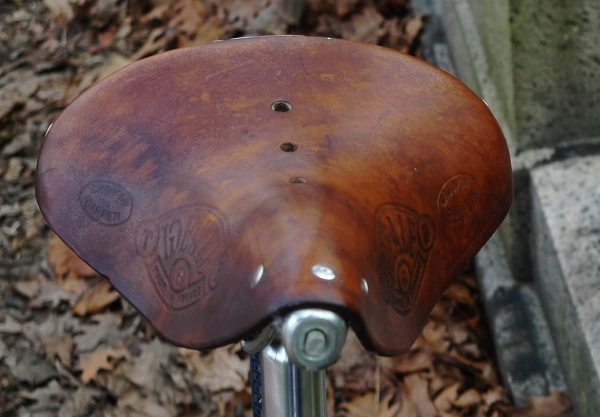 An extremely comfortable, elegant saddle. And the engraving is gorgeous. I have cycled a total of maybe 50 miles on it so far and it feels just perfect.
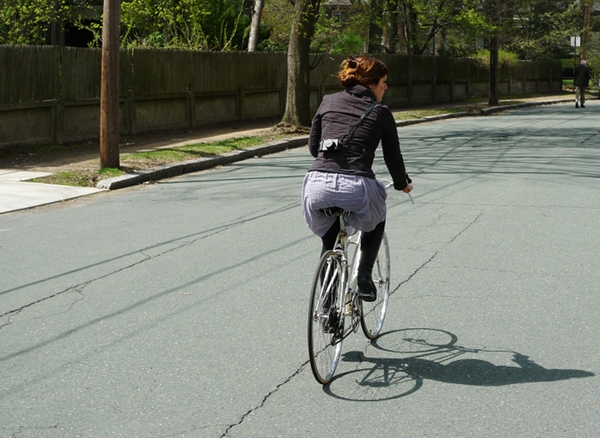 The last significant update has been replacing the tires. The shop where I found the bike fitted it with 20mm racing tires. To give you a point of reference, 20mm is narrower than the wheel rims. I think the fact that I was even able to ride on these tires at all - let alone 10 miles to Harris Cyclery to get new tires - is a testament to how stable and comfortable the Mercier is. The only problem I had, was with cracks in the road: 20mm tires are narrow enough to get stuck in the most innocent-looking cracks! After this happened to me once and I almost got knocked off the bike, I became hyper-vigilant.
 Thankfully, now the bicycle is fitted with 32mm Panaracer Pasela Tourguards - a beautiful vintage-looking tire with tan walls and superb puncture protection (These are the same tires I have on Marianne, and I have been very happy with them over the past year).
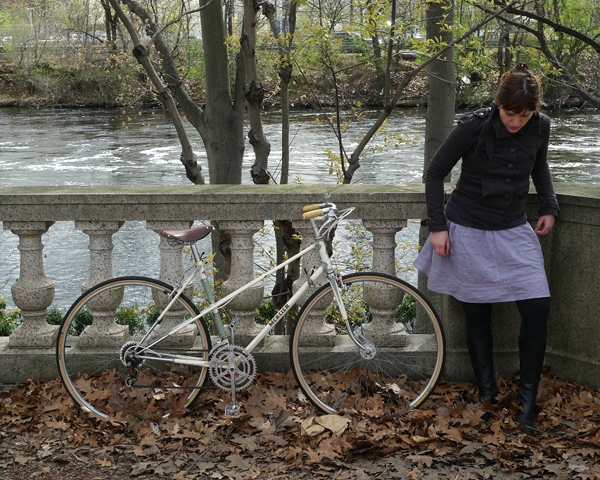 In addition to these updates, there are other little things we've done, like remove the spoke protector and the reflectors from the wheels, remove the Pletscher rack (which did not look right on this bike), clean the handlebar grips, and replace the black tape used to patch up a crack in the white cable housing with white tape, making it less visible. Future updates will include a set of inexpensive fenders from Velo Orange, a vintage front rack, and switching the downtube shifters to a set of old stem-mounted ones. So far, the only new components or accessories I have bought for this bike have been the tires. Everything else has been vintage, and for the most part acquired in a trade. I think I will try to do the same with future updates. Will see where this goes!
 Posting this at the end of April Fool's Day might raise suspicion, but I promise it's true: I have another "new" bike. The Co-Habitant and I were returning home from some errands and minding our own business, not even remotely entertaining the possibility of new bike acquisitions...
 ...when we saw a striking, if slightly decrepit, cream and black Mercier mixte outside of a nearby bike store. This was not the typical mixte we tend to see in these parts, so we got curious. After trying the bicycle I was amazed at how wonderfully it rode - despite the slick 20mm tires the bike shop chose to fit it with! The poor, lonely Mercier was for sale at a very modest sum.
 Half an hour later, I was pedaling it home (after paying for it of course), and now the Mercier is mine!
 Mercier was a well-respected French bicycle manufacturer in the 1960s and 70s, competing with Peugeot, Motobecane and Gitane. Mysteriously, almost no information is now available on the original Mercier (even the wikipedia entry has been deleted). Though a new company now exists under the same brand name, it has no relation to the original manufacturer.
 I don't know where to start describing why I like this bicycle and feel that I must have it. For one thing, there is the attractive lugging. Here is the seat cluster with pinstriping detail on the top of the stays.
 Split headtube lug for the twin lateral stays - something my Motobecane mixte does not have.
 Headtube lugs, fork crown, and pinstriping on the fork. Downtube shifters (which I do not find particularly attractive, but can easily replace). Overall, the lugwork and other aspects of the bicycle's "decor" are charmingly eccentric compared to other mixtes I have seen.
 The components seem to be a mixed bag of lower and higher end. The stem, which I find beautiful, is an AVA stem, which Sheldon Brown described as follows:
"Many higher-quality French bicycles of the '70's came with AVA brand bars and stems. These have a reputation for failure, and should be replaced if the bike is to be ridden hard or fast."Hmmm... "higher quality" and "failure" in the same sentence? Should I interpret this to mean that as long as I don't race on the bike, the AVA stem will be okay? That is how I would like to interpret it. Advice welcome.
 The handlebars are a narrow version of North Roads (what I imagine Nitto's "Dove Bars" are like) and seem original. I prefer narrower bars and love how these feel when I ride the Mercier: they give me a great deal of control and my hands don't seem to grow tired.
 The beautiful Lyotard pedals feel great.
 Simplex front and rear derailleur, as well as Simplex dropouts. Classic 10-speed gearing.
 From what I understand, this rear Simplex derailleur is not good. I am pretty sure it's plastic. The spoke protector ("pie plate") is also original and stamped "made in France".
 Mafac "Racer" centerpull brakes, which I believe are pretty good. However, the bike has steel rims (bad for braking), so I need to think of a solution to this.
 "Beacon" pleather sprung saddle. Feels comfortable so far, but I imagine that after a long ride it will not. I will probably replace it with one of my vintage B72s - but first I want to ride on this one down Beacon Street.
 This Mercier is a 20" frame, whereas my Motobecane is a 21" frame. This is visible in the heights of their seat tubes, but oddly enough their head tubes and stems are about even - despite the fact that the Motobecane has a modern, extended Nitto stem. The Co-Habitant thinks that this is because the Mercier's virtual top tube is upward-sloping, allowing for the handlebars to be higher in their standard position. Whatever the reason, the Mercier does not feel like it is too small; it feels just perfect and is extremely comfortable to ride.
 Here is another side by side comparison. Though they are both French mixtes from the 1970s, I find the Mercier to be a considerably more comfortable ride than the Motobecane. What elusive aspect of the bikes' geometries and/or components account for this I do not know, but it is so. The Mercier was a pleasure to ride from the first moment, whereas the Motobecane required "taming" and is still a bit too "racy" for me even with the many changes I've made in attempts to make it more comfortable for everyday cycling.